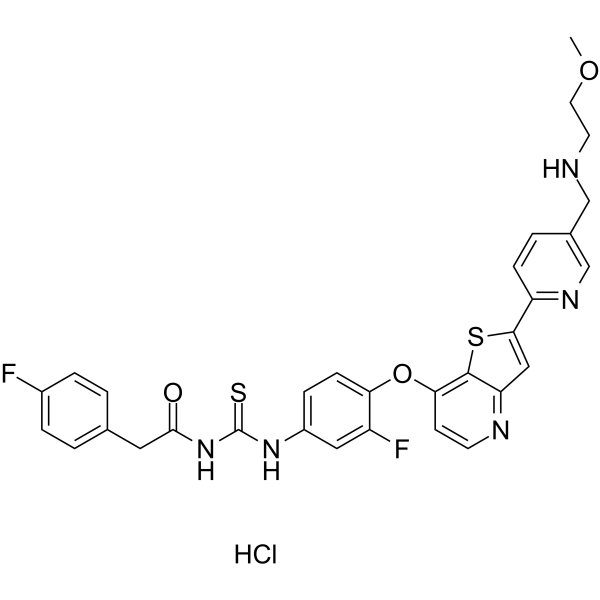
[CAS NO. 1123838-51-6] Glesatinibhydrochloride
PRODUCTS SPECIFICATIONS [1123838-51-6]

DESCRIPTION [1123838-51-6]
Overview
| MDL | MFCD30344661 |
|---|---|
| Molecular Weight | 656.17 |
| Molecular Formula | C31H28ClF2N5O3S2 |
| SMILES | O=C(NC(NC1=CC=C(OC2=C3C(C=C(C4=NC=C(CNCCOC)C=C4)S3)=NC=C2)C(F)=C1)=S)CC5=CC=C(F)C=C5.Cl |
2 Publications Citing Use of MCE
Summary
Glesatinib hydrochloride (MGCD265 hydrochloride) is an orally active, potent MET/SMO dual inhibitor. Glesatinib hydrochloride, a tyrosine kinase inhibitor, antagonizes P-glycoprotein (P-gp) mediated multidrug resistance (MDR) in non-small cell lung cancer (NSCLC) [1] [2] .
In Vitro
Glesatinib hydrochloride (MGCD265 hydrochloride; 0.01-5 μM; for 72 hours) results in a dose-dependent inhibition of cancer cell growth and shows the low IC
50
value of 0.08 μM on NSCLC H1299 cells
[1]
.
Glesatinib hydrochloride (0.01, 0.1, 0.5, 1 μM) significantly increases by several-fold the percentage of apoptotic cells in NSCLC H1299 cells
[1]
.
Glesatinib hydrochloride has the cytotoxicity to P-gp overexpressing cancer cells KB-C2, SW620/Ad300, HEK293/ABCB1, and their parent cells KB-3-1, SW620, HEK293 cells with the IC
50
s fell between 5 and 10 μM
[1]
.
Glesatinib hydrochloride (1, 3 μM; 120 mins) increases the intracellular [
3
H]-Paclitaxel accumulation and inhibits [
3
H]-Paclitaxel efflux in cancer cell lines overexpressing P-gp
[2]
.
Glesatinib hydrochloride (0-40 μM) stimulates the ATPase activity of P-gp transporters in a dose-dependent manner
[2]
.
MCE has not independently confirmed the accuracy of these methods. They are for reference only.
Cell Proliferation Assay [1]
| Cell Line: | NSCLC H1299 cells |
| Concentration: | 0.01, 0.1, 1, 2, 5 μM |
| Incubation Time: | For 72 hours |
| Result: | Resulted in a dose-dependent inhibition of cancer cell growth and showed the lowest IC 50 value of 0.08 μM. |
In Vivo
Glesatinib hydrochloride (MGCD265 hydrochloride; 15 mg/kg/day; orally; 40 weeks) causes a significant decrease in tumor size
[1]
.
MCE has not independently confirmed the accuracy of these methods. They are for reference only.
| Animal Model: | 4−6-week old female balb/c athymic (nu/nu) mice with HCC827 NSCLC tumor xenografts [1] |
| Dosage: | 15 mg/kg |
| Administration: | Orally; daily; 40 weeks |
| Result: | Caused a significant decrease in tumor size. |
Clinical Trial
| NCT Number | Sponsor | Condition | Start Date | Phase |
|---|---|---|---|---|
| NCT02954991 | Mirati Therapeutics Inc. |
Carcinoma, Non-Small-Cell Lung
|
November 7, 2016 | Phase 2 |
| NCT00697632 | Mirati Therapeutics Inc. |
Advanced Cancer
|
June 2008 | Phase 1 |
| NCT00679133 | Mirati Therapeutics Inc. |
Advanced Malignancies
|
April 2008 | Phase 1 |
| NCT02544633 | Mirati Therapeutics Inc. |
Non-Small Cell Lung Cancer
|
October 2015 | Phase 2 |
| NCT01930006 | Mirati Therapeutics Inc. |
Advanced Malignancies
|
August 2013 | Phase 1 |
Appearance
Solid
Shipping
Room temperature in continental US; may vary elsewhere.
Storage
4°C, sealed storage, away from moisture
* In solvent : -80°C, 6 months; -20°C, 1 month (sealed storage, away from moisture)
Solvent & Solubility
DMSO : 50 mg/mL ( 76.20 mM ; Need ultrasonic)
H 2 O : < 0.1 mg/mL (ultrasonic;warming;heat to 60°C) (insoluble)
Stock Solutions
| Concentration Solvent Mass | 1 mg | 5 mg | 10 mg |
|---|
| 1 mM | 1.5240 mL | 7.6200 mL | 15.2400 mL |
| 5 mM | 0.3048 mL | 1.5240 mL | 3.0480 mL |
| 10 mM | 0.1524 mL | 0.7620 mL | 1.5240 mL |
References
- [1] Morgillo F, et al. Dual MET and SMO Negative Modulators Overcome Resistance to EGFR Inhibitors in Human Nonsmall Cell Lung Cancer. J Med Chem. 2017 Sep 14;60(17):7447-7458.
- [2] Cui Q, et al. Glesatinib, a c-MET/SMO Dual Inhibitor, Antagonizes P-glycoprotein Mediated MultidrugResistance in Cancer Cells. Front Oncol. 2019 Apr 25;9:313.