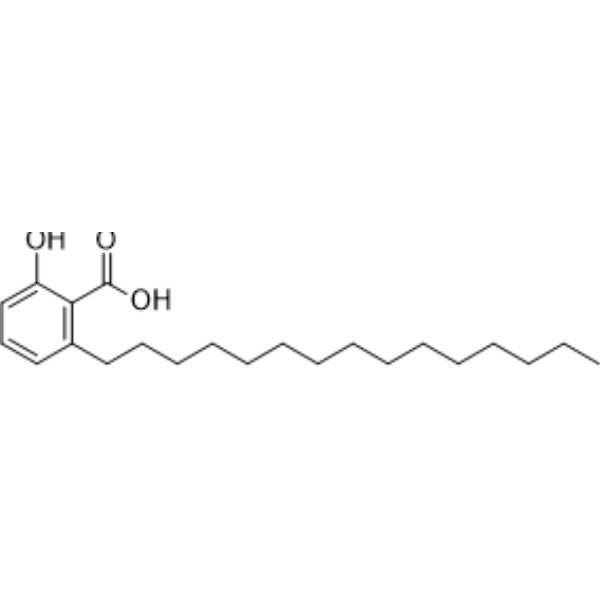
[CAS NO. 16611-84-0] Anacardic Acid
PRODUCTS SPECIFICATIONS [16611-84-0]

DESCRIPTION [16611-84-0]
Overview
| MDL | MFCD07368254 |
|---|---|
| Molecular Weight | 348.52 |
| Molecular Formula | C22H36O3 |
| SMILES | O=C(O)C1=C(CCCCCCCCCCCCCCC)C=CC=C1O |
8 Publications Citing Use of MCE
Summary
Anacardic Acid, extracted from cashew nut shell liquid, is a histone acetyltransferase inhibitor, inhibits HAT activity of p300 and PCAF, with IC 50 s of ∼8.5 μM and ∼5 μM, respectively.
IC50 & Target
|
p300-HAT 8.5 μM (IC 50 ) |
PCAF 5 μM (IC 50 ) |
In Vitro
Anacardic Acid is a histone acetyltransferase, inhibits HAT activity of p300 and PCAF, with IC 50 s of ∼8.5 μM and ∼5 μM, respectively [1] . Anacardic Acid (300 μM) inhibits mycelial growth. Anacardic Acid (50 μM) induces apoptosis-like characteristics in M. oryzae , and the effect is caspase independent. Anacardic Acid (1-80 μM) leads to loss of mitochondrial potential. Anacardic Acid (1-60 μM) also exhibits antioxidant activity in M. oryzae [3] .
MCE has not independently confirmed the accuracy of these methods. They are for reference only.
In Vivo
Anacardic acid (5 mg/kg, i.p.) attenuates the binding of HATs to the promoter of MEF2A and reverse hyperacetylation of H3K9ac caused by phenylephrine in C57BL/6 mice. Anacardic acid inhibits the level of transcription on MEF2A and cardiac development-related downstream genes, attenuates the protein overexpression of cardiac downstream genes caused by phenylephrine, reverses and attenuates cardiac hypertrophy in the hearts of mice exposed to phenylephrine, and attenuates the left ventricular pressure and improves cardiac function in the cardiac hypertrophy mice [2] .
MCE has not independently confirmed the accuracy of these methods. They are for reference only.
Appearance
Solid
Shipping
Room temperature in continental US; may vary elsewhere.
Storage
| Powder | -20°C | 3 years |
|---|---|---|
| 4°C | 2 years | |
| In solvent | -80°C | 6 months |
| -20°C | 1 month |
Solvent & Solubility
DMSO : 100 mg/mL ( 286.93 mM ; Need ultrasonic)
Stock Solutions
| Concentration Solvent Mass | 1 mg | 5 mg | 10 mg |
|---|
| 1 mM | 2.8693 mL | 14.3464 mL | 28.6928 mL |
| 5 mM | 0.5739 mL | 2.8693 mL | 5.7386 mL |
| 10 mM | 0.2869 mL | 1.4346 mL | 2.8693 mL |
References
- [1] Balasubramanyam K, et al. Small molecule modulators of histone acetyltransferase p300. J Biol Chem. 2003 May 23;278(21):19134-40. Epub 2003 Mar 6.
- [2] Peng C, et al. Phenylephrine-induced cardiac hypertrophy is attenuated by a histone acetylase inhibitor anacardic acid in mice. Mol Biosyst. 2017 Mar 28;13(4):714-724.
- [3] Muzaffar S, et al. Anacardic acid induces apoptosis-like cell death in the rice blast fungus Magnaporthe oryzae. Appl Microbiol Biotechnol. 2016 Jan;100(1):323-35.
Synonyms