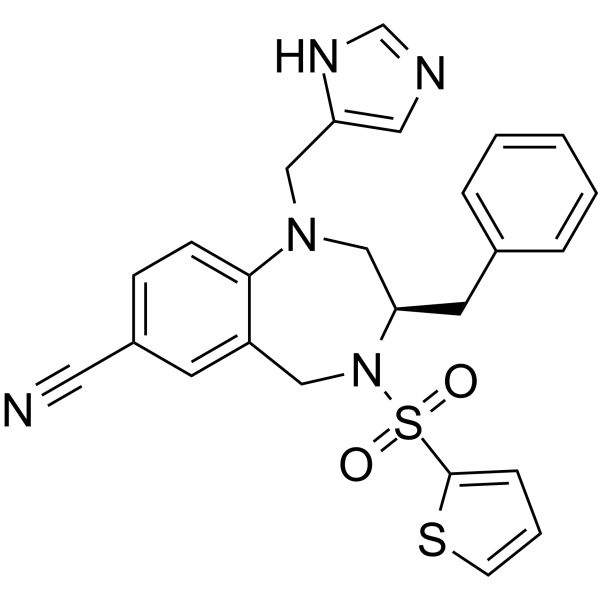
[CAS NO. 195987-41-8] BMS-214662
PRODUCTS SPECIFICATIONS [195987-41-8]

DESCRIPTION [195987-41-8]
Overview
| MDL | - |
|---|---|
| Molecular Weight | 489.61 |
| Molecular Formula | C25H23N5O2S2 |
| SMILES | N#CC1=CC=C(N(CC2=CN=CN2)C[C@@H](CC3=CC=CC=C3)N(S(=O)(C4=CC=CS4)=O)C5)C5=C1 |
Summary
BMS-214662 is a potent and selective farnesyl transferase inhibitor with potent antitumor activity with an IC 50 of 1.35 nM.
IC50 & Target
IC50: 1.35 nM (farnesyl transferase), 1.3 μM (Ras-CVLL), 2.3 μM (K-Ras) [1]
In Vitro
BMS-214662 is over 1000-fold selective for farnesyl transferase, having IC 50 values for inhibition of geranylgeranylation of Ras-CVLL and K-Ras of 1.3 and 2.3 μM, respectively [1] . BMS-214662 shows good potency in inhibiting H-ras-transformed rodent cells, A2780 human ovarian carcinoma tumor cells, and HCT-116 human colon carcinoma tumor cells. BMS-214662 is the most potent apoptotic FTI known and demonstrates broad spectrum yet robust cell-selective cytotoxic activity against a panel of cell lines with diverse histology [2] .
MCE has not independently confirmed the accuracy of these methods. They are for reference only.
In Vivo
Tumors from BMS-214662-treated mice have increased numbers of apoptotic cells as compared with the nontreated control mice. The AIs in HCT-116 tumors are increased 4-10-fold in BMS-214662-treated mice as compared with nontreated controls. BMS-214662 is significantly cytotoxic to both HCT-116 and EJ-1 tumor cells; the doses of BMS-214662 required to kill 90% of clonogenic tumor cells are approximately 75 and 100 mg/kg for HCT-116 and EJ-1 tumors [2] .
MCE has not independently confirmed the accuracy of these methods. They are for reference only.
Clinical Trial
| NCT Number | Sponsor | Condition | Start Date | Phase |
|---|---|---|---|---|
| NCT00006213 | National Cancer Institute (NCI) |
Adult Acute Promyelocytic Leukemia (M3)|Blastic Phase Chronic Myelogenous Leukemia|Childhood Myelodysplastic Syndromes|Previously Treated Myelodysplastic Syndromes|Recurrent Adult Acute Lymphoblastic Leukemia|Recurrent Adult Acute Myeloid Leukemia|Recurrent Childhood Acute Lymphoblastic Leukemia|Recurrent Childhood Acute Myeloid Leukemia|Refractory Anemia With Excess Blasts|Refractory Anemia With Excess Blasts in Transformation|Relapsing Chronic Myelogenous Leukemia
|
April 2000 | Phase 1 |
| NCT00006242 | National Cancer Institute (NCI) |
Unspecified Adult Solid Tumor, Protocol Specific
|
July 2000 | Phase 1 |
| NCT00005973 | National Cancer Institute (NCI) |
Unspecified Adult Solid Tumor, Protocol Specific|Unspecified Childhood Solid Tumor, Protocol Specific
|
April 2000 | Phase 1 |
| NCT00006018 | Case Comprehensive Cancer Center|National Cancer Institute (NCI) |
Unspecified Adult Solid Tumor, Protocol Specific
|
July 2000 | Phase 1 |
| NCT00022529 | National Cancer Institute (NCI) |
Unspecified Adult Solid Tumor, Protocol Specific
|
July 2001 | Phase 1 |
| NCT00004877 | Memorial Sloan Kettering Cancer Center|National Cancer Institute (NCI) |
Unspecified Adult Solid Tumor, Protocol Specific
|
July 1999 | Phase 1 |
Appearance
Solid
Shipping
Room temperature in continental US; may vary elsewhere.
Storage
| Powder | -20°C | 3 years |
|---|---|---|
| 4°C | 2 years | |
| In solvent | -80°C | 6 months |
| -20°C | 1 month |
Solvent & Solubility
DMSO : ≥ 100 mg/mL ( 204.24 mM )
* "≥" means soluble, but saturation unknown.
Stock Solutions
| Concentration Solvent Mass | 1 mg | 5 mg | 10 mg |
|---|
| 1 mM | 2.0424 mL | 10.2122 mL | 20.4244 mL |
| 5 mM | 0.4085 mL | 2.0424 mL | 4.0849 mL |
| 10 mM | 0.2042 mL | 1.0212 mL | 2.0424 mL |
-
1.
-
2.
Add each solvent one by one: 10% DMSO >> 90% corn oil
Solubility: ≥ 2.5 mg/mL (5.11 mM); Clear solution
References
- [1] Hunt JT, et al. Discovery of (R)-7-cyano-2,3,4, 5-tetrahydro-1-(1H-imidazol-4-ylmethyl)-3- (phenylmethyl)-4-(2-thienylsulfonyl)-1H-1,4-benzodiazepine (BMS-214662), a farnesyltransferase inhibitor with potent preclinical antitumor activity. J Med Chem. 200
- [2] Rose WC, et al. Preclinical antitumor activity of BMS-214662, a highly apoptotic and novel farnesyltransferase inhibitor. Cancer Res. 2001 Oct 15;61(20):7507-17.