[CAS NO. 202350-68-3] PNU-159682
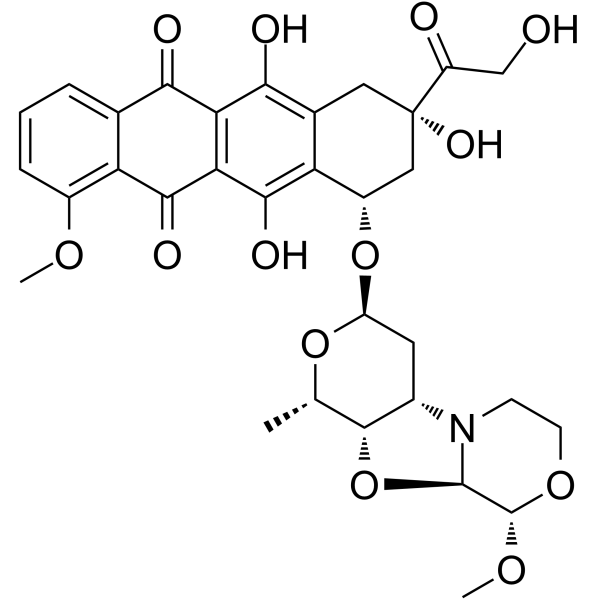
PRODUCTS SPECIFICATIONS [202350-68-3]

DESCRIPTION [202350-68-3]
Overview
| MDL | MFCD12756329 |
|---|---|
| Molecular Weight | 641.62 |
| Molecular Formula | C32H35NO13 |
| SMILES | COC1=C(C(C(C(O)=C([C@@H](O[C@H]2C[C@H]3[C@H](O[C@H]4N3CCO[C@@H]4OC)[C@H](C)O2)C[C@@](C(CO)=O)(O)C5)C5=C6O)=C6C7=O)=O)C7=CC=C1 |
Summary
PNU-159682, a metabolite of the anthracycline Nemorubicin, is a highly potent DNA topoisomerase II inhibitor with excellent cytotoxicity [1] . PNU-159682 acts as a more potent and tolerated ADC cytotoxin than Doxorubicin for ADC synthesis [2] . PNU-159682 can be used in EDV-nanocell technology to overcome drug resistance [3] .
IC50 & Target
|
Daunorubicins/Doxorubicins |
Topoisomerase I |
In Vitro
PNU-159682 (0-500 nM; exposed to the compounds for 1 hour and then cultured in compound-free medium for 72 hours) has cytotoxic effects on human tumor cell lines in a sulforhodamine B assay. The IC
70
values are 0.577 nM, 0.39 nM, 0.128 nM, and 0.081 nM, 0.086 nM and 0.075 nM for HT-29, A2780, DU145, EM-2, Jurkat and CEM cells, respectively
[1]
. It against human tumor cell lines with IC
70
in the ranging 68 nM-578 nM and 181 nM-1717 nM towards MMDX and doxorubicin, respectively
[1]
.
PNU-159682 is more potent than MMAE on NHL cell lines. In a cell viability assay, PNU-159682 is against BJAB.Luc, Granta-519, SuDHL4.Luc, and WSU-DLCL2 with IC
50
values of 0.10 nM, 0.020 nM, 0.055 nM, and 0.1 nM, respectively. While MMAE is against BJAB.Luc, Granta-519, SuDHL4.Luc, and WSU-DLCL2 with IC
50
values of 0.54 nM, 0.25 nM, 1.19 nM and 0.25 nM, respectively
[2]
.
PNU-159682 is thousands of times more cytotoxic than doxorubicin and can be used to develop a new class of ADCs. PNU159682 to anti-CD22 antibody (anti-CD22-NMS249) exhibits strong anti-tumor effects
in vitro
. Anti-CD22-NMS249 (PNU159682 to anti-CD22 antibody) is active in in vitro viability assays of NHL cell lines and is 2 to 20 fold more potent than pinatuzumab vedotin, the ADC anti-CD22-NMS249 is against BJAB.Luc, Granta-519, SuDHL4.Luc, and WSU-DLCL2 with IC
50
values of 0.058 nM, 0.030 nM, 0.0221 nM, and 0.01 nM, respectively
[3]
.
PNU-159682 (100 μM) weakly inhibits topoisomerase II unknotting activity. PNU-159682 shows cytotoxic effect on CAIX-expressing SKRC-52 cells with IC
50
of 25 nM
[4]
.
MCE has not independently confirmed the accuracy of these methods. They are for reference only.
Cell Viability Assay [2]
| Cell Line: | HT-29, A2780, DU145, EM-2, Jurkat and CEM cells |
| Concentration: | 0-500 nM |
| Incubation Time: | Exposed to the PNU-159682 for 1 hour and then cultured in compound-free medium for 72 hours |
| Result: |
Was 2,360- to 790-fold and 6,420- to 2,100-fold more potent than MMDX and doxorubicin, respectively.
Exhibited IC 70 values of PNU-159682 are in the subnanomolar range (0.07-0.58 nM) and noticeably lower than that recorded for both MMDX and doxorubicin. |
In Vivo
PNU-159682 (single-dose; i.v.15 μg/kg) is a maximum tolerated dose in murine L1210 leukemia model. PNU-159682 shows an improved antitumor activity in vivo. The antitumor effect of PNU-159682 (increase in life span=29%) is comparable to that afforded by 90 μg/kg MMDX (increase in life=36%)
[1]
.
PNU-159682 (i.v. 4 μg/kg; q7dx3; 40 days) has a therapeutic response in MX-1 human mammary carcinoma mice. What’s more, from day 39, four out of seven mice receiving PNU-159682 exhibits complete tumor regression
[1]
.
PNU-159682 is more cytotoxic than doxorubicin and can be used to develop a new class of ADCs. PNU159682 to anti-CD22 antibody (anti-CD22-NMS249) exhibits strong anti-tumor effects
in vivo
. ADC dose (anti-CD22-NMS249; 50 µg/m2 conjugated PNU-159682) is well tolerated in mice and results in less than 10% weight loss
[2]
.
In the BJAB.Luc model the efficacy of antiCD22-NMS249 (single dose; 2 mg/kg) is similar to anti-CD22-vc-MMAE. At 2 mg/kg dosage, antiCD22-NMS249 gives complete remission of the tumors (NMS249: 110-134%TGI vs. vc-MMAE: 114-143%TGI). Additionally, a single dose of antiCD22-NMS249 at 2 mg/kg results in tumor stasis for three weeks
[1]
.
MCE has not independently confirmed the accuracy of these methods. They are for reference only.
| Animal Model: | Four- to six-week-old female CD-1 athymic nude mice with MX-1 tumor fragments [1] |
| Dosage: | 4 μg/kg |
| Administration: | Intravenous injection; q7dx3; 40 days |
| Result: | Exhibited anti-cancer effects in MX-1 human mammary carcinoma xenografts to PNU-159682. |
Appearance
Solid
Shipping
Room temperature in continental US; may vary elsewhere.
Storage
4°C, stored under nitrogen
* In solvent : -80°C, 6 months; -20°C, 1 month (stored under nitrogen)
Solvent & Solubility
DMSO : 100 mg/mL ( 155.86 mM ; Need ultrasonic)
Stock Solutions
| Concentration Solvent Mass | 1 mg | 5 mg | 10 mg |
|---|
| 1 mM | 1.5586 mL | 7.7928 mL | 15.5855 mL |
| 5 mM | 0.3117 mL | 1.5586 mL | 3.1171 mL |
| 10 mM | 0.1559 mL | 0.7793 mL | 1.5586 mL |
References
- [1] Quintieri L, et al. Formation and antitumor activity of PNU-159682, a major metabolite of nemorubicin in human liver microsomes. Clin Cancer Res. 2005 Feb 15;11(4):1608-17.
- [2] Cazzamalli S, et al. Acetazolamide Serves as Selective Delivery Vehicle for Dipeptide-Linked Drugs to Renal Cell Carcinoma. Mol Cancer Ther. 2016 Dec;15(12):2926-2935.
- [3] Pengxuan Zhao, et al. Recent advances of antibody drug conjugates for clinical applications. Acta Pharm Sin B. 2020 Sep;10(9):1589-1600.
- [4] Joanne Lundy, Interim data: Phase I/IIa study of EGFR-targeted EDV nanocells carrying cytotoxic drug PNU-159682 (E-EDV-D682) with immunomodulatory adjuvant EDVs carrying α-galactosyl ceramide (EDV-GC) in patients with recurrent, metastatic pancreatic canc