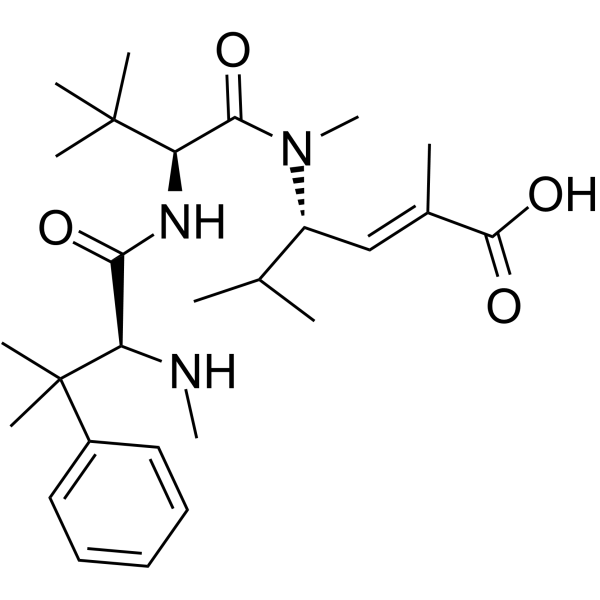
[CAS NO. 228266-40-8] Taltobulin
PRODUCTS SPECIFICATIONS [228266-40-8]

DESCRIPTION [228266-40-8]
Overview
| MDL | MFCD07772353 |
|---|---|
| Molecular Weight | 473.65 |
| Molecular Formula | C27H43N3O4 |
| SMILES | CC(C)(C)[C@H](NC([C@H](C(C)(C1=CC=CC=C1)C)NC)=O)C(N([C@@H](C(C)C)/C=C(C(O)=O)\C)C)=O |
2 Publications Citing Use of MCE
Summary
Taltobulin (HTI-286), a synthetic analogue of the tripeptide hemiasterlin, is a potent antimicrotubule agent that circumvents P-glycoprotein-mediated resistance in vitro and in vivo. Taltobulin inhibits the polymerization of purified tubulin, disrupts microtubule organization in cells, and induces mitotic arrest, as well as apoptosis [1] .
IC50 & Target
|
Traditional Cytotoxic Agents |
In Vitro
Taltobulin (HTI-286; 0.2-7.3 nM; 3 days) inhibits the growth of 18 tumor cell lines (leukemia, ovarian, NSCLC, breast, colon, and melanoma cell lines) with an average IC 50 of 2.5±2.1 nM and a median value of 1.7 nM [1] .
MCE has not independently confirmed the accuracy of these methods. They are for reference only.
Cell Proliferation Assay [1]
| Cell Line: | Leukemia CCRF-CEM cell line; ovarian 1A9 cell line; NSCLC A549 and NCI-H1299 cell lines; breast MX-1W and MCF-7 cell lines; colon HCT-116, DLD-1, Colo205, KM20, SW620, S1, HCT-15 and Moser cell lines; melanoma A375, Lox and SK-Mel-2 cell lines |
| Concentration: | 0.2-7.3 nM |
| Incubation Time: | 3 days |
| Result: | Inhibited the growth of tumor cell lines with IC 50 s of 0.2±0.03 nM (for leukemia CCRF-CEM cell line), 0.6±0.1 nM (for ovarian 1A9 cell line), 1.1±0.5 and 6.8±6.1 nM ( for NSCLC A549 and NCI-H1299 cell lines), 1.8±0.6, 7.3±2.3 nM (for breast MX-1W, MCF-7 cell lines), 0.7±0.2, 1.1±0.4, 1.5±0.6, 1.8±0.6, 3.6±0.8, 3.7±2.0, 4.2±2.5, and 5.3±4.1 nM ( for colon HCT-116, DLD-1, Colo205, KM20, SW620, S1, HCT-15, and Moser cell lines), 1.1±0.8, 1.4±0.6 and 1.7±0.5 nM (for melanoma A375, Lox and SK-Mel-2 cell lines). |
In Vivo
Taltobulin (HTI-286; 1.6 mg/kg i.v.) inhibits the growth of human tumor xenografts (e.g., HCT-15, DLD-1, MX-1W, and KB-8-5) in athymic nu/nu female mice
[1]
.
Taltobulin (HTI-286; 3 mg/kg; p.o. gavage) inhibits growth by 97.3 % and 82% in athymic nu/nu female mice with Lox melanoma xenografts and KB-3-1 epidermoid xenograft model, respectively
[1]
.
MCE has not independently confirmed the accuracy of these methods. They are for reference only.
| Animal Model: | Athymic nu/nu female mice with Lox melanoma model (5-6 weeks of age) [1] |
| Dosage: | 1.6 mg/kg |
| Administration: | Administered i.v.;for 35 days |
| Result: |
Growth of Lox tumors was inhibited by 96-98% on day 12 compared with vehicle-treated controls.
Growth of KB-8-5 tumors was inhibited by 84% on day 14 compared with vehicle-treated controls. Growth of MX-1W tumors was inhibited by 97% compared with vehicle-treated controls. Growth of DLD-1 and HCT-15 tumors was inhibited by 80 and 66%, respectively. |
Appearance
Solid
Shipping
Room temperature in continental US; may vary elsewhere.
Storage
| Powder | -20°C | 3 years |
|---|---|---|
| 4°C | 2 years | |
| In solvent | -80°C | 6 months |
| -20°C | 1 month |
Solvent & Solubility
DMSO : ≥ 100 mg/mL ( 211.13 mM )
* "≥" means soluble, but saturation unknown.
Stock Solutions
| Concentration Solvent Mass | 1 mg | 5 mg | 10 mg |
|---|
| 1 mM | 2.1113 mL | 10.5563 mL | 21.1126 mL |
| 5 mM | 0.4223 mL | 2.1113 mL | 4.2225 mL |
| 10 mM | 0.2111 mL | 1.0556 mL | 2.1113 mL |
-
1.
-
2.
Add each solvent one by one: 10% DMSO >> 90% (20% SBE-β-CD in saline)
Solubility: ≥ 2.5 mg/mL (5.28 mM); Clear solution
-
3.
Add each solvent one by one: 10% DMSO >> 90% corn oil
Solubility: ≥ 2.5 mg/mL (5.28 mM); Clear solution
-
4.
-
5.
Add each solvent one by one: 5% DMSO >> 95% (20% SBE-β-CD in saline)
Solubility: ≥ 2.5 mg/mL (5.28 mM); Clear solution
-
6.
Add each solvent one by one: 1% DMSO >> 99% saline
Solubility: ≥ 0.5 mg/mL (1.06 mM); Clear solution
Synonyms