[CAS NO. 357649-93-5] CPTH2
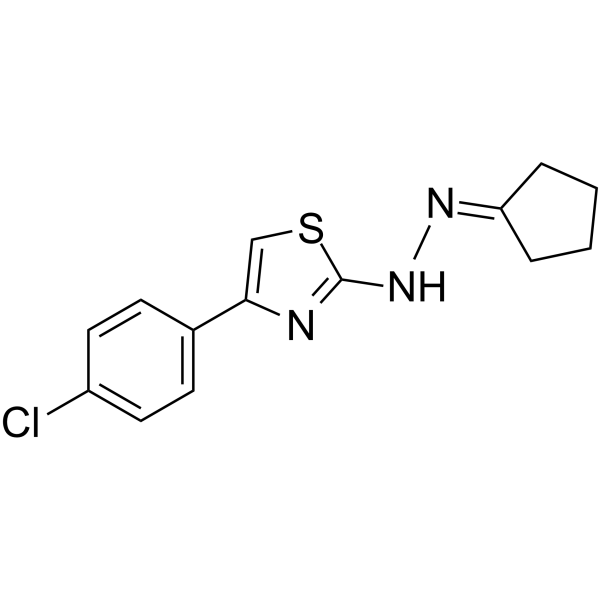
PRODUCTS SPECIFICATIONS [357649-93-5]

DESCRIPTION [357649-93-5]
Overview
| MDL | MFCD02307488 |
|---|---|
| Molecular Weight | 291.80 |
| Molecular Formula | C14H14ClN3S |
| SMILES | ClC1=CC=C(C2=CSC(N/N=C3CCCC/3)=N2)C=C1 |
Summary
CPTH2 is a potent histone acetyltransferase (HAT) inhibitor. CPTH2 selectively inhibits the acetylation of histone H3 by Gcn5 . CPTH2 induces apoptosis and decreases the invasiveness of a clear cell renal carcinoma (ccRCC) cell line through the inhibition of acetyltransferase p300 (KAT3B) [1] [2] .
IC50 & Target
|
GCN5 |
In Vitro
CPTH2 (100 μM; 12, 24, 48 hours) causes a decrease in cell proliferation after as early as 12 h with a further significant reduction after 48 h stimulation
[1]
.
CPTH2 (100 μM; 12 or 48 hours) causes a comparable drop of the activity in both cell lines
[1]
.
CPTH2 (100 μM; 48 hours) produces a drastic increase in apoptotic/dead cell population after 48 h
[1]
.
CPTH2 (100 μM; 12, 24, 48 hours) shows a reduced acetylation of both global AcH3 histone and H3AcK18
[1]
.
CPTH2 (100 μM; 24, 48 hours) is capable to counteract invasion and migration of ccRCC-786-O cells in culture
[1]
.
CPTH2 (0.2, 0.5, 1 mM) inhibits the growth of a GCN5 deleted strain and a single catalytic mutant E173H
[2]
.
CPTH2 (0.6, 0.8 mM; for 24 hours) inhibits histone H3 acetylation in yeast cell cultures
[2]
.
CPTH2 inhibits the Gcn5p dependent functional network
[2]
.
MCE has not independently confirmed the accuracy of these methods. They are for reference only.
Cell Proliferation Assay [1]
| Cell Line: | Papillary thyroid (K1) and clear cell Renal Cell Carcinoma (ccRCC-786-O) cell lines |
| Concentration: | 100 μM |
| Incubation Time: | 12, 24, 48 hours |
| Result: | Caused a decrease in cell proliferation after as early as 12 h with a further significant reduction after 48 h stimulation. |
Cell Viability Assay [1]
| Cell Line: | K1 and ccRCC-786-O cell lines |
| Concentration: | 100 μM |
| Incubation Time: | 24 hours (K1 cell) and 48 hours (ccRCC-786-O cell) |
| Result: | Caused a comparable drop of the activity in both cell lines. |
Apoptosis Analysis [1]
| Cell Line: | ccRCC-786-O cells |
| Concentration: | 100 μM |
| Incubation Time: | 48 hours |
| Result: | Produced a drastic increase in apoptotic/dead cell population after 48 h. |
Western Blot Analysis [1]
| Cell Line: | ccRCC-786-O cells |
| Concentration: | 100 μM |
| Incubation Time: | 12, 24, 48 hours |
| Result: | Showed a reduced acetylation of both global AcH3 histone and H3AcK18. |
Appearance
Solid
Shipping
Room temperature in continental US; may vary elsewhere.
Storage
4°C, protect from light
* In solvent : -80°C, 6 months; -20°C, 1 month (protect from light)
Solvent & Solubility
DMSO : 16.67 mg/mL ( 57.13 mM ; ultrasonic and warming and heat to 60°C)
Ethanol : 1 mg/mL ( 3.43 mM ; Need ultrasonic)
H 2 O : < 0.1 mg/mL (ultrasonic) (insoluble)
Stock Solutions
| Concentration Solvent Mass | 1 mg | 5 mg | 10 mg |
|---|
| 1 mM | 3.4270 mL | 17.1350 mL | 34.2701 mL |
| 5 mM | 0.6854 mL | 3.4270 mL | 6.8540 mL |
| 10 mM | 0.3427 mL | 1.7135 mL | 3.4270 mL |
-
1.
References
- [1] Cocco E, et al. KAT3B-p300 and H3AcK18/H3AcK14 levels are prognostic markers for kidney ccRCC tumoraggressiveness and target of KAT inhibitor CPTH2. Clin Epigenetics. 2018 Apr 4;10:44.
- [2] Chimenti F, et al. A novel histone acetyltransferase inhibitor modulating Gcn5 network: cyclopentylidene-[4-(4'-chlorophenyl)thiazol-2-yl)hydrazone. J Med Chem. 2009 Jan 22;52(2):530-6.