[CAS NO. 536-43-6] Dycloninehydrochloride
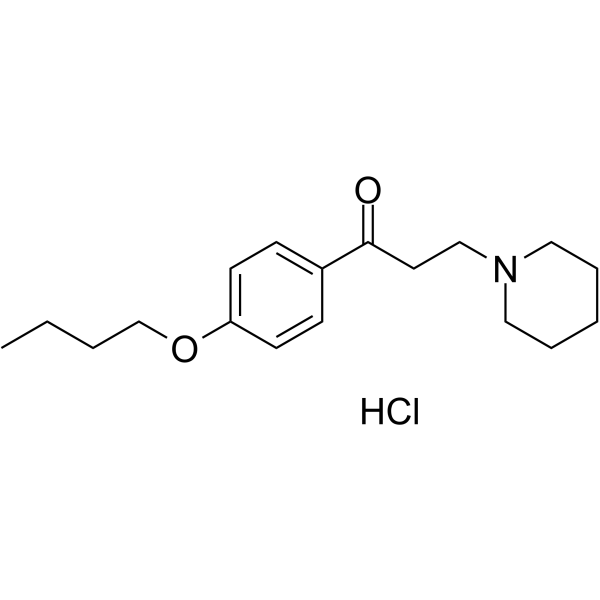
PRODUCTS SPECIFICATIONS [536-43-6]

DESCRIPTION [536-43-6]
Overview
| MDL | MFCD00035386 |
|---|---|
| Molecular Weight | 325.87 |
| Molecular Formula | C18H28ClNO2 |
| SMILES | O=C(C1=CC=C(OCCCC)C=C1)CCN2CCCCC2.Cl |
1 Publications Citing Use of MCE
Summary
Dyclonine (Dyclocaine) hydrochloride is an orally effective ALDH covalent inhibitor (crosses blood-brain barrier), with an IC 50 of 35 µM for ALDH2 and 76 µM for ALDH3A1 . Dyclonine hydrochloride has sensitizing activities for targeted cancer cells and antibacterial. Dyclonine hydrochloride is also a local anesthetic that blocks the transmission of various nerve impulses or stimuli and inhibits the sensation of touch and pain [1] [2] [3] .
IC50 & Target
|
ALDH2 35 μM (IC 50 ) |
ALDH3 76 μM (IC 50 ) |
In Vitro
Dyclonine hydrochloride (50 µM; 24 h) sensitizes cancer cells to deficiency of cysteine and GSH
[1]
.
Dyclonine hydrochloride (0-2048 µg/mL; 24 or 48 h) shows significant bactericidal and fungicidal activity
[2]
.
MCE has not independently confirmed the accuracy of these methods. They are for reference only.
Cell Viability Assay [1]
| Cell Line: | HSC-4 cells |
| Concentration: | 50 µM |
| Incubation Time: | 24 h |
| Result: | Inhibited ALDH activity and induced 4-HNE accumulation in GSH-depleted cancer cells. |
Cell Viability Assay [2]
| Cell Line: | S. aureus , B. subtilis , E. coli , T. mentagrophyte |
| Concentration: | 0-2048 µg/mL |
| Incubation Time: | 24 h (for bacterial), 48 h (for fungi) |
| Result: | Showed good antibacterial and antifungal activity, with minimum microbicidal concentration of 0.006%, 0.025%, 0.012% and 0.025% for S. aureus , B. subtilis , E. coli , T. mentagrophyte , separately. |
In Vivo
Dyclonine hydrochloride (5 mg/kg; i.p.; single daily for 24 days) sensitizes the involucrin
+
differentiated tumor cells to sulfasalazine treatment in vivo
[1]
.
Dyclonine hydrochloride (5 mg/kg; i.p.; single daily for 21 days) suppress the growth of tumors formed by ALDH3A1-expressing gastric cancer stemlike cells when combines with sulfasalazine
[1]
.
MCE has not independently confirmed the accuracy of these methods. They are for reference only.
| Animal Model: | Athymic nude mice (HSC-2 cells implanted model) [1] . |
| Dosage: | 5 mg/kg |
| Administration: | Intraperitoneal injection; single daily for 24 days (combine with sulfasalazine). |
| Result: | Attenuated the formation of tumors by HSC-2 cells implanted in nude mice when combined with sulfasalazine. |
| Animal Model: | C57BL6 mice (K19-Wnt1/C2mE-KP cells implanted model) [1] . |
| Dosage: | 5 mg/kg |
| Administration: | Intraperitoneal injection; single daily for 21 days (combine with sulfasalazine). |
| Result: | Enhanced the antitumor effect of sulfasalazine on HNSCC tumors consisting of CD44vhigh stemlike tumor cells and involucrin + differentiated tumor cells. |
Appearance
Solid
Shipping
Room temperature in continental US; may vary elsewhere.
Storage
4°C, sealed storage, away from moisture
* In solvent : -80°C, 6 months; -20°C, 1 month (sealed storage, away from moisture)
Solvent & Solubility
H 2 O : 50 mg/mL ( 153.44 mM ; Need ultrasonic)
DMSO : ≥ 25 mg/mL ( 76.72 mM )
* "≥" means soluble, but saturation unknown.
Stock Solutions
| Concentration Solvent Mass | 1 mg | 5 mg | 10 mg |
|---|
| 1 mM | 3.0687 mL | 15.3435 mL | 30.6871 mL |
| 5 mM | 0.6137 mL | 3.0687 mL | 6.1374 mL |
| 10 mM | 0.3069 mL | 1.5344 mL | 3.0687 mL |
References
- [1] Okazaki S, et al. Synthetic lethality of the ALDH3A1 inhibitor dyclonine and xCT inhibitors in glutathione deficiency-resistant cancer cells. Oncotarget. 2018 Sep 18;9(73):33832-33843.
- [2] FLORESTANO HJ, et al. Antimicrobial properties of dyclonine hydrochloride, a new topical anesthetic. J Am Pharm Assoc Am Pharm Assoc. 1956 May;45(5):320-5.
- [3] Khanna M, et al. Discovery of a novel class of covalent inhibitor for aldehyde dehydrogenases. J Biol Chem. 2011 Dec 16;286(50):43486-94.
Synonyms