[CAS NO. 7085-55-4] Troxerutin
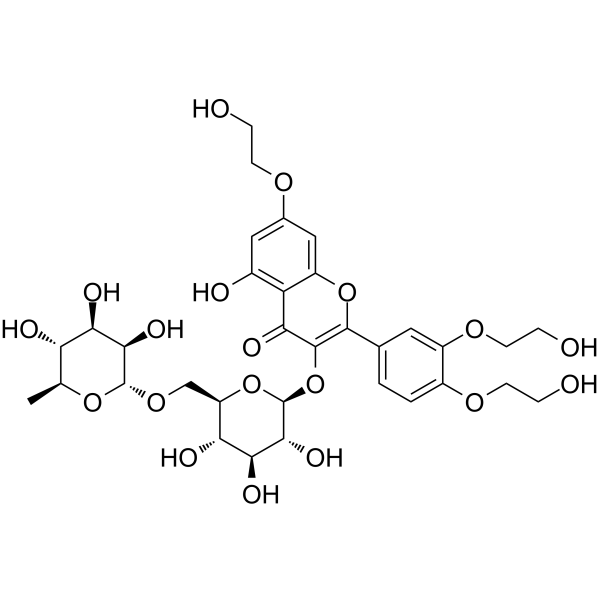
PRODUCTS SPECIFICATIONS [7085-55-4]

DESCRIPTION [7085-55-4]
Overview
| MDL | MFCD00893813 |
|---|---|
| Molecular Weight | 742.68 |
| Molecular Formula | C33H42O19 |
| SMILES | O=C1C(O[C@H]2[C@@H]([C@H]([C@@H]([C@@H](CO[C@H]3[C@@H]([C@@H]([C@H]([C@H](C)O3)O)O)O)O2)O)O)O)=C(C4=CC=C(OCCO)C(OCCO)=C4)OC5=CC(OCCO)=CC(O)=C15 |
1 Publications Citing Use of MCE
Summary
Troxerutin, also known as vitamin P4, is a tri-hydroxyethylated derivative of natural bioflavonoid rutins which can inhibit the production of reactive oxygen species ( ROS ) and depress ER stress-mediated NOD activation.
In Vitro
The results reveal that the maximum protective effect against ROS induced cell damage in the HDP cells occurs following pretreatment with 10 μM Troxerutin. Treatment with H 2 O 2 alone decreases cell viability to 77.33±2.44%; however, pretreatment with 10 μM Troxerutin maintains cell viability at 90.88±2.24% following H 2 O 2 exposure (P<0.05). At concentrations of 5 and 10 μM, pretreatment with Troxerutin causes a decrease in the number of cells in the sub G1 phase, indicative of cell death. In the control and Troxerutin-only-treated cells, 3.58±0.15 and 0.89±0.11% are 2′7′-dichlorofluorescein (DCF)-positive (P<0.05), whereas treatment with H 2 O 2 alone increases the level of ROS to 46.36±2.33%. The cells pretreated with Troxerutin are 19.92±1.95% DCF-positive following H 2 O 2 treatment, indicating that Troxerutin reduces the H 2 O 2 -induced production of ROS in the HDP cells [1] .
MCE has not independently confirmed the accuracy of these methods. They are for reference only.
In Vivo
Troxerutin effectively lowers body weight and obesity-related metabolic parameters in high-fat diet (HFD)-treated mice. Oral administration of Troxerutin notably inhibits those liver injuries in HFD-treated mice, restores glucose intolerance and insulin signaling, and diminishes hepatic gluconeogenesis in HFD-treated mice. Troxerutin remarkably inhibits the nuclear translocation of NF-κB p65, as well as the expressions of its target genes, in the livers of HFD-treated mice. Troxerutin also depresses endoplasmic reticulum (ER) stress-mediated Nucleotide oligomerization domain (NOD) activation in HFD-treated mouse livers [2] . Lipid depositions in tunica intimae and tunica media are attenuated in Troxerutin-treated diabetic rats compare with untreated diabetic rats. Structural disarrangement and deformity of smooth muscle cells in aortic tissue of Troxerutin-treated diabetic rats are considerably lower than histology of untreated diabetic aorta. Administration of Troxerutin for four weeks to diabetic rats significantly reduces the level of malondialdehyde (MDA) compare to that of untreated diabetic rats (P<0.01) [3] .
MCE has not independently confirmed the accuracy of these methods. They are for reference only.
Appearance
Solid
Source
Shipping
Room temperature in continental US; may vary elsewhere.
Storage
| Powder | -20°C | 3 years |
|---|---|---|
| 4°C | 2 years | |
| In solvent | -80°C | 6 months |
| -20°C | 1 month |
Solvent & Solubility
DMSO : 100 mg/mL ( 134.65 mM ; Need ultrasonic and warming)
H 2 O : ≥ 50 mg/mL ( 67.32 mM )
* "≥" means soluble, but saturation unknown.
Stock Solutions
| Concentration Solvent Mass | 1 mg | 5 mg | 10 mg |
|---|
| 1 mM | 1.3465 mL | 6.7324 mL | 13.4647 mL |
| 5 mM | 0.2693 mL | 1.3465 mL | 2.6930 mL |
| 10 mM | 0.1346 mL | 0.6732 mL | 1.3465 mL |
-
1.
Add each solvent one by one: 0.5% CMC-Na /saline water
Solubility: 24 mg/mL (32.32 mM); Clear solution; Need ultrasonic
-
2.
-
3.
Add each solvent one by one: 10% DMSO >> 90% (20% SBE-β-CD in saline)
Solubility: ≥ 2.5 mg/mL (3.37 mM); Clear solution
-
4.
Add each solvent one by one: 10% DMSO >> 90% corn oil
Solubility: ≥ 2.5 mg/mL (3.37 mM); Clear solution
References
- [1] Lim KM, et al. Analysis of changes in microRNA expression profiles in response to the troxerutin-mediated antioxidant effect in human dermal papilla cells. Mol Med Rep. 2015 Aug;12(2):2650-60.
- [2] Zhang Z, et al. Troxerutin Attenuates Enhancement of Hepatic Gluconeogenesis by Inhibiting NOD Activation-Mediated Inflammation in High-Fat Diet-Treated Mice. Int J Mol Sci. 2016 Dec 25;18(1). pii: E31.
- [3] Badalzadeh R, et al. Beneficial effect of troxerutin on diabetes-induced vascular damages in rat aorta: histopathological alterations and antioxidation mechanism. Int J Endocrinol Metab. 2015 Apr 30;13(2):e25969.
Synonyms