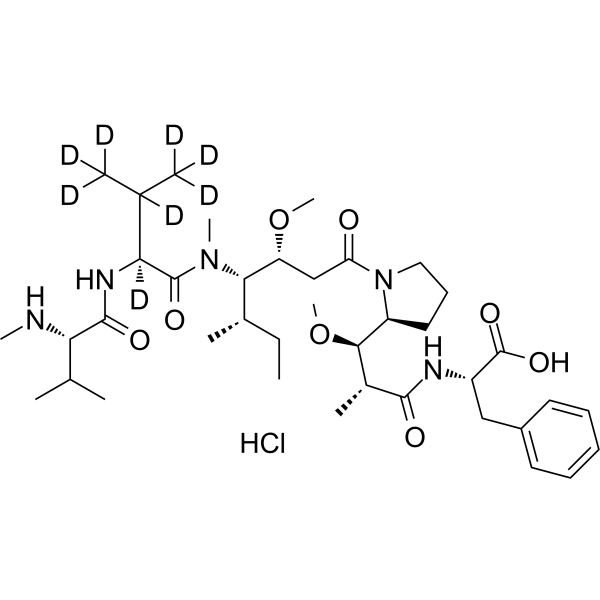
MMAF-d8hydrochloride
PRODUCTS SPECIFICATIONS

DESCRIPTION
Overview
| MDL | - |
|---|---|
| Molecular Weight | 776.47 |
| Molecular Formula | C39H58D8ClN5O8 |
| SMILES | O=C(O)[C@H](CC1=CC=CC=C1)NC([C@H](C)[C@@H](OC)[C@H]2N(C(C[C@@H](OC)[C@@H](N(C)C([C@@]([2H])(NC([C@@H](NC)C(C)C)=O)C([2H])(C([2H])([2H])[2H])C([2H])([2H])[2H])=O)[C@@H](C)CC)=O)CCC2)=O.Cl |
1 Publications Citing Use of MCE
Summary
D8-MMAF hydrochloride is a deuterated form of MMAF hydrochloride, which is a microtubule disrupting agent.
IC50 & Target
|
Auristatin |
In Vitro
MMAF shows in vitro cytotoxicity against a panel of cell lines. The IC 50 values for Karpas 299, H3396, 786-O and Caki-1 are 119, 105, 257, and 200 nM, respectively. Targeted MMAF is much more potent than the free drug, and that cAC10 conjugates of MMAF display pronounced activities. On a molar basis, the cAC10-L1-MMAF 4 is an average of over 2200-fold more potent than free MMAF and is active on all the CD30-positive cell lines tested [1] .
MCE has not independently confirmed the accuracy of these methods. They are for reference only.
In Vivo
The maximum tolerated dose in mice of MMAF (>16 mg/kg) is much higher than MMAE (1 mg/kg). cAC10-L1-MMAF 4 has an MTD of 50 mg/kg in mice and 15 mg/kg in rats. The corresponding cAC10-L4-MMAF 4 ADC was much less toxic, having MTDs in mice and rats of >150 mg/ kg and 90 mg/kg in rats, respectively [1] .
MCE has not independently confirmed the accuracy of these methods. They are for reference only.
Appearance
Solid
Shipping
Room temperature in continental US; may vary elsewhere.
Storage
4°C, sealed storage, away from moisture
* The compound is unstable in solutions, freshly prepared is recommended.
Solvent & Solubility
DMSO : 100 mg/mL ( 128.79 mM ; Need ultrasonic)
Stock Solutions
| Concentration Solvent Mass | 1 mg | 5 mg | 10 mg |
|---|
| 1 mM | 1.2879 mL | 6.4394 mL | 12.8788 mL |
| 5 mM | 0.2576 mL | 1.2879 mL | 2.5758 mL |
| 10 mM | 0.1288 mL | 0.6439 mL | 1.2879 mL |