
[CAS NO. 191732-72-6] Lenalidomide (CC-5013)
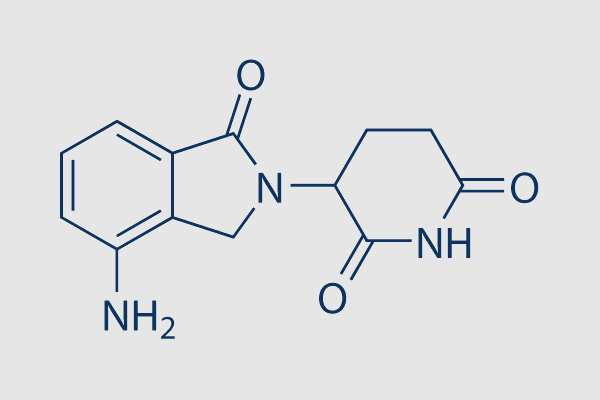
Please click "REQUEST A QUOTE" button if you need other sizes or custom synthesis
request a quote
If there is no stock, or you need other sizes or custom synthesis, please:
PRODUCTS SPECIFICATIONS [191732-72-6]
Store

Catalog
SLK-S1029
Brand
Selleck
CAS
191732-72-6
DESCRIPTION [191732-72-6]
Overview
| MDL | MFCD07772307 |
|---|---|
| Molecular Weight | 259.26 |
| Molecular Formula | C13H13N3O3 |
| SMILES | O=C1N(CC=2C1=CC=CC2N)C3C(=O)NC(=O)CC3 |
For research use only.
Storage
3 years,-20°C,powder
1 years,-80°C,in solvent
1 years,-80°C,in solvent
Shipping
Room temperature shipping(Stability testing shows this product can be shipped without any cooling measures.)
Preparing Stock Solutions
| 1 mg | 5 mg | 10 mg | |
| 1 mM | 3.8571 mL | 19.2857 mL | 38.5713 mL |
| 5 mM | 0.7714 mL | 3.8571 mL | 7.7143 mL |
| 10 mM | 0.3857 mL | 1.9286 mL | 3.8571 mL |
| 50 mM | 0.0771 mL | 0.3857 mL | 0.7714 mL |
Description
Lenalidomide (CC-5013) is a secretion inhibitor with of 13 nM in PBMCs. Lenalidomide (CC-5013) is a ligand of , and it causes selective ubiquitination and degradation of two lymphoid transcription factors, IKZF1 and IKZF3, by the CRBN-CRL4 ubiquitin ligase. Lenalidomide promotes expression and inhibit expression and induces .
In vitro
Lenalidomide strongly induces IL-2 and sIL-2R production. Lenalidomide-induced tyrosine phosphorylation of CD28 on T cells is followed by a down-stream activation of NF-κB. Lenalidomide and pomalidomide inhibits autoubiquitination of CRBN in HEK293 T cells expressing thalidomide-binding competent wild-type CRBN, but not thalidomide-binding defective CRBN(YW/AA). Overexpression of CRBN wild-type protein, but not CRBN(YW/AA) mutant protein, in KMS12 myeloma cells, amplifies pomalidomide-mediated reductions in c-myc and IRF4 expression and increases in p21(WAF-1) expression. Long-term selection for Lenalidomide resistance in H929 myeloma cell lines is accompanied by a reduction in CRBN, while in DF15R myeloma cells resistant to both pomalidomide and Lenalidomide, CRBN protein is undetectable. Lenalidomide prevents induction of defects by down-regulating tumor cell inhibitory molecule expression. Lenalidomide prevents induction of tumor-induced T cell lytic synapse dysfunction. Lenalidomide treatment blocks CLL cell-induced T cell actin synapse dysfunction, mimicks antibody blockade, and down-regulates expression of CLL inhibitory ligands and their receptors on T cells. Lenalidomide treatment prevents tumor-induced immune suppression in FL, DLBCL, HL, MM, SCC, and OC and down-regulates immunosuppressive ligand expression on all tumor cells examined. CTL killing function significantly increases following antibody blockade of CLL inhibitory ligands or Lenalidomide treatment compared to control treatments. Treatment of autologous CLL-T cell co-cultures with Lenalidomide reverses impaired CD8 T cell lytic synapse formation and granzyme B trafficking.
References
[1] Muller GW, et al. Bioorg Med Chem Lett, 1999, 9(11), 1625-1630.
[2] Zangari M, et al. Expert Opin Investig Drugs. 2005, 14(11), 1411-1418.
[3] Lopez-Girona A, et al. Leukemia. 2012.
[4] Ramsay AG, et al. Blood, 2012, 120(7), 1412-1421.
[5] Dredge K, et al. Microvasc Res. 2005, 69(1-2), 56-63.
[6] Henry JY, et al. Prostate. 2012, 72(8), 856-867.
[7] Ocio EM, et al. Haematologica, 2010, 95(5), 794-803.
[8] Henry JY, et al. J Clin Oncol, 2010, 28(suppl), Abst e13155.
[9] Moros A, et al. Canc Res, 2012, 72(8, Suppl 1), Abst 1942.
[2] Zangari M, et al. Expert Opin Investig Drugs. 2005, 14(11), 1411-1418.
[3] Lopez-Girona A, et al. Leukemia. 2012.
[4] Ramsay AG, et al. Blood, 2012, 120(7), 1412-1421.
[5] Dredge K, et al. Microvasc Res. 2005, 69(1-2), 56-63.
[6] Henry JY, et al. Prostate. 2012, 72(8), 856-867.
[7] Ocio EM, et al. Haematologica, 2010, 95(5), 794-803.
[8] Henry JY, et al. J Clin Oncol, 2010, 28(suppl), Abst e13155.
[9] Moros A, et al. Canc Res, 2012, 72(8, Suppl 1), Abst 1942.
Synonyms
2,6-Piperidinedione, 3-(4-amino-1,3-dihydro-1-oxo-2H-isoindol-2-yl)-
3-(4-Amino-1,3-dihydro-1-oxo-2H-isoindol-2-yl)-2,6-piperidinedione
3-(4-Amino-1-oxoisoindolin-2-yl)piperidine-2,6-dione
Revimid
CC 5013
CDC 501
Lenalidomide
Revlimid
1-Oxo-4-amino-2-(2,6-dioxopiperidin-3-yl)isoindole
3-(4-Amino-1-oxoisoindolin-2-yl)piperidin-2,6-dione
ENMD 0997
IMiD 3
revlMiD

Powered by Arctom Copyright © 2026 Arctom. All rights
reserved.