
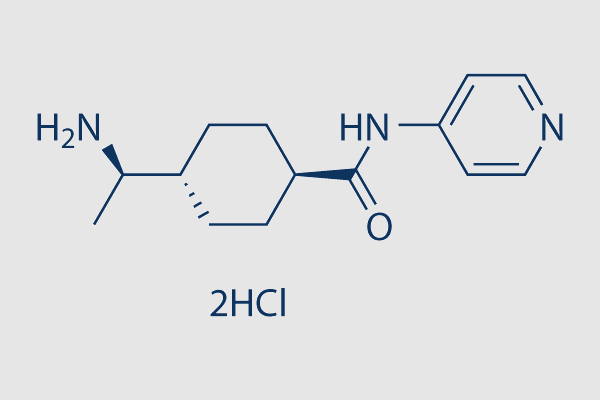
[CAS NO. 129830-38-2] Y-27632 2HCl
Please click "REQUEST A QUOTE" button if you need other sizes or custom synthesis
request a quote
If there is no stock, or you need other sizes or custom synthesis, please:
PRODUCTS SPECIFICATIONS [129830-38-2]
Store

Catalog
SLK-S1049
Brand
Selleck
CAS
129830-38-2
DESCRIPTION [129830-38-2]
Overview
| MDL | MFCD03490488 |
|---|---|
| Molecular Weight | 320.26 |
| Molecular Formula | C14H21N3O.2HCl |
| SMILES | O=C([C@H]1CC[C@H]([C@H](N)C)CC1)NC2=CC=NC=C2.[H]Cl.[H]Cl |
For research use only.
Storage
3 years,-20°C,powder
1 years,-80°C,in solvent
1 years,-80°C,in solvent
Shipping
Room temperature shipping(Stability testing shows this product can be shipped without any cooling measures.)
Description
Y-27632 2HCl is a selective inhibitor with a of 140 nM and 300nM in a cell-free assay, exhibits >200-fold selectivity over other kinases, including PKC, cAMP-dependent protein kinase, MLCK and PAK.
In vitro
Y-27632 2HCl inhibits ROCK-II while displaying little activity against PKC, cAMP-dependent protein kinase and myosin light-chain kinase (MLCK) with K of 26 μM, 25 μM and > 250 μM, respectively, as well as PKA activated by another Rho-family GTPase member, Cdc42. Y-27632 2HCl inhibits smooth-muscle contraction induces by various agonists including phenylephrine, histamine, acetylcholine, serotonin, endothelin, and thromboxane with IC50 of 0.3-1 μM, by selectively inhibiting Ca sensitization. Y-27632 2HCl suppresses Rho-induced, p160ROCK-mediated formation of stress fibres in cultured cells. Y-27632 2HCl treatment blocks both Rho-mediated activation of actomyosin and LPA-stimulated invasive activity of MM1 cells in a concentration-dependent manner. Y-27632 2HCl treatment is not only sufficient to initiate formation of exuberant axonal processes but also facilitates axonal maturation during the very early stages of axonogenesis, while largely sparing axon elongation. In human embryonic stem (hES) cells, Y-27632 2HCl treatment at 10 μM markedly diminishes dissociation-induced apoptosis even in serum-free suspension (SFEB) culture, increases cloning efficiency (from ~1% to ~27%), facilitates subcloning after gene transfer, and enables SFEB-cultured hES cells to survive and differentiate into Bf1 cortical and basal telencephalic progenitors.
References
[1] Uehata M, et al. Nature, 1997, 389(6654), 990-994.
[2] Itoh K, et al. Nat Med, 1999, 5(2), 221-225.
[3] Bito H, et al. Neuron, 2000, 26(2), 431-441.
[4] Watanabe K, et al. Nat Biotechnol, 2007, 25(6), 681-686.
[5] Hyvelin JM, et al. Circ Res, 2005, 97(2), 185-191.
[6] Ishizaki T, et al. Mol Pharmacol. 2000, 57(5), 976-983.
[7] Isler D, et al. Pharmacol Rep. 2014, 66(1), 114-120.
[2] Itoh K, et al. Nat Med, 1999, 5(2), 221-225.
[3] Bito H, et al. Neuron, 2000, 26(2), 431-441.
[4] Watanabe K, et al. Nat Biotechnol, 2007, 25(6), 681-686.
[5] Hyvelin JM, et al. Circ Res, 2005, 97(2), 185-191.
[6] Ishizaki T, et al. Mol Pharmacol. 2000, 57(5), 976-983.
[7] Isler D, et al. Pharmacol Rep. 2014, 66(1), 114-120.

Powered by Arctom Copyright © 2026 Arctom. All rights
reserved.