
[CAS NO. 34157-83-0] Celastrol (NSC 70931)
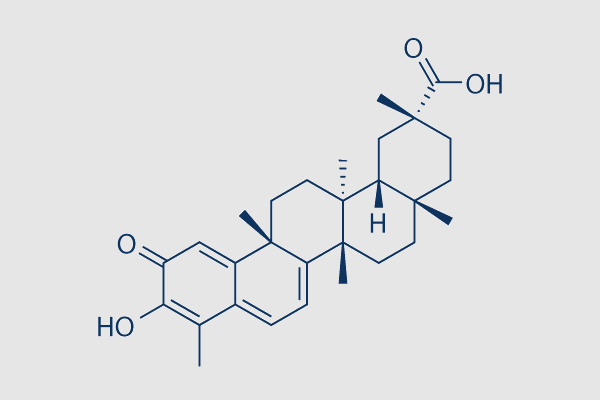
Please click "REQUEST A QUOTE" button if you need other sizes or custom synthesis
request a quote
If there is no stock, or you need other sizes or custom synthesis, please:
PRODUCTS SPECIFICATIONS [34157-83-0]
Store

Catalog
SLK-S1290
Brand
Selleck
CAS
34157-83-0
DESCRIPTION [34157-83-0]
Overview
| MDL | - |
|---|---|
| Molecular Weight | 450.61 |
| Molecular Formula | C29H38O4 |
| SMILES | C[C@@]12[C@](C)([C@]3([C@@](C)(CC1)CC[C@](C(O)=O)(C)C3)[H])CC[C@]4(C)C2=CC=C5C4=CC(=O)C(O)=C5C |
For research use only.
Storage
3 years,-20°C,powder
1 years,-80°C,in solvent
1 years,-80°C,in solvent
Shipping
Room temperature shipping(Stability testing shows this product can be shipped without any cooling measures.)
Preparing Stock Solutions
| 1 mg | 5 mg | 10 mg | |
| 1 mM | 2.2192 mL | 11.0961 mL | 22.1921 mL |
| 5 mM | 0.4438 mL | 2.2192 mL | 4.4384 mL |
| 10 mM | 0.2219 mL | 1.1096 mL | 2.2192 mL |
| 50 mM | 0.0444 mL | 0.2219 mL | 0.4438 mL |
Description
Celastrol (NSC 70931, Tripterine) is a potent inhibitor for the chymotrypsin-like activity of a purified 20S proteasome with of 2.5 μM. Celastrol induces and via the ROS/JNK signaling pathway. Celastrol inhibits dopaminergic neuronal death of Parkinson's disease through activating .
Features
A potent antioxidant and anti-inflammatory drug.
Targets
| 20S proteasome [1] (Cell-free assay) |
| 2.5 μM |
In vitro
Celastrol at 5 μM inhibits the chymotrypsin-like, PGPH-like, and trypsin-like activities of the purified 20S proteasome by 80%, 5%, and <1%, respectively, whereas at 10 μM, it inhibits these three proteasomal activities by ∼90%, 15%, and <1%, respectively. Celastrol significantly inhibits the proteasomal chymotrypsin activity in PC-3 cells in a concentration-dependent manner. Celastrol at 2.5 μM to 5 μM induces caspase-3 activity by 4.7-fold to 5.5-fold in PC-3 cells. Celastrol (5 μM) treated cells, the levels of the proteasome target proteins, IκB-α and Bax, are increased after 1 hour and further increased to its peak for 4 hours to 12 hours. Celastrol (2.5 μM) treatment induces proteasome inhibition by 40%, as shown by the decreased levels of chymotrypsin-like activity and increased accumulation of ubiquitinated proteins in LNCaP cells. Celastrol (2.5 μM) induces apoptosis in the Celastrol-treated LNCaP cells, as shown by increased levels of caspase-3 activity (up to 3.5-fold), PARP cleavage, and apoptotic morphology. Celastrol (300 nM) is found to suppress LPS-induced production of TNF-alpha and IL-1beta by human monocytes and macrophages. Celastrol (100 nM) also decreases LPS-induced expression of class II MHC molecules by microglia. Celastrol strongly inhibits LPS and IFN-y-induced NO production with IC50 of 200 nM in macrophage lineage cells. Celastrol strongly inhibits TNF-α and IFN-γ-induced NO production with IC50 of 200 nM in endothelial cells. Celastrol (2.5 μM) potentiates the apoptosis induced by TNF and chemotherapeutic agents and inhibits invasion, both regulated by NF-kappaB activation, in KBM-5 cells. Celastrol (2.5 μM) suppresses the expression of TNF induced the expression of gene products involved in antiapoptosis (IAP1, IAP2, Bcl-2, Bcl-XL, c-FLIP, and survivin), proliferation (cyclin D1 and COX-2), invasion (MMP-9), and angiogenesis (VEGF) in KBM-5 cells. Celastrol (5 μM) is found to inhibit the TNF-induced activation of IkappaBalpha kinase, IkappaBalpha phosphorylation, IkappaBalpha degradation, p65 nuclear translocation and phosphorylation, and NF-kappaB-mediated reporter gene expression. Celastrol inhibits proliferating of RPMI 8226, KATOIII, UM-SCC1, U251MG and MDA-MB-231 cells with IC50 of 0.52 μM, 0.54 μM, 0.76 μM, 0.69 μM and 0.67 μM, respectively. Celastrol (1 μM) inhibits growth of RPMI 8226 with a decrease in the levels of cyclin D1 and cyclin E, but concomitant increase in the levels of p21 and p27. Celastrol induces apoptosis in RPMI-8226 cells indicated by the activation of caspase-8, bid cleavage, caspase-9 activation, caspase-3 activation, PARP cleavage and through the down regulation of anti-apoptototic proteins. Celastrol (1 μM) suppresses Akt pathway and activates JNK kinase in RPMI-8226 cells.
In vivo
Celastrol (3 mg/kg) results in significant inhibition (up to 70%) of tumor growth in male nude mice bearing PC-3 tumors, associated with increased p27 levels and Bax level. Celastrol (3 mg/kg) results more apoptotic tumor cells with the appearance of various PARP cleavage fragments in tumor of male nude mice bearing PC-3 tumors. Celastrol (3 mg/kg) causes 35% of tumor inhibition, associated with decreased proteasome activity and decreased expression of AR protein in nude mice bearing C4-2B tumors. Celastrol (3 mg/kg) is found to suppress strongly joint swelling and other manifestations of adjuvant arthritis in mice. Celastrol (0.2 mg/kg) significantly improves the performance in memory, learning and psychomotor activity tests in rats.
References
Synonyms
24,25,26-Trinoroleana-1(10),3,5,7-tetraen-29-oic acid, 3-hydroxy-9,13-dimethyl-2-oxo-, (9β,13α,14β,20α)-
D:A-Friedo-24-noroleana-1(10),3,5,7-tetraen-29-oic acid, 3-hydroxy-2-oxo-, (20α)-
24-Nor-D:A-friedooleana-1(10),3,5,7-tetraen-29-oic acid, 3-hydroxy-2-oxo-
(9β,13α,14β,20α)-3-Hydroxy-9,13-dimethyl-2-oxo-24,25,26-trinoroleana-1(10),3,5,7-tetraen-29-oic acid
Celastrol
Tripterin
2-Picenecarboxylic acid, 1,2,3,4,4a,5,6,6a,11,12b,13,14,14a,14b-tetradecahydro-10-hydroxy-2,4a,6a,9,12b,14a-hexamethyl-11-oxo-, [2R-(2α,4aβ,6aβ,12bβ,14aα,14bβ)]-
2-Picenecarboxylic acid, 1,2,3,4,4a,5,6,6a,11,12b,13,14,14a,14b-tetradecahydro-10-hydroxy-2,4a,6a,9,12b,14a-hexamethyl-11-oxo-, (2R,4aS,6aS,12bR,14aS,14bR)-
NSC 70931
UI1590

Powered by Arctom Copyright © 2026 Arctom. All rights
reserved.