
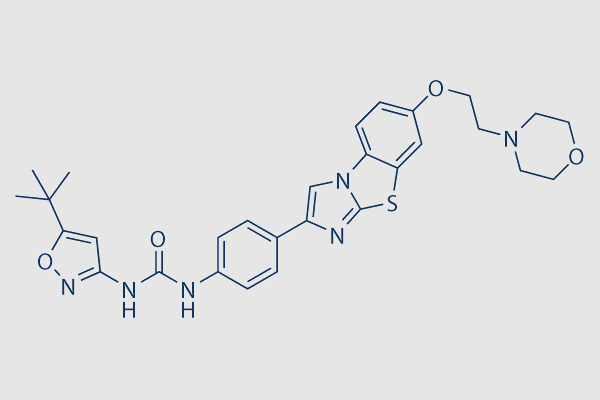
[CAS NO. 950769-58-1] Quizartinib (AC220)
Please click "REQUEST A QUOTE" button if you need other sizes or custom synthesis
request a quote
If there is no stock, or you need other sizes or custom synthesis, please:
PRODUCTS SPECIFICATIONS [950769-58-1]
Store

Catalog
SLK-S1526
Brand
Selleck
CAS
950769-58-1
DESCRIPTION [950769-58-1]
Overview
| MDL | MFCD18074524 |
|---|---|
| Molecular Weight | 560.67 |
| Molecular Formula | C29H32N6O4S |
| SMILES | O(CCN1CCOCC1)C=2C=C3C(N4C(S3)=NC(=C4)C5=CC=C(NC(NC=6C=C(C(C)(C)C)ON6)=O)C=C5)=CC2 |
For research use only.
Storage
3 years,-20°C,powder
1 years,-80°C,in solvent
1 years,-80°C,in solvent
Shipping
Room temperature shipping(Stability testing shows this product can be shipped without any cooling measures.)
Description
Quizartinib (AC220) is a second-generation inhibitor for with of 1.1 nM/4.2 nM in MV4-11 and RS4;11 cells, respectively, 10-fold more selective for Flt3 than KIT, PDGFRα, PDGFRβ, RET, and CSF-1R. Quizartinib (AC220) induces of tumor cells. Phase 3.
Features
The most potent cellular FLT3-ITD inhibitor.
In vitro
AC220, a unique, potent and selective inhibitor of FLT3, has high affinity for FLT3 with a K value of 1.6 nM. AC220 inhibits the autophosphorylation of FLT3 in the human leukemia cell lines MV4-11 which harbor a homozygous FLT3-ITD mutation and is FLT3 dependent, and RS4;11 which expresses wild-type FLT3 with IC50 values of 1.1 nM and 4.2 nM, respectively. AC220 is the most potent cellular FLT3-ITD inhibitor, leading to the most significant inhibition of MV4-11 cell proliferation with IC50 of 0.56 nM compared to all other FLT3 inhibitors whose IC50 values range from 0.87 nM to 64 nM. AC220 has no inhibitory activity against the proliferation of A375 cells which harbor an activating mutation in BRAF and are not FLT3 dependent, indicating a large window between FLT3 inhibition and general cytotoxic effects.
In vivo
Oral administration of AC220 (10 mg/kg) induces time-dependent inhibition of FLT3 autophosphorylation in the FLT3-ITD–dependent MV4-11 tumor xenograft mouse model; the inhibition being 90% at 2 hours and 40% at 24 hours. AC220 significantly extends survival in a mouse model of FLT3-ITD AML with doses as low as 1 mg/kg given orally once a day. Treatment with AC220 at 10 mg/kg for 28 days results in rapid and complete regression of tumors in all mice with no tumor regrowth during the 60-day posttreatment period. AC220 displays more significant efficacy compared to sunitinib treatment which causes tumors to shrink slowly and resume growth immediately upon discontinuation of treatment in all but one of the mice.
Synonyms
Urea, N-[5-(1,1-dimethylethyl)-3-isoxazolyl]-N′-[4-[7-[2-(4-morpholinyl)ethoxy]imidazo[2,1-b]benzothiazol-2-yl]phenyl]-
N-[5-(1,1-Dimethylethyl)-3-isoxazolyl]-N′-[4-[7-[2-(4-morpholinyl)ethoxy]imidazo[2,1-b]benzothiazol-2-yl]phenyl]urea
N-(5-tert-Butylisoxazol-3-yl)-N′-[4-[7-[2-(morpholin-4-yl)ethoxy]imidazo[2,1-b][1,3]benzothiazol-2-yl]phenyl]urea
Quizartinib
AC 220
AC 010220

Powered by Arctom Copyright © 2026 Arctom. All rights
reserved.