
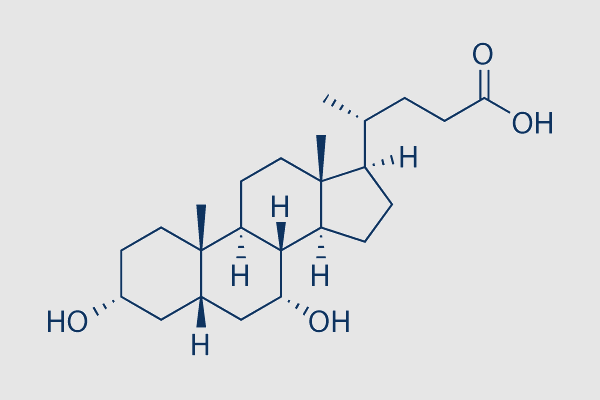
[CAS NO. 474-25-9] Chenodeoxycholic Acid
Please click "REQUEST A QUOTE" button if you need other sizes or custom synthesis
request a quote
If there is no stock, or you need other sizes or custom synthesis, please:
PRODUCTS SPECIFICATIONS [474-25-9]
Store

Catalog
SLK-S1843
Brand
Selleck
CAS
474-25-9
DESCRIPTION [474-25-9]
Overview
| MDL | - |
|---|---|
| Molecular Weight | 392.57 |
| Molecular Formula | C24H40O4 |
| SMILES | C[C@@]12[C@]([C@]3([C@@]([C@]4(C)[C@](C[C@H]3O)(C[C@H](O)CC4)[H])(CC1)[H])[H])(CC[C@@]2([C@@H](CCC(O)=O)C)[H])[H] |
For research use only.
Storage
3 years,-20°C,powder
1 years,-80°C,in solvent
1 years,-80°C,in solvent
Shipping
Room temperature shipping(Stability testing shows this product can be shipped without any cooling measures.)
Preparing Stock Solutions
| 1 mg | 5 mg | 10 mg | |
| 1 mM | 2.5473 mL | 12.7366 mL | 25.4732 mL |
| 5 mM | 0.5095 mL | 2.5473 mL | 5.0946 mL |
| 10 mM | 0.2547 mL | 1.2737 mL | 2.5473 mL |
| 50 mM | 0.0509 mL | 0.2547 mL | 0.5095 mL |
Description
Chenodeoxycholic Acid (Chenodiol, Chenodesoxycholic acid, Chenocholic acid,CDCA) is a naturally occurring human bile acid, and inhibits production of cholesterol in the liver and absorption in the intestines. Chenodeoxycholic Acid is a hydrophobic primary bile acid that activates nuclear receptors (FXR) involved in cholesterol metabolism.
In vitro
Chenodeoxycholic acid (CDCA) and Deoxycholic acid (DCA) both inhibits 11 beta HSD2 with IC(50) values of 22 mM and 38 mM, respectively and causes cortisol-dependent nuclear translocation and increases transcriptionalactivity of mineralocorticoid receptor (MR). Chenodeoxycholic acid is able to stimulate Ishikawa cell growth by inducing a significant increase in Cyclin D1 protein and mRNA expression through the activation of the membrane G protein-coupled receptor (TGR5)-dependent pathway. Chenodeoxycholic acid (CDCA) induces LDL receptor mRNA levels approximately 4 fold and mRNA levels for HMG-CoA reductase and HMG-CoA synthase two fold in a cultured human hepatoblastoma cell line, Hep G2. Chenodeoxycholic acid-induced Isc is inhibited (≥67%) by Bumetanide, BaCl2, and the cystic fibrosis transmembrane conductance regulator (CFTR) inhibitor CFTRinh-172. Chenodeoxycholic acid-stimulated Isc is decreased 43% by the adenylate cyclase inhibitor MDL12330A and Chenodeoxycholic acid increases intracellular cAMP concentration. Chenodeoxycholic acid treatment activates C/EBPβ, as shown by increases in its phosphorylation, nuclear accumulation, and expression in HepG2 cells. Chenodeoxycholic acid enhances luciferase gene transcription from the construct containing -1.65-kb GSTA2 promoter, which contains C/EBP response element (pGL-1651). Chenodeoxycholic acid treatment activates AMP-activated protein kinase (AMPK), which leads to extracellular signal-regulated kinase 1/2 (ERK1/2) activation, as evidenced by the results of experiments using a dominant-negative mutant of AMPKα and chemical inhibitor.
References
[1] Stauffer AT, et al. J Biol Chem,?002, 277(29), 26286-26292.
[2] Casaburi I, et al. Cell Cycle, 2012, 11(14), 2699-2710.
[3] Kawabe Y, et al. Biochem Biophys Res Commun,?995, 208(1), 405-411.
[4] Ao M, et al. Am J Physiol Cell Physiol,?013, 305(4), C447-456.
[5] Noh K, et al. Drug Metab Dispos,?011, 39(8), 1451-1459.
[2] Casaburi I, et al. Cell Cycle, 2012, 11(14), 2699-2710.
[3] Kawabe Y, et al. Biochem Biophys Res Commun,?995, 208(1), 405-411.
[4] Ao M, et al. Am J Physiol Cell Physiol,?013, 305(4), C447-456.
[5] Noh K, et al. Drug Metab Dispos,?011, 39(8), 1451-1459.
Synonyms
Cholan-24-oic acid, 3,7-dihydroxy-, (3α,5β,7α)-
5β-Cholan-24-oic acid, 3α,7α-dihydroxy-
5β-Cholanic acid, 3α,7α-dihydroxy-
(3α,5β,7α)-3,7-Dihydroxycholan-24-oic acid
Anthropodeoxycholic acid
Anthropodesoxycholic acid
Chenodeoxycholic acid
Chenodesoxycholic acid
3α,7α-Dihydroxycholanic acid
Gallodesoxycholic acid
17β-(1-Methyl-3-carboxypropyl)etiocholane-3α,7α-diol
3α,7α-Dihydroxy-5β-cholanic acid
3α,7α-Dihydroxy-5β-cholanoic acid
Anthropododesoxycholic acid
CDC
3α,7α-Dihydroxy-5β-cholan-24-oic acid
Chenic acid
Chendol
Chenodiol
7α-Hydroxylithocholic acid
Chenofalk
Chenix
Chenocol
Chenodex
Hekbilin
Ulmenide
Cholanorm
Fluibil
Chenocedon
Kebilis
Chenossil
(+)-Chenodeoxycholic acid

Powered by Arctom Copyright © 2026 Arctom. All rights
reserved.