
[CAS NO. 153559-49-0] Bexarotene (LGD1069)
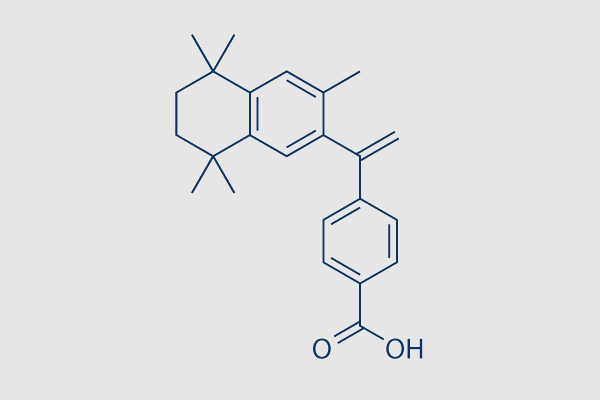
Please click "REQUEST A QUOTE" button if you need other sizes or custom synthesis
request a quote
If there is no stock, or you need other sizes or custom synthesis, please:
PRODUCTS SPECIFICATIONS [153559-49-0]
Store

Catalog
SLK-S2098
Brand
Selleck
CAS
153559-49-0
DESCRIPTION [153559-49-0]
Overview
| MDL | MFCD00932428 |
|---|---|
| Molecular Weight | 348 |
| Molecular Formula | C24H28O2 |
| SMILES | CC1(C)C=2C(C(C)(C)CC1)=CC(C)=C(C(=C)C3=CC=C(C(O)=O)C=C3)C2 |
For research use only.
Storage
3 years,-20°C,powder
1 years,-80°C,in solvent
1 years,-80°C,in solvent
Shipping
Room temperature shipping(Stability testing shows this product can be shipped without any cooling measures.)
Preparing Stock Solutions
| 1 mg | 5 mg | 10 mg | |
| 1 mM | 2.8736 mL | 14.3678 mL | 28.7356 mL |
| 5 mM | 0.5747 mL | 2.8736 mL | 5.7471 mL |
| 10 mM | 0.2874 mL | 1.4368 mL | 2.8736 mL |
| 50 mM | 0.0575 mL | 0.2874 mL | 0.5747 mL |
Description
Bexarotene (Targretin, LGD1069) is a retinoid specifically selective for retinoid X receptors, used as an oral antineoplastic agent in the treatment of cutaneous T-cell lymphoma.
Targets
| RXR [1] |
In vitro
Bexarotene treatment at 1 mM and 10 mM for 96 h increases the number of cells with sub-G1 populations and annexin V binding in a dose-dependent manner compared with vehicle controls (DMSO) in well-established CTCL cell lines (MJ, Hut78, and HH), respectively. Bexarotene treatment suppresses the expression of retinoid X receptor alpha and retinoic acid receptor alpha proteins in all three lines compared with untreated controls. Bexarotene treatment decreases the protein levels of survivin, activates caspase-3, and cleaved poly(ADP-Ribose) polymerase, but has no obvious effect on expression of Fas/Fas ligand and bcl-2 proteins in all three CTCL lines. Bexarotene induces a loss of viability and more pronounced inhibition of clonogenic proliferation in HH and Hut-78 cells, whereas the MJ line exhibits resistance. Bexarotene upregulates and activates Bax in sensitive lines, although not enough to signal significant apoptosis. Bexarotene signals both G(1) and G(2)/M arrest by the modulation of critical checkpoint proteins. Bexarotene activates p53 by phosphorylation at Ser15, which influences the binding of p53 to promoters for cell cycle arrest, induces p73 upregulation, and, in concordance, also modulates some p53/p73 downstream target genes, such as p21, Bax, survivin and cdc2.
In vivo
Bexarotene significantly prevents ER-negative mammary tumorigenesis with less toxicity than naturally occurring retinoids in animal models. Bexarotene inhibits the development of preinvasive mammary lesions such as hyperplasias and carcinoma-in-situ in MMTV-erbB2 mice.
References
Synonyms
Benzoic acid, 4-[1-(5,6,7,8-tetrahydro-3,5,5,8,8-pentamethyl-2-naphthalenyl)ethenyl]-
4-[1-(5,6,7,8-Tetrahydro-3,5,5,8,8-pentamethyl-2-naphthalenyl)ethenyl]benzoic acid
LGD 1069
LG 1069
LG 100069
Bexarotene
Targrexin
Targretyn
RO 26-4455
LG 69
Targretin
LG 69 (retinoid)
Targret
SR 11247

Powered by Arctom Copyright © 2026 Arctom. All rights
reserved.