
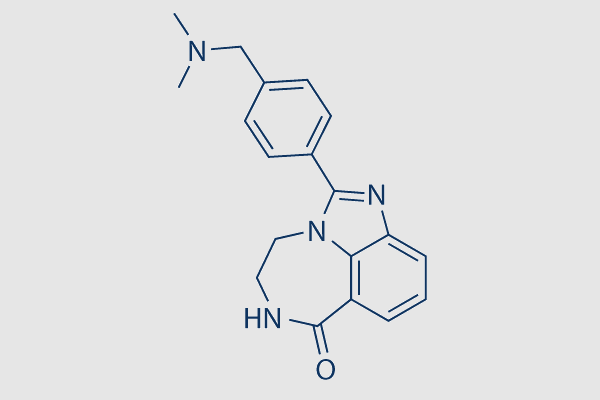
[CAS NO. 328543-09-5] AG-14361
Please click "REQUEST A QUOTE" button if you need other sizes or custom synthesis
request a quote
If there is no stock, or you need other sizes or custom synthesis, please:
PRODUCTS SPECIFICATIONS [328543-09-5]
Store

Catalog
SLK-S2178
Brand
Selleck
CAS
328543-09-5
DESCRIPTION [328543-09-5]
Overview
| MDL | - |
|---|---|
| Molecular Weight | 320.39 |
| Molecular Formula | C19H20N4O |
| SMILES | - |
For research use only.
Storage
3 years,-20°C,powder
1 years,-80°C,in solvent
1 years,-80°C,in solvent
Shipping
Room temperature shipping(Stability testing shows this product can be shipped without any cooling measures.)
Preparing Stock Solutions
| 1 mg | 5 mg | 10 mg | |
| 1 mM | 3.1212 mL | 15.6060 mL | 31.2120 mL |
| 5 mM | 0.6242 mL | 3.1212 mL | 6.2424 mL |
| 10 mM | 0.3121 mL | 1.5606 mL | 3.1212 mL |
| 50 mM | 0.0624 mL | 0.3121 mL | 0.6242 mL |
Description
AG14361 is a potent inhibitor of with of <5 nM in a cell-free assay. It is at least 1000-fold more potent than the benzamides.
Features
The 1st high-potency PARP-1 inhibitor with the specificity & in vivo activity to enhance chemotherapy and radiation therapy of human cancers.
Targets
| PARP1 [1] (Cell-free assay) |
| <5 nM(Ki) |
In vitro
AG14361 is at least 1000-fold more potent than the benzamides. The IC50 for AG14361 is 29 nM in permeabilized SW620 cells and 14 nM in intact SW620 cells. Crystallographic analysis of AG14361 bound to the catalytic domain of chicken PARP-1 shows that the tricyclic ring system of AG14361 is located in a pocket composed of amino acid residues Trp861, His862, Gly863, Tyr896, Phe897, Ala898, Lys903, Ser904, Tyr907, and Glu988. AG14361 forms important hydrogen bonds with Ser904 and Gly863 and a water-mediated hydrogen bond with Glu988. AG14361-induced growth inhibition is not attributed to PARP-1-related effects because maximal PARP-1 inhibition is observed at much lower concentrations (≤1 μM) than the GI50. AG14361 at 0.4 μM does not affect cancer cell gene expression or growth, but it increases the antiproliferative activity of temozolomide and topotecan, and inhibits recovery from potentially lethal γ-radiation damage in LoVo cells by 73%. In addition, 0.4 μM AG14361 does not substantially alter gene expression as shown by microarray analysis. A 17-hour exposure of A549 cells to 0.4 μM AG14361 does not change the expression of the 6800 genes. Thus, although 0.4 μM AG14361 inhibits cellular PARP-1 activity by more than 85%, it essentially does not change gene expression and cell proliferation, indicating that the cellular effects of this low concentration of AG14361 are specific for PARP-1 inhibition. Higher, growth-inhibitory concentrations of AG14361 affects gene expression, but these effects are not likely to be related to PARP-1 inhibition because cell proliferation is affected equally in PARP/ and PARP-1/ cells. AG14361 is rapidly absorbed into the bloodstream and distributed to the tumor and liver with lower concentrations detected in the brain. Tissue-to-plasma concentration ratio indicates that AG14361 is retained in tumor tissue over time in both xenograft models, with tumor concentrations (≥15 μM for 2 hours) in excess of that required to inhibit PARP-1 activity in vitro. AG14361 enhances temozolomide activity in all MMR-proficient cells (1.5–3.3-fold) but is more effective in MMR-deficient cells (3.7–5.2-fold potentiation), overcoming temozolomide resistance. In contrast, benzylguanine only increases the efficacy of temozolomide in MMR-proficient cells but is ineffective in MMR-deficient cells. AG14361 enhances the growth-inhibitory and cytotoxic effects of topoisomerase I poisons. AG14361 increases the persistence of camptothecin-induced DNA single-strand breaks.
In vivo
AG14361 treatment before irradiation statistically significantly increases the sensitivity to radiation therapy of mice bearing LoVo xenografts. AG14361 statistically significantly increases blood flow in xenografts and thus potentially increases drug delivery to tumor xenografts. In vivo, nontoxic doses of AG14361 increases the delay of LoVo xenograft growth induced by irinotecan, x-irradiation, or temozolomide by 2- to 3-fold. Coadministration of AG14361 with temozolomide statistically significantly increases temozolomide activity against LoVo xenografts, with the tumor growth delay being increased from 3 days to 9 days by AG14361 at 5 mg/kg and to 10 days by AG14361 at 15 mg/kg. The combination of AG14361 and temozolomide causes complete regression of SW620 xenograft tumors. PARP-1 activity, detected by pharmacodynamic assay, in SW620 xenografts is inhibited by more than 75% for at least 4 hours after intraperitoneal administration of AG14361 (10 mg/kg), consistent with the concentration of AG14361 persisting in the tumor.
References

Powered by Arctom Copyright © 2026 Arctom. All rights
reserved.