
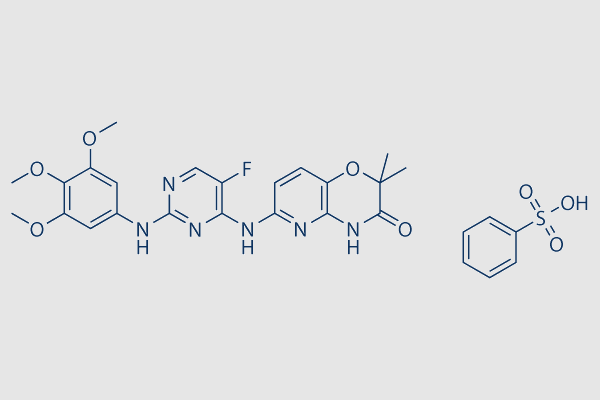
[CAS NO. 841290-81-1] R406
Please click "REQUEST A QUOTE" button if you need other sizes or custom synthesis
request a quote
If there is no stock, or you need other sizes or custom synthesis, please:
PRODUCTS SPECIFICATIONS [841290-81-1]
Store

Catalog
SLK-S2194
Brand
Selleck
CAS
841290-81-1
DESCRIPTION [841290-81-1]
Overview
| MDL | - |
|---|---|
| Molecular Weight | 628.63 |
| Molecular Formula | C22H23FN6O5.C6H6O3S |
| SMILES | - |
For research use only.
Storage
3 years,-20°C,powder
1 years,-80°C,in solvent
1 years,-80°C,in solvent
Shipping
Room temperature shipping(Stability testing shows this product can be shipped without any cooling measures.)
Preparing Stock Solutions
| 1 mg | 5 mg | 10 mg | |
| 1 mM | 1.5908 mL | 7.9538 mL | 15.9076 mL |
| 5 mM | 0.3182 mL | 1.5908 mL | 3.1815 mL |
| 10 mM | 0.1591 mL | 0.7954 mL | 1.5908 mL |
| 50 mM | 0.0318 mL | 0.1591 mL | 0.3182 mL |
Description
R406 is a potent inhibitor with of 41 nM in cell-free assays, strongly inhibits Syk but not Lyn, 5-fold less potent to Flt3. R406 induces . Phase 1.
Features
Lead drug candidate for rheumatoid arthritis.
In vitro
R406 is a potent inhibitor of immunoglobulin E (IgE)- and IgG-mediated activation of Fc receptor signaling. R406 inhibits the anti-IgE-induced production and release of LTC4 and cytokines and chemokines, including TNFα, IL-8, and GM-CSF. R406 inhibits phosphorylation of Syk substrate linker for activation of T cells in mast cells and B-cell linker protein/SLP65 in B cells. R406 binds to the ATP binding pocket of Syk and inhibits its kinase activity as an ATP-competitive inhibitor with K of 30 nM. R406 blocks Syk-dependent FcR-mediated activation of monocytes/macrophages and neutrophils and Bcr-mediated activation of B lymphocytes. R406 significantly induces chronic lymphocytic leukemia (CLL) cell apoptosis in nurselike cells cocultures and blocks CCL3 and CCL4 secretion by CLL cells in response to B-cell antigen receptor (Bcr) triggering. R406 is a potent inhibitor of platelet signaling and functions initiated by FcγRIIA cross-linking by specific antibodies or by sera from HIT patients.
References

Powered by Arctom Copyright © 2026 Arctom. All rights
reserved.