
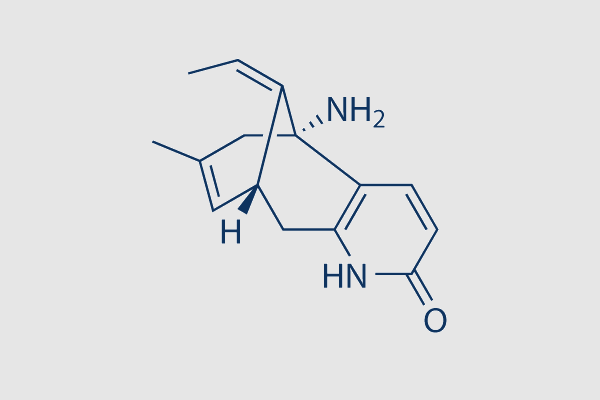
[CAS NO. 102518-79-6] (-)-Huperzine A (HupA)
Please click "REQUEST A QUOTE" button if you need other sizes or custom synthesis
request a quote
If there is no stock, or you need other sizes or custom synthesis, please:
PRODUCTS SPECIFICATIONS [102518-79-6]
Store

Catalog
SLK-S2251
Brand
Selleck
CAS
102518-79-6
DESCRIPTION [102518-79-6]
Overview
| MDL | MFCD01714949 |
|---|---|
| Molecular Weight | 242.32 |
| Molecular Formula | C15H18N2O |
| SMILES | N[C@@]\12C3=C(C[C@@H](/C1=C\C)C=C(C)C2)NC(=O)C=C3 |
For research use only.
Storage
3 years,-20°C,powder
1 years,-80°C,in solvent
1 years,-80°C,in solvent
Shipping
Room temperature shipping(Stability testing shows this product can be shipped without any cooling measures.)
Preparing Stock Solutions
| 1 mg | 5 mg | 10 mg | |
| 1 mM | 4.1268 mL | 20.6339 mL | 41.2677 mL |
| 5 mM | 0.8254 mL | 4.1268 mL | 8.2535 mL |
| 10 mM | 0.4127 mL | 2.0634 mL | 4.1268 mL |
| 50 mM | - | - | - |
Description
(-)-Huperzine A is a potent, highly specific and reversible inhibitor of with K of 7 nM, exhibiting 200-fold more selectivity for G4 AChE over G1 AChE. Also acts as an antagonist. Phase 4.
Features
Greater penetration of the blood-brain barrier, higher oral bioavailability, and longer AChE inhibition relative to tacrine, donepezil, and rivastigmine.
Targets
| AChE (G4 form) [1] |
| 7 nM(Ki) |
In vitro
(-)-Huperzine A is a novel alkaloid isolated from the Chinese herb Huperzia serrata. (-)-Huperzine A preferentially inhibits tetrameric AChE (G4 form). (-)-Huperzine A is more potent than tacrine, physostigmine, galanthamine, and rivastigmine with respect to inhibition of AChE activity, whereas HupA is the least potent BuChE inhibitor among the inhibitors. (-)-Huperzine A possesses the ability to protect cells against hydrogen peroxide, β-amyloid protein, glutamate, ischemia and staurosporine-induced cytotoxicity and apoptosis. These protective effects are related to its ability to attenuate oxidative stress, regulate the expression of apoptotic proteins Bcl-2, Bax, P53, and caspase-3, protect mitochondria, upregulate nerve growth factor and its receptors, and interfere with amyloid precursor protein metabolism.
In vivo
(-)-Huperzine A can ameliorate the learning and memory deficiency in animal models and AD patients. Its potentially beneficial actions include modification of β-amyloid peptide processing, reduction of oxidative stress, neuronal protection against apoptosis, and regulation of the expression and secretion of nerve growth factor (NGF) and NGF signaling. (-)-Huperzine A significantly inhibits AChE activity in the cortex, hippocampus, striatum, medial septum, medulla oblongata, cerebellum, and hypothalamus of rats that are killed 30 min following the administration of (-)-Huperzine A at several dose levels compared with the saline control.
References
Synonyms
5,9-Methanocycloocta[b]pyridin-2(1H)-one, 5-amino-11-ethylidene-5,6,9,10-tetrahydro-7-methyl-, (5R,9R,11E)-
5,9-Methanocycloocta[b]pyridin-2(1H)-one, 5-amino-11-ethylidene-5,6,9,10-tetrahydro-7-methyl-, [5R-(5α,9β,11E)]-
Selagine
(5R,9R,11E)-5-Amino-11-ethylidene-5,6,9,10-tetrahydro-7-methyl-5,9-methanocycloocta[b]pyridin-2(1H)-one
Huperzine A
(-)-Huperzine A
(-)-Selagine
Kimpukan A
Hupzine A
Hup A
Huperzine

Powered by Arctom Copyright © 2026 Arctom. All rights
reserved.