
[CAS NO. 1211877-36-9] MG132
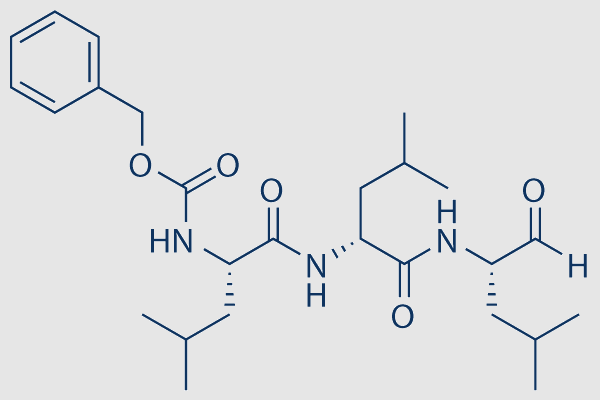
Please click "REQUEST A QUOTE" button if you need other sizes or custom synthesis
request a quote
If there is no stock, or you need other sizes or custom synthesis, please:
PRODUCTS SPECIFICATIONS [1211877-36-9]
Store

Catalog
SLK-S2619
Brand
Selleck
CAS
1211877-36-9
DESCRIPTION [1211877-36-9]
Overview
| MDL | MFCD28580122 |
|---|---|
| Molecular Weight | 475.62 |
| Molecular Formula | C26H41N3O5 |
| SMILES | CC(C)C[C@H](C(N)=O)N(C([C@H](CC(C)C)NC(OCC1=CC=CC=C1)=O)=O)[C@H](C=O)CC(C)C |
For research use only.
Storage
3 years,-20°C,powder
1 years,-80°C,in solvent
1 years,-80°C,in solvent
Shipping
Room temperature shipping(Stability testing shows this product can be shipped without any cooling measures.)
Preparing Stock Solutions
| 1 mg | 5 mg | 10 mg | |
| 1 mM | 2.1025 mL | 10.5126 mL | 21.0252 mL |
| 5 mM | 0.4205 mL | 2.1025 mL | 4.2050 mL |
| 10 mM | 0.2103 mL | 1.0513 mL | 2.1025 mL |
| 50 mM | 0.0421 mL | 0.2103 mL | 0.4205 mL |
Description
MG132 ((S,R,S)-(-)-MG132, Z-Leu-D-Leu-Leu-al) is a potent inhibitor. MG132 also inhibits calpain (IC50=1.2 μM).
Targets
| Proteasome [9] (Cell-free assay) |
| 100 nM |
In vitro
MG-132 displays >1000 times more activity than ZLLal in inhibiting the ZLLL-MCA-degrading activity of 20S proteasome with IC50 of 100 nM versus 110 μM. MG-132 also inhibits calpain with IC50 of 1.2 μM. MG-132 induces neurite outgrowth in PC12 cells at an optimal concentration of 20 nM, displaying 500 times more potency than ZLLal. MG-132 (10 μM) potently inhibits TNF-α-induced NF-κB activation, interleukin-8 (IL-8) gene transcription, and IL-8 protein release in A549 cells by inhibition of proteasome-mediated IκBα degradation. MG-132 treatment potently induces p53-dependent apoptosis in KIM-2 cells by 26S proteasome inhibition. Unlike BzLLLCOCHO or PS-341, MG-132 treatment results in weak inhibition of the chymotrypsinlike (CT-L) and peptidylglutamyl peptide hydrolysing (PGPH) activities of the 26S proteasome, whereas multiple myeloma cells (U266 and OPM-2) are more sensitive to induction of apoptosis by MG-132 than BzLLLCOCHO. MG-132 (1 μM) sensitizes TRAIL-resistant prostate cancer cells by activating the AP-1 family members c-Fos and c-Jun, which, in turn, repress the antiapoptotic molecule c-FLIP(L). MG-132 significantly enhances the ability of inositol hexakisphosphate (IP6) to reduce cellular metabolic activity in both PC3 and DU145 androgen-independent prostate cancer (AIPCa) cell lines.
References
[1] Tsubuki S, et al. J Biochem, 1996, 119(3), 572-576.
[2] Fiedler MA, et al. Am J Respir Cell Mol Biol, 1998, 19(2), 259-268.
[3] MacLaren AP, et al. Cell Death Differ, 2001, 8(3), 210-218.
[4] Crawford LJ, et al. Cancer Res, 2006, 66(12), 6379-6386.
[5] Li W, et al. Cancer Res, 2007, 67(5), 2247-2255.
[6] Diallo JS, et al. Br J Cancer, 2008, 99(10), 1613-1622.
[7] Bonuccelli G, et al. Am J Pathol, 2003, 163(4), 1663-1675.
[8] Caron AZ, et al. BMC Musculoskelet Disord, 2011, 12:185.
[9] Mroczkiewicz M, et al. J Med Chem. 2010 Feb 25;53(4):1509-18.
[2] Fiedler MA, et al. Am J Respir Cell Mol Biol, 1998, 19(2), 259-268.
[3] MacLaren AP, et al. Cell Death Differ, 2001, 8(3), 210-218.
[4] Crawford LJ, et al. Cancer Res, 2006, 66(12), 6379-6386.
[5] Li W, et al. Cancer Res, 2007, 67(5), 2247-2255.
[6] Diallo JS, et al. Br J Cancer, 2008, 99(10), 1613-1622.
[7] Bonuccelli G, et al. Am J Pathol, 2003, 163(4), 1663-1675.
[8] Caron AZ, et al. BMC Musculoskelet Disord, 2011, 12:185.
[9] Mroczkiewicz M, et al. J Med Chem. 2010 Feb 25;53(4):1509-18.

Powered by Arctom Copyright © 2026 Arctom. All rights
reserved.