
[CAS NO. 911222-45-2] Rabusertib (LY2603618)
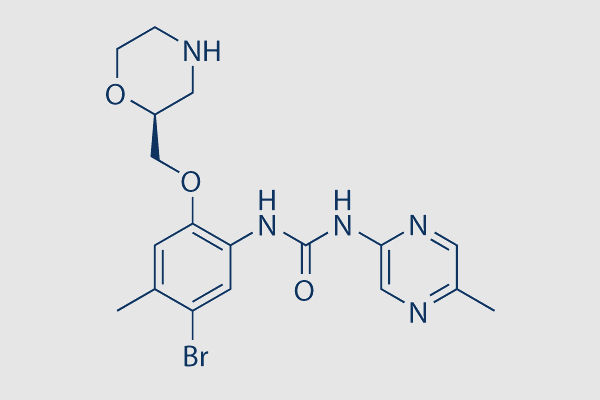
Please click "REQUEST A QUOTE" button if you need other sizes or custom synthesis
request a quote
If there is no stock, or you need other sizes or custom synthesis, please:
PRODUCTS SPECIFICATIONS [911222-45-2]
Store

Catalog
SLK-S2626
Brand
Selleck
CAS
911222-45-2
DESCRIPTION [911222-45-2]
Overview
| MDL | MFCD18633253 |
|---|---|
| Molecular Weight | 436.3 |
| Molecular Formula | C18H22BrN5O3 |
| SMILES | O=C(NC1=NC=C(C)N=C1)NC2=CC(Br)=C(C)C=C2OC[C@@H]3CNCCO3 |
For research use only.
Storage
3 years,-20°C,powder
1 years,-80°C,in solvent
1 years,-80°C,in solvent
Shipping
Room temperature shipping(Stability testing shows this product can be shipped without any cooling measures.)
Preparing Stock Solutions
| 1 mg | 5 mg | 10 mg | |
| 1 mM | 2.2920 mL | 11.4600 mL | 22.9200 mL |
| 5 mM | 0.4584 mL | 2.2920 mL | 4.5840 mL |
| 10 mM | 0.2292 mL | 1.1460 mL | 2.2920 mL |
| 50 mM | 0.0458 mL | 0.2292 mL | 0.4584 mL |
Description
Rabusertib (LY2603618, IC-83) is a highly selective inhibitor with potential anti-tumor activity in a cell-free assay. IC50=7 nM, showing approximately 100-fold more potent against Chk1 than against any of the other protein kinases evaluated. Rabusertib (LY2603618) induces cell cycle arrest, DNA damage response and in cancer cells. Rabusertib (LY2603618) induces bak-dependent in AML cell lines.
Targets
| Chk1 [1] (Cell-free assay) |
| 7 nM |
In vitro
Chk1 is an ATP-dependent serine-threonine kinase and a key component in the DNA replication-monitoring checkpoint system activated by double-stranded breaks (DSBs). Chk1 contributes to all currently defined cell cycle checkpoints, including G1/S, intra-S-phase, G2/M, and the mitotic spindle checkpoint. By inhibiting the activity of chk1, LY2603618 prevents the repair of DNA caused by DNA-damaging agents, thus potentiating the antitumor efficacies of various chemotherapeutic agents. However, preclinical data involving LY2603618 has not been published until now. Inhibition of Chk1 is predicted to enhance the effects of antimetabolites, such as gemcitabine. LY2603618 treatment impairs DNA synthesis, increases DNA damage (via mitotic defects), induces apoptosis, and has synergistic activity with pemetrexed, especially in p53 mutant tumor cells.
References

Powered by Arctom Copyright © 2026 Arctom. All rights
reserved.