
[CAS NO. 1020172-07-9] Rebastinib (DCC-2036)
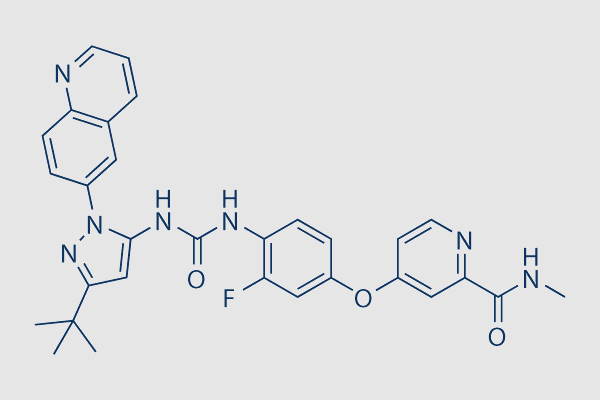
Please click "REQUEST A QUOTE" button if you need other sizes or custom synthesis
request a quote
If there is no stock, or you need other sizes or custom synthesis, please:
PRODUCTS SPECIFICATIONS [1020172-07-9]
Store

Catalog
SLK-S2634
Brand
Selleck
CAS
1020172-07-9
DESCRIPTION [1020172-07-9]
Overview
| MDL | MFCD19443646 |
|---|---|
| Molecular Weight | 553.59 |
| Molecular Formula | C30H28FN7O3 |
| SMILES | O=C(NC)C1=NC=CC(OC2=CC=C(NC(NC3=CC(C(C)(C)C)=NN3C4=CC=C5N=CC=CC5=C4)=O)C(F)=C2)=C1 |
For research use only.
Storage
3 years,-20°C,powder
1 years,-80°C,in solvent
1 years,-80°C,in solvent
Shipping
Room temperature shipping(Stability testing shows this product can be shipped without any cooling measures.)
Preparing Stock Solutions
| 1 mg | 5 mg | 10 mg | |
| 1 mM | 1.8064 mL | 9.0320 mL | 18.0639 mL |
| 5 mM | 0.3613 mL | 1.8064 mL | 3.6128 mL |
| 10 mM | 0.1806 mL | 0.9032 mL | 1.8064 mL |
| 50 mM | 0.0361 mL | 0.1806 mL | 0.3613 mL |
Description
Rebastinib (DCC-2036) is a conformational control Bcr-Abl inhibitor for and Abl1(T315I) with of 0.8 nM and 4 nM, also inhibits SRC, LYN, FGR, HCK, KDR, FLT3, and Tie-2, and low activity to seen towards c-Kit. Phase 1.
Features
A conformational control inhibitor of Abl1 and T315I Abl1.
Targets
In vitro
DCC-2036 shows the potent inhibitory activities against purified native Abl1 in unphosphorylated (u-Abl1) and phosphorylated (p-Abl1) forms, unphosphorylated and phosphorylated gatekeeper mutant Abl1, and the activation loop mutant Abl1 in a non-ATP-competitive manner with IC50 of 0.8 nM, 2 nM, 1.4 nM, 5 nM, and 4 nM, respectively. Moreover, DCC-2036 also inhibits the Src family kinases Src, LYN, FGR, and HCK, and the receptor TKs KDR, FLT3, and TIE2 with IC50 of 34 nM, 29 nM, 38 nM, 40 nM, 4 nM, 2 nM and 6 nM, respectively. DCC-2036 shows the anti-proliferative activities against Ba/F3 cells expressing native or mutant Bcr-Abl1 with IC50 ranging from 2 nM to 150 nM. In addition, DCC-2036 also inhibits proliferation of the Ph cell line K562 (IC50 5.5 nM), and induces apoptosis in both Bcr-Abl1-expressing Ba/F3 and K562 cells potently. A recent study shows that DCC-2036 shows the selectivity for growth inhibition of Bcr-Abl-positive cells by its marked inhibition of CML cell lines compared to non-CML leukemia lines.
In vivo
In a mouse allograft model bearing Ba/F3-Bcr-Abl1T315I leukemia cells, DCC-2036 treatment by oral gavage at 100 mg/kg once daily effectively inhibits Bcr-Abl1 signaling and significantly prolongs mouse survival.
References

Powered by Arctom Copyright © 2026 Arctom. All rights
reserved.