
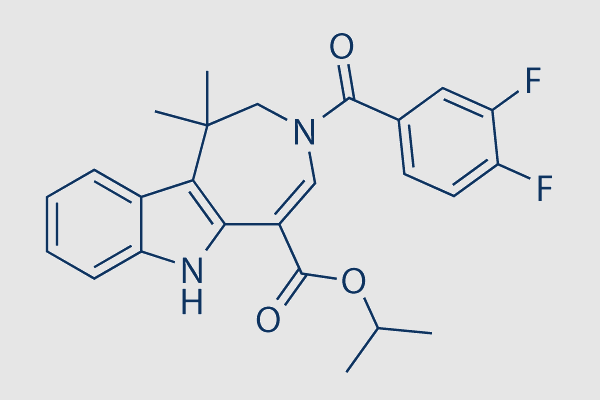
[CAS NO. 629664-81-9] Turofexorate Isopropyl (XL335)
Please click "REQUEST A QUOTE" button if you need other sizes or custom synthesis
request a quote
If there is no stock, or you need other sizes or custom synthesis, please:
PRODUCTS SPECIFICATIONS [629664-81-9]
Store

Catalog
SLK-S2694
Brand
Selleck
CAS
629664-81-9
DESCRIPTION [629664-81-9]
Overview
| MDL | MFCD13181507 |
|---|---|
| Molecular Weight | 438.47 |
| Molecular Formula | C25H24F2N2O3 |
| SMILES | CC(C)OC(=O)C1=CN(CC(C)(C)C2=C1NC1=C2C=CC=C1)C(=O)C1=CC=C(F)C(F)=C1 |
For research use only.
Storage
3 years,-20°C,powder
1 years,-80°C,in solvent
1 years,-80°C,in solvent
Shipping
Room temperature shipping(Stability testing shows this product can be shipped without any cooling measures.)
Description
Turofexorate Isopropyl (XL335, Fxr 450) is a potent, selective agonist with of 4 nM, highly selective versus other nuclear receptors, such as LXR, PPAR, ER and etc. Phase 1.
Targets
| FXR [1] |
| 4 nM(EC50) |
In vitro
WAY-362450 binds to the ligand-binding domain (LBD) of human FXR. WAY-362450 resides in a predominately hydrophobic pocket with only a few polar atoms making contact with WAY-362450. WAY-362450 promotes transcription of the human BSEP, human SHP, and mouse IBABP genes utilizing reporter constructs with EC50 of 17, 230, and 33 nM, respectively in promoter assays. WAY-362450 at concentration of 1 μM significantly induces mRNAs encoding for BSEP, SHP, and IBABP in human cell cultures to 13-, 2-, and 20-fold, respectively. WAY-362450 at concentration of 1 μM suppresses interleukin-6-induced CRP expression in human Hep3B hepatoma cells, and the inhibitory effect is attenuated when knockdown of FXR by short interfering RNA.
In vivo
WAY-362450 administrated intravenously or orally at does of 3 mg/kg in rats with a protracted half-life of 25 h, modest volume of distribution, and low clearance of 3.3 L/kg. WAY-362450 administered orally at dose of 10 mg/kg in normal C57bl/6 mice for a period of 7 days significantly lowers triglycerides to 62.0 ± 6.4 mg/dL and total cholesterol to 78.1 ± 5.0 mg/dL. WAY-362450 administered orally at dose of 1 and 3 mg/kg daily for 6 weeks in LDLR mice, triglycerides is lowered by 19% and 39%, respectively, total cholesterol is lowered by 23% and 50%, respectively and lesion formation by 18% and 36%, respectively. WAY-362450 intraperitoneally administrated at dose of 30 mg/kg daily for 4 days in wild type C57BL/6 mice attenuates lipopolysaccharide-induced serum amyloid P component and serum amyloid A3 mRNA levels in the liver. WAY-362450 orally administered at dose of 30 mg/kg/day for 4 weeks in adult male C57BL/6 mice reduces inflammatory cell infiltration and hepatic fibrosis, the reduction in inflammatory cell infiltration correlates with deceased serum levels of keratinocyte derived chemokine (mKC) and MCP 1 and decreased hepatic gene expression of MCP-1 and VCAM-1, and the reduction of hepatic fibrosis by WAY-362450 treatment corresponded to a reduction in hepatic gene expression of fibrosis markers. WAY-362450 administrated orally at dose of 30mg/kg in LDLR and apoE mice blocks diet-induced hypertriglyceridemia and elevations of non-HDL cholesterol and produced a near complete inhibition of aortic lesion formation, WAY-362450 also induced small heterodimer partner (SHP) expression and repressed cholesterol 7α-hydroxylase (CYP7A1) and sterol 12 α-hydroxylase (CYP8B1) expression.
References

Powered by Arctom Copyright © 2026 Arctom. All rights
reserved.