
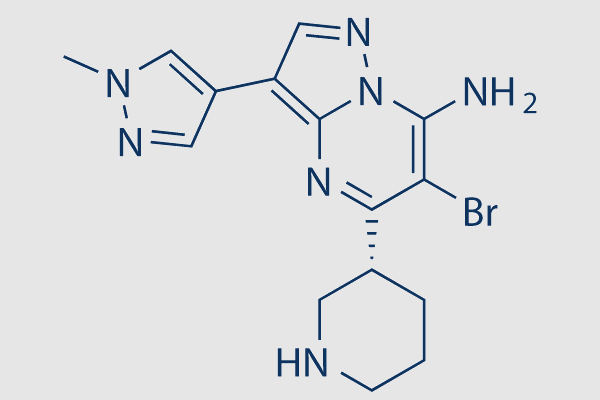
[CAS NO. 891494-63-6] MK-8776 (SCH 900776)
Please click "REQUEST A QUOTE" button if you need other sizes or custom synthesis
request a quote
If there is no stock, or you need other sizes or custom synthesis, please:
PRODUCTS SPECIFICATIONS [891494-63-6]
Store

Catalog
SLK-S2735
Brand
Selleck
CAS
891494-63-6
DESCRIPTION [891494-63-6]
Overview
| MDL | MFCD20922873 |
|---|---|
| Molecular Weight | 376.25 |
| Molecular Formula | C15H18BrN7 |
| SMILES | NC1=C(Br)C([C@H]2CNCCC2)=NC3=C(C4=CN(C)N=C4)C=NN13 |
For research use only.
Storage
3 years,-20°C,powder
1 years,-80°C,in solvent
1 years,-80°C,in solvent
Shipping
Room temperature shipping(Stability testing shows this product can be shipped without any cooling measures.)
Preparing Stock Solutions
| 1 mg | 5 mg | 10 mg | |
| 1 mM | 2.6578 mL | 13.2890 mL | 26.5781 mL |
| 5 mM | 0.5316 mL | 2.6578 mL | 5.3156 mL |
| 10 mM | 0.2658 mL | 1.3289 mL | 2.6578 mL |
| 50 mM | 0.0532 mL | 0.2658 mL | 0.5316 mL |
Description
MK-8776 (SCH 900776) is a selective inhibitor with of 3 nM in a cell-free assay. It shows 500-fold selectivity against Chk2. Phase 2.
In vitro
SCH 900776 is a less potent inhibitor of Chk2 and CDK2 with IC50 of 1.5 μM and 0.16 μM, respectively. SCH 900776 shows no significant inhibition of cytochrome P450 human liver microsomal isoforms 1A2, 2C9, 2C19, 2D6, and 3A4. SCH 900776 induces a dose-dependent loss of DNA replication capability 24 hours after hydroxyurea exposure. SCH 900776 enhances the γ-H2AX response of hydroxyurea, 5-fluoruracil, and cytarabine. In combination with an antimetabolite, SCH 900776 induces accumulation of γ-H2AX within 2 hours, indicative of replication fork collapse and double stranded DNA breaks. Additionally, SCH 900776 suppresses accumulation of the Chk1 pS296 autophosphorylation in a dose-dependent manner. Exposure of proliferating WS1 cells to SCH 900776 is associated with rapid, dose-dependent accumulation of Chk1 pS345, indicating that cycling populations of normal cells induce Chk1 pS345 following exposure to SCH 900776 as part of a futile cycle, perhaps driven by AT-family kinases and DNA-PK.
References

Powered by Arctom Copyright © 2026 Arctom. All rights
reserved.