
[CAS NO. 1038915-60-4] Niraparib (MK-4827)
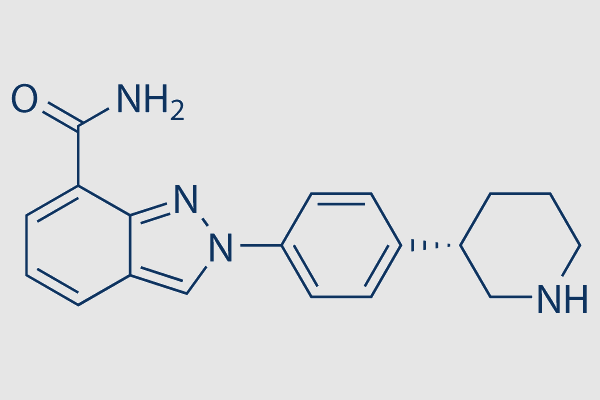
Please click "REQUEST A QUOTE" button if you need other sizes or custom synthesis
request a quote
If there is no stock, or you need other sizes or custom synthesis, please:
PRODUCTS SPECIFICATIONS [1038915-60-4]
Store

Catalog
SLK-S2741
Brand
Selleck
CAS
1038915-60-4
DESCRIPTION [1038915-60-4]
Overview
| MDL | MFCD17779309 |
|---|---|
| Molecular Weight | 320.39 |
| Molecular Formula | C19H20N4O |
| SMILES | C(N)(=O)C=1C=2C(=CN(N2)C3=CC=C(C=C3)[C@@]4(CCCNC4)[H])C=CC1 |
For research use only.
Storage
3 years,-20°C,powder
1 years,-80°C,in solvent
1 years,-80°C,in solvent
Shipping
Room temperature shipping(Stability testing shows this product can be shipped without any cooling measures.)
Preparing Stock Solutions
| 1 mg | 5 mg | 10 mg | |
| 1 mM | 3.1212 mL | 15.6060 mL | 31.2120 mL |
| 5 mM | 0.6242 mL | 3.1212 mL | 6.2424 mL |
| 10 mM | 0.3121 mL | 1.5606 mL | 3.1212 mL |
| 50 mM | 0.0624 mL | 0.3121 mL | 0.6242 mL |
Description
Niraparib (MK-4827) is a selective inhibitor of with of 3.8 nM/2.1 nM, with great activity in cancer cells with mutant BRCA-1 and BRCA-2. It is >330-fold selective against PARP3, V-PARP and Tank1. Niraparib can form PARP–DNA complexes resulting in DNA damage, , and cell death. Phase 3.
In vitro
In a whole cell assay, MK-4827 inhibited PARP activity with EC50 = 4 nM and inhibited proliferation of cancer cells with mutant BRCA-1 and BRCA-2 with CC50 in the 10-100 nM range. It was demonstrated
to be a potent and selective PARP-1 and PARP-2 inhibitor with IC50=3.8 and 2.1 nM, respectively. Furthermore, it displayed at least a 100-fold selectivity over PARP-3, V-PARP, and tankyrase-1, with IC50 = 1300, 330, and 570 nM, respectively. As well as inhibiting the growth of HeLa cell lacking BRCA-1 because of silencing by RNA interference, MK-4827 is able to inhibit the proliferation of cancer cell lines carrying natural BRCA-1 or BRCA-2 mutations. In MDA-MB-436 human mammary gland adenocarcinoma cells carrying BRCA-1 mutations, MK-4827 displayed CC50 = 18 nM, while in CAPAN-1 human pancreatic adenocarcinoma cells, which are BRCA-2 mutant, MK-4827 displayed CC50 = 90 nM. In contrast, normal human prostate and mammary epithelial cells are resistant to MK-4827, displaying antiproliferative effects in the micromolar range, thereby demonstrating the very high selective cytotoxicity from these PARP inhibitors in BRCA-1 and -2 mutant cancer cells compared to surrounding tissue.
In vivo
MK-4827, a novel, orally bioavailable, PARP-1 and PARP-2 inhibitor, strongly enhanced the effect of radiation on a variety of human tumor xenografts, both p53 wild type and p53 mutant. It was well tolerated in vivo and demonstrated efficacy as a single agent in a xenograft model of BRCA-1 deficient cancer.
References
Synonyms
2H-Indazole-7-carboxamide, 2-[4-(3S)-3-piperidinylphenyl]-
2-[4-(3S)-3-Piperidinylphenyl]-2H-indazole-7-carboxamide
Niraparib
2H-Indazole-7-carboxamide 2-[4-(3S)-3-piperidinylphenyl]-
2-[4-[(3S)-Piperidin-3-yl]phenyl]indazole-7-carboxamide

Powered by Arctom Copyright © 2026 Arctom. All rights
reserved.