
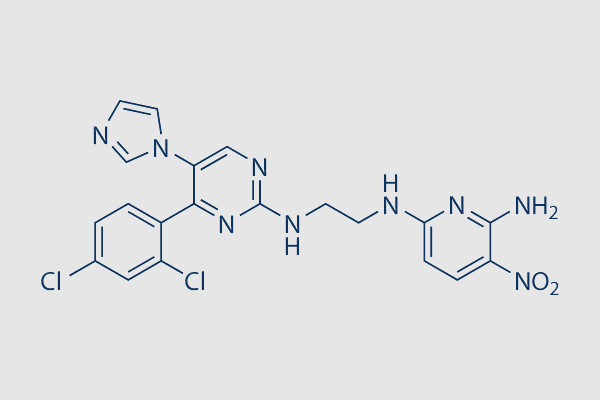
[CAS NO. 252935-94-7] CHIR-98014
Please click "REQUEST A QUOTE" button if you need other sizes or custom synthesis
request a quote
If there is no stock, or you need other sizes or custom synthesis, please:
PRODUCTS SPECIFICATIONS [252935-94-7]
Store

Catalog
SLK-S2745
Brand
Selleck
CAS
252935-94-7
DESCRIPTION [252935-94-7]
Overview
| MDL | MFCD10565922 |
|---|---|
| Molecular Weight | 486.31 |
| Molecular Formula | C20H17Cl2N9O2 |
| SMILES | ClC1=C(C=2C(=CN=C(NCCNC=3N=C(N)C(N(=O)=O)=CC3)N2)N4C=CN=C4)C=CC(Cl)=C1 |
For research use only.
Storage
3 years,-20°C,powder
1 years,-80°C,in solvent
1 years,-80°C,in solvent
Shipping
Room temperature shipping(Stability testing shows this product can be shipped without any cooling measures.)
Preparing Stock Solutions
| 1 mg | 5 mg | 10 mg | |
| 1 mM | 2.0563 mL | 10.2815 mL | 20.5630 mL |
| 5 mM | 0.4113 mL | 2.0563 mL | 4.1126 mL |
| 10 mM | 0.2056 mL | 1.0282 mL | 2.0563 mL |
| 50 mM | - | - | - |
Description
CHIR-98014 (CT98014) is a potent inhibitor with of 0.65 nM/0.58 nM in cell-free assays, with the ability to distinguish GSK-3 from its closest homologs Cdc2 and ERK2.
In vitro
CHIR-98014 inhibits human GSK-3β with K of 0.87 nM. CHIR-98014 is very effective in preventing murine and rat GSK-3. Although CHIR-98014 acts as a simple competitive inhibitor of ATP binding, it displays from 500-fold to >1000-fold selectivity for GSK-3 versus 20 other protein kinases including Cdc2, ERK2, Tie-2 and KDR. CHIR-98014 prevents Cdc2 with IC50 of 3.7 μM. However, CHIR 98014 reveals similar ptoency against the highly homologous ɑ and β isoforms of GSK-3, it is noteworthy that it stronly discriminated between GSK-3 and its closest homologs CDC2 and ERK2. Exposure of insulin receptor-expressing CHO-IR cells or primary rat hepatocytes to increasing concentrations of inhibitor CHIR98014 results in a two- to three-fold stimulation of the GS activity ratio above basal. The concentrations of CHIR-98014 giving rise to half-maximal GS stimulation (EC50) is 106 nM and 107 nM for CHO-IR and rat hepatocytes, respectively.
In vivo
GSK-3 inhibitor CHIR-98014 activates the GS activity ratio in isolated type I skeletal muscle from insulin-sensitive lean Zucker and from insulin-ressitant ZDF rats. Soleus muscle isolated from ZDF rats shows significant resistance to insulin for activation of GS but responded to 500 nM CHIR-98014 to the same extent (40% increase) as muscle from lean Zucker rats. Notably, GS activation by insulin plus CHIR-98014 is additive in muscle from lean Zucker rats and greater than additive in muscle from the ZDF rats. Total GS activity is not altered by either CHIR-98014 or insulin in these cells and muscles. Meanwhile, CHIR-98014 does not influence the insulin dose-response in muscle from lean animals. The reduction in hyperglycemia and improved glucose disposal are not limited to db/db mice and ZDF rats, as similar results are observed with ob/ob mice, diet-induced diabetic C57BL/6 mice, and glucose-intolerant SHHF rats treated with CHIR-98014. Additionally, CHIR-98014 decreases the phosphorylation (Ser396) of tau protein in the cortex and hippocampus of postnatal rats.
References
Synonyms
2,6-Pyridinediamine, N6-[2-[[4-(2,4-dichlorophenyl)-5-(1H-imidazol-1-yl)-2-pyrimidinyl]amino]ethyl]-3-nitro-
N6-[2-[[4-(2,4-Dichlorophenyl)-5-(1H-imidazol-1-yl)-2-pyrimidinyl]amino]ethyl]-3-nitro-2,6-pyridinediamine
CHIR 98014
CT 98014

Powered by Arctom Copyright © 2026 Arctom. All rights
reserved.