
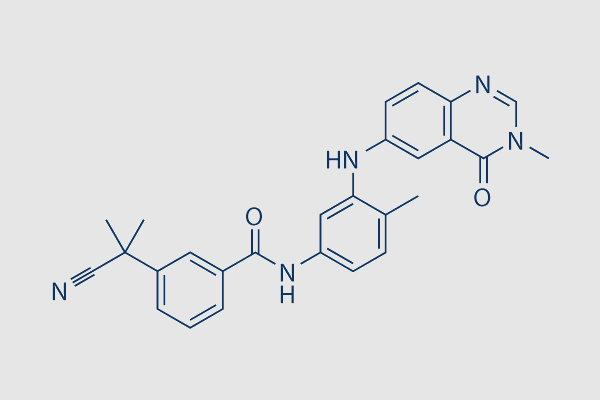
[CAS NO. 878739-06-1] AZ 628
Please click "REQUEST A QUOTE" button if you need other sizes or custom synthesis
request a quote
If there is no stock, or you need other sizes or custom synthesis, please:
PRODUCTS SPECIFICATIONS [878739-06-1]
Store

Catalog
SLK-S2746
Brand
Selleck
CAS
878739-06-1
DESCRIPTION [878739-06-1]
Overview
| MDL | MFCD17392577 |
|---|---|
| Molecular Weight | 451.52 |
| Molecular Formula | C27H25N5O2 |
| SMILES | O=C(NC1=CC=C(C)C(NC2=CC3=C(N=CN(C)C3=O)C=C2)=C1)C4=CC=CC(C(C)(C#N)C)=C4 |
For research use only.
Storage
3 years,-20°C,powder
1 years,-80°C,in solvent
1 years,-80°C,in solvent
Shipping
Room temperature shipping(Stability testing shows this product can be shipped without any cooling measures.)
Description
AZ628 is a new pan- inhibitor for BRAF, BRAFV600E, and c-Raf-1 with of 105 nM, 34 nM and 29 nM in cell-free assays, also inhibits VEGFR2, DDR2, Lyn, Flt1, FMS, etc. AZ628 induces apoptosis.
Targets
In vitro
AZ628 prevents activation of number of tyrosine protein kinases including VEGFR2, DDR2, Lyn, Flt1, FMS and others. AZ628 suppresses anchorage-dependent and -independent growth, gives rise to cell cycle arrest, and induces apoptosis in colon and melanoma cell lines harboring B-RafV600E mutation. The profile of AZ628 cross-reactivity suggests that similar to sorafenib, AZ628 may be antiangiogenic based on prevention of VEGFR2. AZ628-resistant clones are approximately 100-fold more resistant to AZ628 than the parental cell line, exhibiting IC50 of approximately 10 μM, compared with 0.1 μM for the parental cell line. Effective suppression of p-ERK1/2 levels is observed in the M14 parental cell line following treatment with increasing concentrations of AZ628. AZ628-resistant clones express elevated CRAF. Elevated CRAF expression is a potential mechanism of acquired resistance to continuous AZ628 exposure, resulting in sustained activation of ERK1/2. p-ERK1/2 activity is not significantly inhibited by exposure to AZ628 in one of these three AZ628-insensitive cell lines (Wm1552C). Unlike in the AZ628-resistant M14 cells in which AZ628 fails to suppress the activation of ERK, AZ628 treatment efficiently attenuates ERK activation in the NRAS mutant melanoma cells.
References

Powered by Arctom Copyright © 2026 Arctom. All rights
reserved.