
[CAS NO. 1256580-46-7] Alectinib (CH5424802)
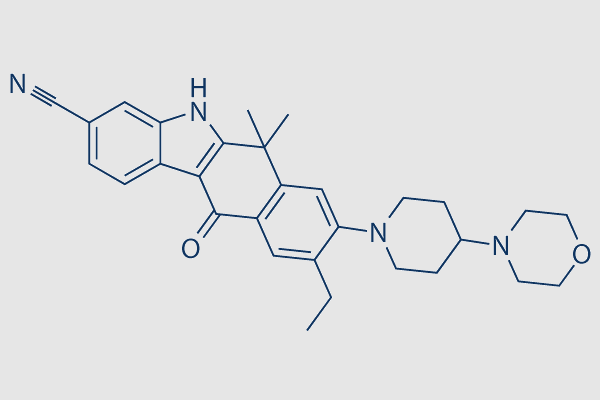
Please click "REQUEST A QUOTE" button if you need other sizes or custom synthesis
request a quote
If there is no stock, or you need other sizes or custom synthesis, please:
PRODUCTS SPECIFICATIONS [1256580-46-7]
Store

Catalog
SLK-S2762
Brand
Selleck
CAS
1256580-46-7
DESCRIPTION [1256580-46-7]
Overview
| MDL | MFCD19440988 |
|---|---|
| Molecular Weight | 482.62 |
| Molecular Formula | C30H34N4O2 |
| SMILES | O=C1C2=C(C(C)(C)C=3C1=CC(CC)=C(C3)N4CCC(CC4)N5CCOCC5)NC=6C2=CC=C(C#N)C6 |
For research use only.
Storage
3 years,-20°C,powder
1 years,-80°C,in solvent
1 years,-80°C,in solvent
Shipping
Room temperature shipping(Stability testing shows this product can be shipped without any cooling measures.)
Preparing Stock Solutions
| 1 mg | 5 mg | 10 mg | |
| 1 mM | 2.0720 mL | 10.3601 mL | 20.7202 mL |
| 5 mM | 0.4144 mL | 2.0720 mL | 4.1440 mL |
| 10 mM | 0.2072 mL | 1.0360 mL | 2.0720 mL |
| 50 mM | - | - | - |
Description
Alectinib (CH5424802, AF-802, RG-7853) is a potent inhibitor with of 1.9 nM in cell-free assays, sensitive to L1196M mutation and higher selectivity for ALK than PF-02341066, NVP-TAE684 and PHA-E429.
Targets
In vitro
The dissociation constant (KD) value of CH5424802 for ALK in an ATP-competitive manner is 2.4 nM. CH5424802 has substantial inhibitory potency against both native ALK and L1196M with K of 0.83 nM and 1.56 nM, respectively. CH5424802 prevents autophosphorylation of ALK in NCI-H2228 NSCLC cells expressing EML4-ALK. CH5424802 also suppresses the phosphorylation of STAT3 and AKT, but not of ERK1/2. CH5424802 completely inhibits the phosphorylation of STAT3 at Tyr705. CH5424802 is preferentially efficacious against NCI-H2228 cells expressing EML4-ALK, but not ALK fusion-negative NSCLC cell lines, including HCC827 cells (EGFR exon 19 deletion), A549 cells (KRAS mutant), or NCI-H522 cells (EGFR wild-type, KRAS wild-type, and ALK wild-type) in monolayer culture. CH5424802 elicits an apoptotic marker—caspase-3/7-like activation—in NCI-H2228 spheroid cells. CH5424802 blocks the growth of two lymphoma lines, KARPAS-299 and SR, with NPM-ALK fusion protein but does not influence the growth of an HDLM-2 lymphoma line without ALK fusion. CH5424802 displays high target selectivity and the stronger anti-proliferative activity against KARPAS-299. CH5424802 inhibits KAPRAS-299 with an IC50 of 3 nM, and KDR with IC50 of 1.4 μM. The metabolic stability of CH5424802 is very high.
In vivo
Oral administration of CH5424802 dose-dependently inhibits tumor growth with an ED50 of 0.46 mg/kg and tumor regression. Treatment of 20 mg/kg CH5424802 reveals rapid tumor regression by 168%, the tumor volume in any mouse is <30 mm after 11 days of treatment (at day 28), a potent antitumor effect is maintained, and tumor regrowth does not occur throughout the 4-week drug-free period. The half-life and the oral bioavailability of CH5424802 in mice are 8.6 hours and 70.8%, respectively. At a repeated dose of 6 mg/kg, the mean plasma levels reached 1.7, 1.5, and 0.3 nM at 2, 7, and 24 hours post-dose, respectively. Administration of CH5424802 leads to tumor growth prevention and tumor regression. Tumor growth inhibition at 20 mg/kg is 119% for KARPAS-299 and 104% for NB-1 on day 20. CH5424802 inhibits the phosphorylation of STAT3 in a dose-dependent manner (2–20 mg/kg). A partial decrease in AKT phosphorylation is also observed in CH5424802-treated xenograft tumors.
References
Synonyms
5H-Benzo[b]carbazole-3-carbonitrile, 9-ethyl-6,11-dihydro-6,6-dimethyl-8-[4-(4-morpholinyl)-1-piperidinyl]-11-oxo-
9-Ethyl-6,11-dihydro-6,6-dimethyl-8-[4-(4-morpholinyl)-1-piperidinyl]-11-oxo-5H-benzo[b]carbazole-3-carbonitrile
AF 802
CH 5424802
Alectinib
CH 542480210
RG 7853
RG7853
RG-7853
Alecensa free base

Powered by Arctom Copyright © 2026 Arctom. All rights
reserved.