
[CAS NO. 155270-99-8] Istradefylline
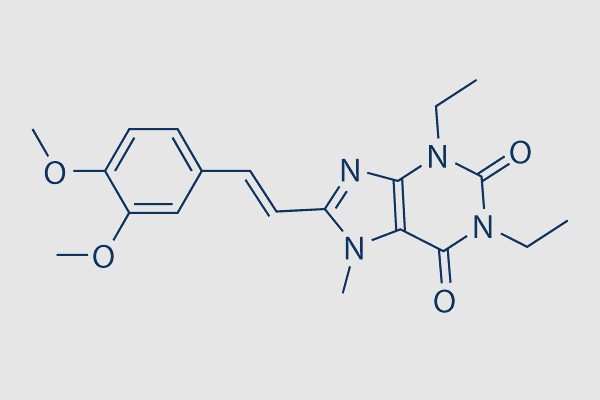
Please click "REQUEST A QUOTE" button if you need other sizes or custom synthesis
request a quote
If there is no stock, or you need other sizes or custom synthesis, please:
PRODUCTS SPECIFICATIONS [155270-99-8]
Store

Catalog
SLK-S2790
Brand
Selleck
CAS
155270-99-8
DESCRIPTION [155270-99-8]
Overview
| MDL | - |
|---|---|
| Molecular Weight | 384.43 |
| Molecular Formula | C20H24N4O4 |
| SMILES | CN1C2=C(N(CC)C(=O)N(CC)C2=O)N=C1/C=C/C3=CC(OC)=C(OC)C=C3 |
For research use only.
Storage
3 years,-20°C,powder
1 years,-80°C,in solvent
1 years,-80°C,in solvent
Shipping
Room temperature shipping(Stability testing shows this product can be shipped without any cooling measures.)
Preparing Stock Solutions
| 1 mg | 5 mg | 10 mg | |
| 1 mM | 2.6013 mL | 13.0063 mL | 26.0125 mL |
| 5 mM | 0.5203 mL | 2.6013 mL | 5.2025 mL |
| 10 mM | 0.2601 mL | 1.3006 mL | 2.6013 mL |
| 50 mM | - | - | - |
Description
Istradefylline (KW-6002) is a selective antagonist with of 2.2 nM. Phase 3.
Targets
| Adenosine A2A receptor [1] |
| 2.2 nM(Ki) |
In vitro
The affinity of Istradefylline for the A2AR is 70-fold greater than that for the A1 receptor with K of 2.2 nM versus 150 nM. Exposure of primary rat striatal astrocytes to Istradefylline results in concentration-dependent abolition of bFGF induction of astrogliosis in vitro. Binding affinities (K) of Istradefylline for A1 receptor, A2A receptor, and A3 receptor in human are >287 nM, 9.12 nM, and >681 nM, respectively, for A1 receptor and A2A receptor in rat 50.9 nM and 1.57 nM, respectively, and for A1 receptor and A2A receptor in mouse 105.02 nM and 1.87 nM, respectively.
In vivo
Istradefylline reverses CGS21680-induced and reserpine-induced catalepsy with ED50 of 0.05 mg/kg and 0.26 mg/kg, respectively. Istradefylline is over 10 times as potent in these models compared to other adenosine antagonists and dopamine agonist drugs. Administration of Istradefylline in combination with L-dopa (50 mg/kg) exerts prominent effects on haloperidol-induced and reserpine-induced catalepsy. Oral administration of Istradefylline at 10 mg/kg to MPTP-treated common marmosets produces an increase in locomotor activity to approximately twice that of control and improves motor disability. Administration of Istradefylline (10 mg/kg, po, 90 minutes before SKF80723/quinpirole/L-DOPA) in combination with SKF80723 (1 mg/kg, ip), quinpirole (0.06 mg/kg ip), or L-DOPA (2.5 mg/kg po) produces a significant additive effect on locomotor activity and improvement of motor disability but not dyskinesia. In the MPTP mice model, Istradefylline significantly attenuates striatal dopamine depletion under various conditions. Pretreatment with Istradefylline (3.3 mg/kg, i.p.) before a single dose of MPTP attenuates the partial dopamine and DOPAC depletions measured in striata 1 week later. Oral administration of Istradefylline protects against the loss of nigral dopaminergic neuronal cells induced by 6-hydroxydopamine in rats, and prevents the functional loss of dopaminergic nerve terminals in the striatum and the ensuing gliosis caused by MPTP in mice. Chronic Istradefylline treatment does not improve the reversal deficits in dopamine-depleted rats. The tremulous jaw movements induced by pimozide are significantly reduced by co-administration of either Istradefylline or tropicamide. Pimozide-induced increases in ventrolateral striatal c-Fos expression are reduced by a behaviorally effective dose of Istradefylline, in contrast to tropicamide by which c-Fos expression in pimozide-treated rats is actually increased.
References
[1] Chen JF, et al. J Neurosci, 2001, 21(10), RC143.
[2] Shiozaki S, et al. Psychopharmacology (Berl), 1999, 147(1), 90-95.
[3] Kanda T, et al. Exp Neurol, 2000, 162(2), 321-327.
[4] Ikeda K, et al. J Neurochem, 2002, 80(2), 262-270.
[5] Brambilla R, et al. Glia, 2003, 43(2), 190-194.
[6] Mihara T, et al. J Pharmacol Exp Ther, 2007, 23(2), 708-719.
[2] Shiozaki S, et al. Psychopharmacology (Berl), 1999, 147(1), 90-95.
[3] Kanda T, et al. Exp Neurol, 2000, 162(2), 321-327.
[4] Ikeda K, et al. J Neurochem, 2002, 80(2), 262-270.
[5] Brambilla R, et al. Glia, 2003, 43(2), 190-194.
[6] Mihara T, et al. J Pharmacol Exp Ther, 2007, 23(2), 708-719.
Synonyms
1H-Purine-2,6-dione, 8-[(1E)-2-(3,4-dimethoxyphenyl)ethenyl]-1,3-diethyl-3,7-dihydro-7-methyl-
1H-Purine-2,6-dione, 8-[2-(3,4-dimethoxyphenyl)ethenyl]-1,3-diethyl-3,7-dihydro-7-methyl-, (E)-
8-[(1E)-2-(3,4-Dimethoxyphenyl)ethenyl]-1,3-diethyl-3,7-dihydro-7-methyl-1H-purine-2,6-dione
KW 6002
Istradefylline
Nourianz
Nouriast

Powered by Arctom Copyright © 2026 Arctom. All rights
reserved.