
[CAS NO. 168273-06-1] Rimonabant (SR141716)
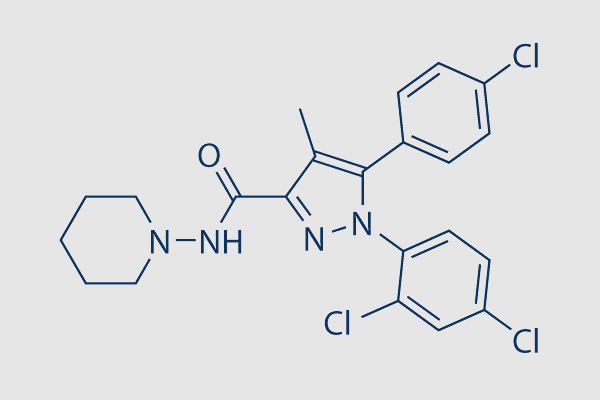
Please click "REQUEST A QUOTE" button if you need other sizes or custom synthesis
request a quote
If there is no stock, or you need other sizes or custom synthesis, please:
PRODUCTS SPECIFICATIONS [168273-06-1]
Store

Catalog
SLK-S3021
Brand
Selleck
CAS
168273-06-1
DESCRIPTION [168273-06-1]
Overview
| MDL | - |
|---|---|
| Molecular Weight | 463.79 |
| Molecular Formula | C22H21Cl3N4O |
| SMILES | CC1=C(N(N=C1C(NN2CCCCC2)=O)C3=C(Cl)C=C(Cl)C=C3)C4=CC=C(Cl)C=C4 |
For research use only.
Storage
3 years,-20°C,powder
1 years,-80°C,in solvent
1 years,-80°C,in solvent
Shipping
Room temperature shipping(Stability testing shows this product can be shipped without any cooling measures.)
Preparing Stock Solutions
| 1 mg | 5 mg | 10 mg | |
| 1 mM | 2.1561 mL | 10.7807 mL | 21.5615 mL |
| 5 mM | 0.4312 mL | 2.1561 mL | 4.3123 mL |
| 10 mM | 0.2156 mL | 1.0781 mL | 2.1561 mL |
| 50 mM | 0.0431 mL | 0.2156 mL | 0.4312 mL |
Description
Rimonabant (SR141716) is a selective antagonist of with of 13.6 nM and of 17.3 nM in hCB1 transfected HEK 293 membrane. Rimonabant is also a dual inhibitor of and inhibits mycobacterial MmpL3.
Features
Efficacious to induce weight reduction and improvements in cardiometabolic risk factors, however was withdrawn in 2009 due to severe depressive disorder and anxiety.
In vitro
Rimonabant dose-dependently reduces ACAT activity in Raw264.7macrophages with IC50 of 2.9 μM and isolated peritoneal macrophages. Rimonabant inhibits ACATactivity in intact CHO-ACAT1 and CHO-ACAT2 cells and in cell-free assays with approximately equal efficiency with IC50 of 1.5 μM and 2.2 μM for CHO-ACAT1 and CHO-ACAT2, respectively. Consistent with ACAT inhibition, Rimonabant treatment blocks ACAT dependent processes in macrophages, oxysterol-induced apoptosis and acetylated-LDL induced foam cell formation. Rimonabant antagonizes the inhibitory effects of cannabinoid receptor agonists on both mouse vas deferens contractions and adenylyl cyclase activity in rat brain membranes in a concentration-dependent manner. Rimonabant significantly reduces cell growth and induces cell death of human colorectal cancer cells (DLD-1, CaCo-2 and SW620). Rimonabant is able to alter cell cycle distribution in all the cell lines tested. Particularly, Rimonabant produces a G2/M cell cycle arrest in DLD-1 cells without inducing apoptosis or necrosis.
References
[1] Chu CM, et al, Org Biomol Chem, 2008, 6(18), 3399-3407
[2] Netherland C, et al, Biochem Biophys Res Commun, 2010, 398(4), 671-676.
[3] Rinaldi-Carmona M, et al, FEBS Lett, 1994, 350(2-3), 240-244.
[4] Santoro A, et al, Int J Cancer, 2009, 125(5), 996-1003.
[5] Schafer A, et al, Br J Pharmacol, 2008, 154(5), 1047-1054.
[6] Wise LE, et al, Neuropsychopharmacology, 2007, 32(8), 1805-1812.
[7] Bing Zhang, et al. Cell . 2019 Jan 24;176(3):636-648.e13.
[2] Netherland C, et al, Biochem Biophys Res Commun, 2010, 398(4), 671-676.
[3] Rinaldi-Carmona M, et al, FEBS Lett, 1994, 350(2-3), 240-244.
[4] Santoro A, et al, Int J Cancer, 2009, 125(5), 996-1003.
[5] Schafer A, et al, Br J Pharmacol, 2008, 154(5), 1047-1054.
[6] Wise LE, et al, Neuropsychopharmacology, 2007, 32(8), 1805-1812.
[7] Bing Zhang, et al. Cell . 2019 Jan 24;176(3):636-648.e13.
Synonyms
1H-Pyrazole-3-carboxamide, 5-(4-chlorophenyl)-1-(2,4-dichlorophenyl)-4-methyl-N-1-piperidinyl-
5-(4-Chlorophenyl)-1-(2,4-dichlorophenyl)-4-methyl-N-1-piperidinyl-1H-pyrazole-3-carboxamide
SR 141716
Rimonabant
Acomplia
A 281
N-Piperidino-5-(4-chlorophenyl)-1-(2,4-dichlorophenyl)-4-methylpyrazole-3-carboxamide
1-(2,4-Dichlorophenyl)-5-(4-chlorophenyl)-4-methyl-N-(piperidin-1-yl)-1H-pyrazole-3-carboxamide
5-(4-Chlorophenyl)-1-(2,4-dichlorophenyl)-4-methyl-1H-pyrazole-3-carboxylic acid N-(piperidin-1-yl)amide
5-(4-Chlorophenyl)-1-(2,4-dichlorophenyl)-4-methyl-N-(piperidin-1-yl)-1H-pyrazole-3-carboxamide
SR 141617
Zimulti
ENP 9

Powered by Arctom Copyright © 2026 Arctom. All rights
reserved.