
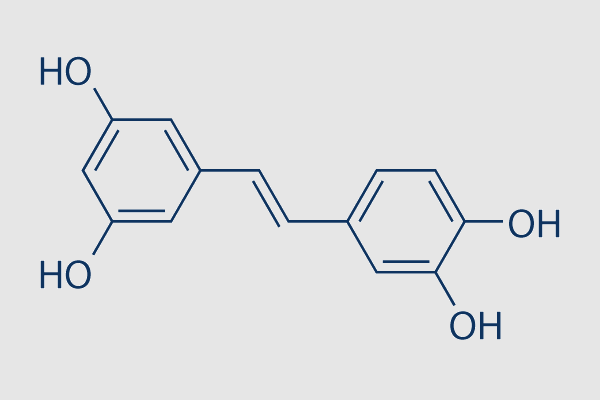
[CAS NO. 10083-24-6] Piceatannol
Please click "REQUEST A QUOTE" button if you need other sizes or custom synthesis
request a quote
If there is no stock, or you need other sizes or custom synthesis, please:
PRODUCTS SPECIFICATIONS [10083-24-6]
Store

Catalog
SLK-S3026
Brand
Selleck
CAS
10083-24-6
DESCRIPTION [10083-24-6]
Overview
| MDL | MFCD00221715 |
|---|---|
| Molecular Weight | 244.24 |
| Molecular Formula | C14H12O4 |
| SMILES | C(=C/C1=CC(O)=CC(O)=C1)\C2=CC(O)=C(O)C=C2 |
For research use only.
Storage
3 years,-20°C,powder
1 years,-80°C,in solvent
1 years,-80°C,in solvent
Shipping
Room temperature shipping(Stability testing shows this product can be shipped without any cooling measures.)
Description
Piceatannol, a natural stilbene, is a selective inhibitor and ~10-fold selectivity versus Lyn.
Targets
In vitro
Piceatannol displays ~10-fold selectivity for Syk over Lyn. Piceatannol treatment in RBL-2H3 cells strongly inhibits the antigen-stimulated phosphorylation of Syk and of most other cellular proteins but not the receptor β or γ subunit, in a dose-dependent manner. Piceatannol is also a potent inhibitor of histamine release in mast cells. Selective inhibition of Syk by Piceatannol blocks receptor-mediated down-stream cellular responses in mast cells including prevention of 1,4,5-IP synthesis, secretion and membrane ruffling and spreading. Piceatannol also potently inhibits PKA, PKC, MLCK, and CDPK with IC50 of 3 μM, 8 μM, 12 μM, and 19 μM, respectively. Piceatannol selectively prevents the IFNα-induced tyrosine phosphorylation of STAT3 and -5 but not STAT1 and -2, paralleled by the loss of Jak1 and IFNAR1 tyrosine phosphorylation but not Tyk2 and IFNAR2. Piceatannol potently induces apoptotic cell death in BJAB Burkitt-like lymphoma cells with ED50 of 25 μM, through the activation of caspase-3 and mitochondrial permeability transition independent of the CD95/Fas signaling pathway. Piceatannol inhibits NF-κB activation induced by TNF, HO, PMA, LPS, okadaic acid, and ceramide. Piceatannol suppresses the expression of TNF-induced NF-κB-dependent reporter gene and of matrix metalloprotease-9, cyclooxygenase-2, and cyclin D1 independent of Syk kinase, by blocking TNF-induced IκBα phosphorylation, p65 phosphorylation, p65 nuclear translocation, and IκBα kinase activation. Piceatannol directly binds with PI3K in an ATP-competitive manner, and suppresses PI3K activity with anti-atherosclerotic effects more effectively than resveratrol. Piceatannol inhibits androgen-dependent (AD) and androgen-independent (AI) CaP cell proliferation, which is accompanied by reduced expression of mTOR and its key effectors AKT and eIF4EBP-1.
In vivo
Oral administration of Piceatannol induces a remarkable amelioration of the disruption of the colonic architecture, a significant reduction in colonic myeloperoxidase (MPO) activity, and a decrease in production of inflammatory mediators such as nitric oxide (NO), prostaglandin (PG) E2, and pro-inflammatory cytokines in BALB/c mice with dextran sulfate sodium (DSS)-induced colitis. Piceatannol treatment inhibits the rises in blood glucose levels at early stages and improves the impaired glucose tolerance at late stages in type 2 diabetic model db/db mice.
References
[1] Oliver JM, et al. J Biol Chem, 1994, 269(47), 29697-29703.
[2] Wang BH, et al. Planta Med, 1998, 64(3), 195-199.
[3] Su L, et al. J Biol Chem, 2000, 275(17), 12661-12666.
[4] Wieder T, et al. Leukemia, 2001, 15(11), 1735-1742.
[5] Ashikawa K, et al. J Immunol, 2002, 169(11), 6490-6497.
[6] Fernandez LA, et al. Transplantation, 2002, 74(11), 1609-1617.
[7] Kim YH, et al. Int Immunopharmacol, 2008, 8(12), 1695-1702.
[8] Choi KH, et al. Cardiovasc Res, 2010, 85(4), 836-844.
[9] Minakawa M, et al. Biochem Biophys Res Commun, 2012, 422(3), 469-475.
[10] Hsieh TC, et al. ISRN Urol, 2012, 272697.
[2] Wang BH, et al. Planta Med, 1998, 64(3), 195-199.
[3] Su L, et al. J Biol Chem, 2000, 275(17), 12661-12666.
[4] Wieder T, et al. Leukemia, 2001, 15(11), 1735-1742.
[5] Ashikawa K, et al. J Immunol, 2002, 169(11), 6490-6497.
[6] Fernandez LA, et al. Transplantation, 2002, 74(11), 1609-1617.
[7] Kim YH, et al. Int Immunopharmacol, 2008, 8(12), 1695-1702.
[8] Choi KH, et al. Cardiovasc Res, 2010, 85(4), 836-844.
[9] Minakawa M, et al. Biochem Biophys Res Commun, 2012, 422(3), 469-475.
[10] Hsieh TC, et al. ISRN Urol, 2012, 272697.
Synonyms
1,2-Benzenediol, 4-[(1E)-2-(3,5-dihydroxyphenyl)ethenyl]-
3,3′,4,5′-Stilbenetetrol, (E)-
Piceatannol
1,2-Benzenediol, 4-[2-(3,5-dihydroxyphenyl)ethenyl]-, (E)-
4-[(1E)-2-(3,5-Dihydroxyphenyl)ethenyl]-1,2-benzenediol
Astringenin
trans-3,3′,4,5′-Tetrahydroxystilbene
(E)-Piceatannol
trans-Piceatannol

Powered by Arctom Copyright © 2026 Arctom. All rights
reserved.