
[CAS NO. 73-03-0] Cordycepin
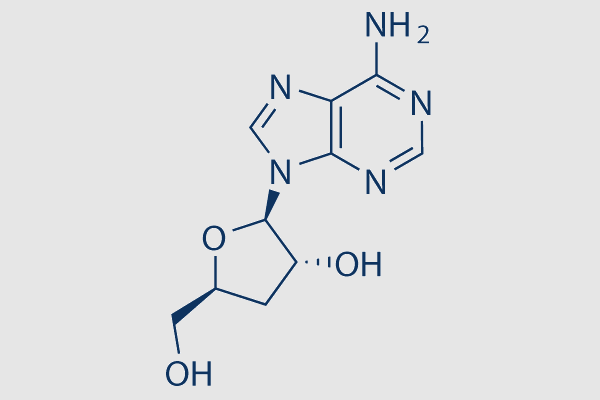
Please click "REQUEST A QUOTE" button if you need other sizes or custom synthesis
request a quote
If there is no stock, or you need other sizes or custom synthesis, please:
PRODUCTS SPECIFICATIONS [73-03-0]
Store

Catalog
SLK-S3610
Brand
Selleck
CAS
73-03-0
DESCRIPTION [73-03-0]
Overview
| MDL | MFCD00037998 |
|---|---|
| Molecular Weight | 251.24 |
| Molecular Formula | C10H13N5O3 |
| SMILES | O[C@H]1[C@](N2C=3C(N=C2)=C(N)N=CN3)(O[C@H](CO)C1)[H] |
For research use only.
Storage
3 years,-20°C,powder
1 years,-80°C,in solvent
1 years,-80°C,in solvent
Shipping
Room temperature shipping(Stability testing shows this product can be shipped without any cooling measures.)
Preparing Stock Solutions
| 1 mg | 5 mg | 10 mg | |
| 1 mM | 3.9803 mL | 19.9013 mL | 39.8026 mL |
| 5 mM | 0.7961 mL | 3.9803 mL | 7.9605 mL |
| 10 mM | 0.3980 mL | 1.9901 mL | 3.9803 mL |
| 50 mM | 0.0796 mL | 0.3980 mL | 0.7961 mL |
Description
Cordycepin (3'-Deoxyadenosine) is an adenosine analogue, which is readily phosphorylated to its mono-, di-, and triphosphate intracellularly. It has a very potent anti-cancer, anti-oxidant and anti-inflammatory activities.
In vitro
Cordycepin increases interleukin (IL)-10 expression, decreased IL-2 expression and suppresses T lymphocyte activity. It also up-regulates IL-1beta, IL-6, IL-8 and TNF-alpha and suppresses phytohemagglutinin (PHA)-induced production of IL-2, IL-4, IL-5, IFN-gamma and IL-12. The structure of Cordycepin is very much similar with cellular nucleoside, adenosine and acts like a nucleoside analogue. Cordycepin lacks 3' hydroxyl group in its structure. It provokes RNA chain termination and interferes in mTOR signal transduction. At higher doses, Cordycepin inhibits cell attachment and reduces focal adhesion. under low nutritional stress, Cordycepin activates AMPK which blocks the activity of mTORC1 and mTORC2 complex. The inactivated mTORC2 complex cannot activate AKT 1 kinase fully, which in turn blocks mTOR signal transduction inhibiting translation and further cell proliferation and growth. Cordycepin also induces apoptosis by enhancing JNK and p38 kinase activity and increasing the protein expression of Bcl-2 pro-apoptotic molecules. Cordycepin has anti-tumor effect on mouse melanoma and lung carcinoma cells and human oral cancer cells.
In vivo
Orally administered cordycepin inhibits melanoma cell growth in mice with no adverse effects. Oral cordycepin administration at dose of 10 mg/kg significantly improves Y-maze learning performance both in healthy and ischemic mice. However, cordycepin at dose of 5 mg/kg enhanced Y-maze learning only in ischemic mice but not healthy mice. Cordycepin significantly decreases the neuronal loss induced by ischemia in hippocampal CA1 and CA3 regions.
References
[1] Zhou X, et al. Am J Chin Med. 2008, 36(5):967-80.
[2] Hardeep S. Tuli, et al. 3 Biotech. 2014 Feb, 4(1): 1–12.
[3] Jen CY, et al. Evid Based Complement Alternat Med. 2011, 2011:984537.
[4] Yoshikawa N, et al. Clin Exp Pharmacol Physiol. 2004, 31 Suppl 2:S51-3.
[5] Cai ZL, et al. Eur J Pharmacol. 2013, 714(1-3):249-53.
[2] Hardeep S. Tuli, et al. 3 Biotech. 2014 Feb, 4(1): 1–12.
[3] Jen CY, et al. Evid Based Complement Alternat Med. 2011, 2011:984537.
[4] Yoshikawa N, et al. Clin Exp Pharmacol Physiol. 2004, 31 Suppl 2:S51-3.
[5] Cai ZL, et al. Eur J Pharmacol. 2013, 714(1-3):249-53.
Synonyms
Adenosine, 3′-deoxy-
Cordycepin
3′-Deoxyadenosine
9-Cordyceposidoadenine
9H-Purin-6-amine, 9-(3-deoxy-β-D-erythro-pentofuranosyl)-
β-D-erythro-Pentofuranoside, adenine-9 3-deoxy-
Cordycepine
9-(3-Deoxy-β-D-ribofuranosyl)adenine
NSC 63984
NSC 401022
NQZ-001

Powered by Arctom Copyright © 2026 Arctom. All rights
reserved.