
[CAS NO. 20283-92-5] Rosmarinic acid
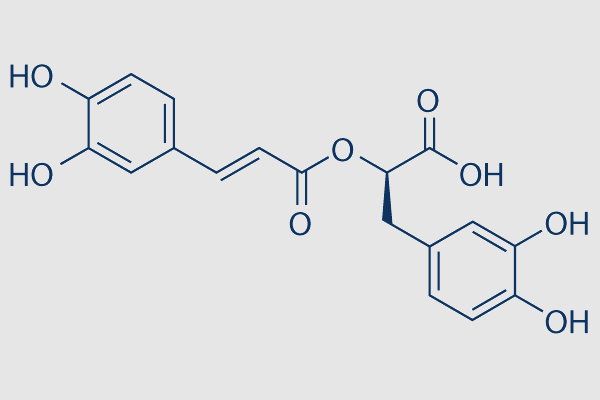
Please click "REQUEST A QUOTE" button if you need other sizes or custom synthesis
request a quote
If there is no stock, or you need other sizes or custom synthesis, please:
PRODUCTS SPECIFICATIONS [20283-92-5]
Store

Catalog
SLK-S3612
Brand
Selleck
CAS
20283-92-5
DESCRIPTION [20283-92-5]
Overview
| MDL | MFCD00017740 |
|---|---|
| Molecular Weight | 360.31 |
| Molecular Formula | C18H16O8 |
| SMILES | C([C@@H](OC(/C=C/C1=CC(O)=C(O)C=C1)=O)C(O)=O)C2=CC(O)=C(O)C=C2 |
For research use only.
Storage
3 years,-20°C,powder
1 years,-80°C,in solvent
1 years,-80°C,in solvent
Shipping
Room temperature shipping(Stability testing shows this product can be shipped without any cooling measures.)
Description
Rosmarinic acid (RA, Rosemary acid) is a naturally occurring hydroxylated compound. It has the ability to block complement fixation, inhibit lipoxygenase and cyclooxygenase activity and inhibit the expression of CCL11 and CCR3 by suppressing the activity in NF-κB activation signaling.
Targets
| IKK β [2] (cell-based assay) |
| 12 μM |
In vitro
RA exerts a significant cytoprotective effect by scavenging intracellular ROS induced by UVB. RA also attenuates UVB-induced oxidative macromolecular damage, including protein carbonyl content, DNA strand breaks, and the level of 8-isoprostane. Furthermore, RA increases the expression and activity of superoxide dismutase, catalase, heme oxygenase-1, and their transcription factor Nrf2, which are decreased by UVB radiation. RA treatment recovers the protein expression levels of Nrf2 decreased by UVB exposure, and results in the translocation of Nrf2 protein from the cytosol into the nucleus. RA may protect cellular environments from free-radical damage and thereby, enhance the cellular antioxidant defense system. Rosmarinic acid inhibits TNF-α-induced phosphorylation and degradation of IκB-α, as well as nuclear translocation of NF-κB heterodimer induced by TNF-α. It downregulates the expression of CCL11 and CCR3 via the inhibition of NF-κB activation signaling. Rosmarinic acid inhibits the Ca2+-dependent pathways of TCR-mediated signaling by inhibiting PLC-γ1 and Itk activities.
In vivo
RA improves histological and serum markers of liver damage and significantly ameliorates oxidative/nitrosative stress and inflammatory response in liver tissue. Additionally, RA prevents transforming growth factor-beta1 (TGF-b1) and alpha-smooth muscle actin (a-SMA) expression, suggesting suppression of profibrotic response. RA significantly inhibits the CCl4-induced apoptosis, which is evident from decreased cleavage of caspase-3. The hepatoprotective activity of RA coincides with enhanced NF-E2-related factor 2 (Nrf2) and hemeoxygenase-1 (HO-1) expression. Rosmarinic acid acts as a natural inducer of endogenous cellular antioxidant defense via activation of the Nrf2/HO-1 pathway.
References
Synonyms
Benzenepropanoic acid, α-[[(2E)-3-(3,4-dihydroxyphenyl)-1-oxo-2-propen-1-yl]oxy]-3,4-dihydroxy-, (αR)-
Cinnamic acid, 3,4-dihydroxy-, 2-ester with 3-(3,4-dihydroxyphenyl)lactic acid
Benzenepropanoic acid, α-[[3-(3,4-dihydroxyphenyl)-1-oxo-2-propenyl]oxy]-3,4-dihydroxy-, [R-(E)]-
Rosmarinic acid
Benzenepropanoic acid, α-[[(2E)-3-(3,4-dihydroxyphenyl)-1-oxo-2-propenyl]oxy]-3,4-dihydroxy-, (αR)-
(αR)-α-[[(2E)-3-(3,4-Dihydroxyphenyl)-1-oxo-2-propen-1-yl]oxy]-3,4-dihydroxybenzenepropanoic acid
Rosemary acid
Rosemaric acid
RM 21A
Mamorekku RUH 2
Meiji Red Perilla Polyphenol
trans-Rosmarinic acid
Labiatenic acid
Labiatic acid
NPLC 0542
SYL 001

Powered by Arctom Copyright © 2026 Arctom. All rights
reserved.