
[CAS NO. 500-38-9] Nordihydroguaiaretic acid (NDGA)
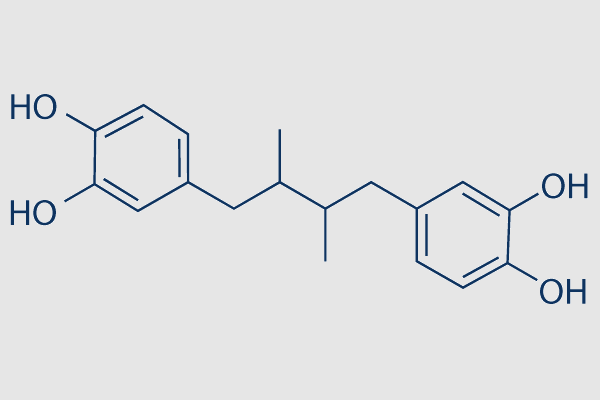
Please click "REQUEST A QUOTE" button if you need other sizes or custom synthesis
request a quote
If there is no stock, or you need other sizes or custom synthesis, please:
PRODUCTS SPECIFICATIONS [500-38-9]
Store

Catalog
SLK-S3984
Brand
Selleck
CAS
500-38-9
DESCRIPTION [500-38-9]
Overview
| MDL | MFCD00002206 |
|---|---|
| Molecular Weight | 302.36 |
| Molecular Formula | C18H22O4 |
| SMILES | C(C(C(CC1=CC(O)=C(O)C=C1)C)C)C2=CC(O)=C(O)C=C2 |
For research use only.
Storage
3 years,-20°C,powder
1 years,-80°C,in solvent
1 years,-80°C,in solvent
Shipping
Room temperature shipping(Stability testing shows this product can be shipped without any cooling measures.)
Preparing Stock Solutions
| 1 mg | 5 mg | 10 mg | |
| 1 mM | 3.3073 mL | 16.5366 mL | 33.0732 mL |
| 5 mM | 0.6615 mL | 3.3073 mL | 6.6146 mL |
| 10 mM | 0.3307 mL | 1.6537 mL | 3.3073 mL |
| 50 mM | 0.0661 mL | 0.3307 mL | 0.6615 mL |
Description
Nordihydroguaiaretic acid (NDGA) is a phenolic antioxidant found in the leaves and twigs of the evergreen desert shrub, Larrea tridentata (Sesse and Moc. ex DC) Coville (creosote bush). It is a recognized inhibitor of and has antioxidant and free radical scavenging properties. Nordihydroguaiaretic acid (NDGA) is a cytotoxic inhibitor and induces .
In vitro
NDGA has been proven to selectively inhibit arachidonic acid 5-lipoxygenase activity, which reduces leukotriene and prostaglandin synthesis, thus leading to a reduction of inflammatory pathways. NDGA also has profound effects on the secretory pathway, reflected in its ability to block production of leukotriene B4, degranulation, phagocytosis, and the respiratory burst by exerting effects on the mitochondria and nonspecifically inhibiting NADPH oxidase and protein kinase C. NDGA has also been shown to block protein transport from the endoplasmic reticulum (ER) to the Golgi complex, induce the redistribution of Golgi proteins into the ER and affect levels of intracellular calcium. Furthermore, NDGA has been shown to disrupt the actincytoskeleton and exert effects on cell adhesion and also to directly inhibit activationof two receptor tyrosine kinases (RTKs), the Insulin-like growth factor-1 receptor and the c-erbB2/HER2/neu receptor, that results in decreased cellular proliferation. NDGA selectively inhibits platelet-derived growth factor (PDGF)-stimulated DNA synthesis in Swiss 3T3 cells, diploid murine cells and rat and human fibroblasts. NDGA is a bioactive natural product which is able to crosslink collagen. NDGA cross-linking may provide a viable approach to stabilizing collagenous materials for use in repair of ruptured, lacerated or surgically transected tendons, as well as other biomaterial constructs for surgical repair of musculoskeletal injuries and disease.
References
[1] Lü JM, et al. Med Sci Monit. 2010, 16(5):RA93-100.
[2] Ansar S, et al. Carcinogenesis. 1999, 20(4):599-606.
[3] Huang JK, et al. Life Sci. 2004, 75(19):2341-51.
[4] Danica L. Rowe, et al. Mol Cancer Ther . 2008 Jul;7(7):1900-8.
[5] Tugsan Tezil, et al. NPJ Aging Mech Dis . 2019 Oct 2;5:7.
[6] Tian-Xiang Wang, et al. Cell Death Dis . 2019 Oct 7;10(10):755.
[2] Ansar S, et al. Carcinogenesis. 1999, 20(4):599-606.
[3] Huang JK, et al. Life Sci. 2004, 75(19):2341-51.
[4] Danica L. Rowe, et al. Mol Cancer Ther . 2008 Jul;7(7):1900-8.
[5] Tugsan Tezil, et al. NPJ Aging Mech Dis . 2019 Oct 2;5:7.
[6] Tian-Xiang Wang, et al. Cell Death Dis . 2019 Oct 7;10(10):755.
Synonyms
1,2-Benzenediol, 4,4′-(2,3-dimethyl-1,4-butanediyl)bis-
Pyrocatechol, 4,4′-(2,3-dimethyltetramethylene)di-
4,4′-(2,3-Dimethyl-1,4-butanediyl)bis[1,2-benzenediol]
Butane, 1,4-bis(3,4-dihydroxyphenyl)-2,3-dimethyl-
Dihydronorguaiaretic acid
β,γ-Dimethyl-α,δ-bis(3,4-dihydroxyphenyl)butane
4,4′-(2,3-Dimethyltetramethylene)dipyrocatechol
Dinorguaiaretic acid, dihydro-
NDGA
Nordihydroguaiaretic acid
Norguaiaretic acid, dihydro-
4,4′-(2,3-Dimethyl-1,4-butanediyl)bis(pyrocatechol)
1,4-Bis(3,4-dihydroxyphenyl)-2,3-dimethylbutane
NSC 4291
4-[4-(3,4-Dihydroxyphenyl)-2,3-dimethylbutyl]benzene-1,2-diol

Powered by Arctom Copyright © 2026 Arctom. All rights
reserved.