
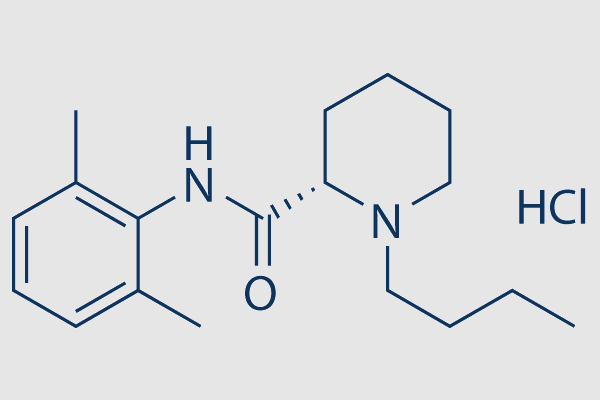
[CAS NO. 27262-48-2] Levobupivacaine HCl
Please click "REQUEST A QUOTE" button if you need other sizes or custom synthesis
request a quote
If there is no stock, or you need other sizes or custom synthesis, please:
PRODUCTS SPECIFICATIONS [27262-48-2]
Store

Catalog
SLK-S4061
Brand
Selleck
CAS
27262-48-2
DESCRIPTION [27262-48-2]
Overview
| MDL | - |
|---|---|
| Molecular Weight | 324.89 |
| Molecular Formula | C18H28N2O.HCl |
| SMILES | C(NC1=C(C)C=CC=C1C)(=O)[C@H]2N(CCCC)CCCC2.Cl |
For research use only.
Storage
3 years,-20°C,powder
1 years,-80°C,in solvent
1 years,-80°C,in solvent
Shipping
Room temperature shipping(Stability testing shows this product can be shipped without any cooling measures.)
Preparing Stock Solutions
| 1 mg | 5 mg | 10 mg | |
| 1 mM | 3.0780 mL | 15.3898 mL | 30.7796 mL |
| 5 mM | 0.6156 mL | 3.0780 mL | 6.1559 mL |
| 10 mM | 0.3078 mL | 1.5390 mL | 3.0780 mL |
| 50 mM | 0.0616 mL | 0.3078 mL | 0.6156 mL |
Description
Levobupivacaine HCl ((S)-(-)-Bupivacaine), the pure S(-)-enantiomer of bupivacaine, is a reversible neuronal inhibitor, used as a long-acting local anesthetic.
Targets
| Sodium Channel [1] |
In vitro
Levobupivacaine is an amide-type local anaesthetic. Levobupivacaine acts via blockade of voltage-sensitive ion channels in neuronal membranes, preventing transmission of nerve impulses. Localised and reversible anaesthesia is produced by interference with the opening of the sodium channel, which inhibits conduction of the action potential in nerves involved in sensory and motor activity and sympathetic activity.
Levobupivacaine displaces H-BTX from sodium channels of rat brain synaptosomes with IC50 of 2.9 μM and Hill coefficients of 1.2. When cell membrane is held at -80 mV, -70 mV, -60 mV or -100 mV, Levobupivacaine shows tonic inhibition of sodium channel in GH3 cells with IC50s of 132.1, 37.6, 21.6 and 264 μM, respectively.
Levobupivacaine depresses action potential of isolated axon in vitro. Levobupivacaine (1mM) depresses action potential amplitude and maximal rate of rise of action potential (dV/dt) in the crayfish giant axons with value of 88 and 81 respectively, after perfusion for 15 min.
Levobupivacaine also displays activity on cardiac ion channels. In isolated ventricular myocytes, the apparent affinity for inactivated state of the sodium channel is 4.8 μM for Levobupivacaine, with a calculated KD of 39μM. On inhibition of cardiac delayed rectifier potassium channels (hKv1.5), the steady-state block for Levobupivacaine (20 μM) is 31%, with a calculated KD of 27.3 μM. Levobupivacaine may also inhibit cardiac calcium channels. 10 μM Levobupivacaine produces a 50% decrease in contractile force of guinea-pig papillary muscles.
In vivo
Levobupivacaine has similar nerve blocking potency with bupivacaine. Levobupivacaine at a dose of 0.125%, inhibits motor and nocifensive pinch responses with maximum %MPE of 99 and 68 respectively, and inhibits the duration of deficits of motor and nocifensive pinch responses (60 and 30 , respectively) after sciatic nerve block.
References
Synonyms
2-Piperidinecarboxamide, 1-butyl-N-(2,6-dimethylphenyl)-, hydrochloride (1:1), (2S)-
2′,6′-Pipecoloxylidide, 1-butyl-, monohydrochloride, (-)-
2-Piperidinecarboxamide, 1-butyl-N-(2,6-dimethylphenyl)-, monohydrochloride, (S)-
2-Piperidinecarboxamide, 1-butyl-N-(2,6-dimethylphenyl)-, monohydrochloride, (2S)-
(-)-Bupivacaine monohydrochloride
(S)-(-)-Bupivacaine monohydrochloride
Chirocaine
Levobupivacaine hydrochloride
Popscaine

Powered by Arctom Copyright © 2026 Arctom. All rights
reserved.