
[CAS NO. 94-20-2] Chlorpropamide
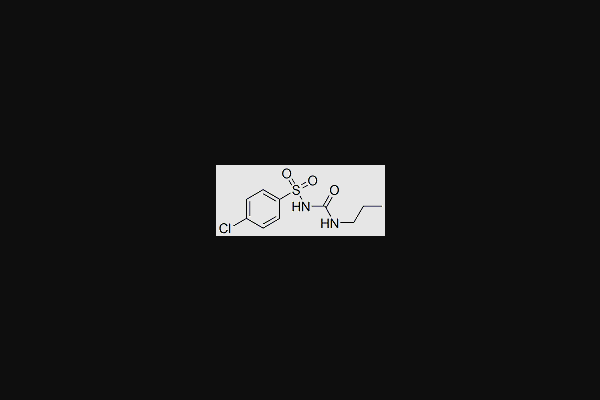
Please click "REQUEST A QUOTE" button if you need other sizes or custom synthesis
request a quote
If there is no stock, or you need other sizes or custom synthesis, please:
PRODUCTS SPECIFICATIONS [94-20-2]
Store

Catalog
SLK-S4166
Brand
Selleck
CAS
94-20-2
DESCRIPTION [94-20-2]
Overview
| MDL | MFCD00079004 |
|---|---|
| Molecular Weight | 276.74 |
| Molecular Formula | C10H13ClN2O3S |
| SMILES | S(NC(NCCC)=O)(=O)(=O)C1=CC=C(Cl)C=C1 |
For research use only.
Storage
3 years,-20°C,powder
1 years,-80°C,in solvent
1 years,-80°C,in solvent
Shipping
Room temperature shipping(Stability testing shows this product can be shipped without any cooling measures.)
Preparing Stock Solutions
| 1 mg | 5 mg | 10 mg | |
| 1 mM | 3.6135 mL | 18.0675 mL | 36.1350 mL |
| 5 mM | 0.7227 mL | 3.6135 mL | 7.2270 mL |
| 10 mM | 0.3614 mL | 1.8068 mL | 3.6135 mL |
| 50 mM | 0.0723 mL | 0.3614 mL | 0.7227 mL |
Description
Chlorpropamide inhibits and stimulates a high affinity cyclic AMP-phosphodiesterase of isolated liver plasma membrane. Chlorpropamide is a sulfonylurea class drug for type 2 diabetes mellitus.
Targets
| Na(+),K(+)-ATPase [4] |
In vitro
Chlorpropamide acts through a cyclic AMP-independent mechanism. The addition of 0.2 mM Chlorpropamide to hepatocytes isolated from fed rats, raises the cellular concentration of fructose-2,6-bisphosphate (F-2, 6-P). The accumulation of F-2, 6-P caused by Chlorpropamide (1 mM) is parallel to the stimulation of L-lactate production (36.6 versus 26.1 μmol of lactate/g of cells) and to the inhibition of gluconeogenesis (0.57 versus 0.94 μmol of [U-C]pyruvate converted to glucose/g of cells). Chlorpropamide enhances the inhibitory action evoked by insulin on glucagon-stimulated gluconeogenesis. Chlorpropamide treatment has no effect on insulin binding, altering neither receptor number nor affinity in rat adipocytes. Chlorpropamide (175 μg/mL) enhances 2-deoxyglucose transport in both the absence (17%) and presence (20%) of insulin. Chlorpropamide significantly increases glucose metabolism and total lipids in both the absence (30%) and presence (31%) of insulin. Chlorpropamide competitively inhibits antidiuretic hormone (ADH) binding and adenylyl cyclase (AC) stimulation with K of 2.8 mM and 250 μM, respectively, in the LLC-PK1 cell line. Chlorpropamide (333 μM) increases the apparent K of ADH for AC activation (0.31 vs. 0.08 nM) without affecting a maximal response. Twenty-four-hour Chlorpropamide exposure (100 μM) upregulates the ADH receptors without affecting affinity, which lowers K and increases basal AC activity and maximal response (1.86 vs. 1.35 and 14.9 vs. 10.6 fmol cAMP/min/1000 cells).
References
Synonyms
Benzenesulfonamide, 4-chloro-N-[(propylamino)carbonyl]-
Urea, 1-[(p-chlorophenyl)sulfonyl]-3-propyl-
4-Chloro-N-[(propylamino)carbonyl]benzenesulfonamide
P 607
Catanil
N-(p-Chlorobenzenesulfonyl)-N′-propylurea
1-(p-Chlorobenzenesulfonyl)-3-propylurea
1-(p-Chlorophenylsulfonyl)-3-propylurea
Chloropropamide
Chlorpropamide
Diabenese
Diabinese
N-Propyl-N′-(p-chlorobenzenesulfonyl)urea
1-Propyl-3-(p-chlorobenzenesulfonyl)urea
N-Propyl-N′-p-chlorphenylsulfonylcarbamide
N-(4-Chlorophenylsulfonyl)-N′-propylurea
Chlorpropamid
Diabeneza
Diabaril
U 9818
Glisema
Chloronase
Meldian
Chlorodiabina
Diabetoral
Diabet-Pages
Diabenal
Melitase
Adiaben
Diabechlor
Millinese
Asucrol
Stabinol
NSC 44634
NSC 626720
Pamidin
1-(4-Chlorophenyl)sulfonyl-3-propyl-urea
1-(4-Chlorophenyl)sulfonyl-3-propylurea
1-(4-Chloro-benzenesulfonyl)-3-n-propyl-urea
4-Chloro-N-(propylcarbamoyl)benzenesulfonamide

Powered by Arctom Copyright © 2026 Arctom. All rights
reserved.