
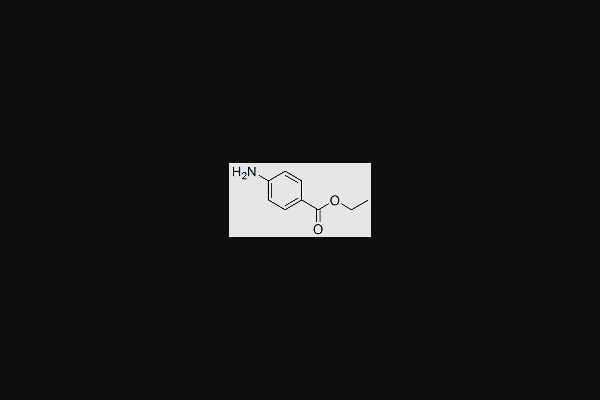
[CAS NO. 94-09-7] Benzocaine
Please click "REQUEST A QUOTE" button if you need other sizes or custom synthesis
request a quote
If there is no stock, or you need other sizes or custom synthesis, please:
PRODUCTS SPECIFICATIONS [94-09-7]
Store

Catalog
SLK-S4210
Brand
Selleck
CAS
94-09-7
DESCRIPTION [94-09-7]
Overview
| MDL | MFCD00007892 |
|---|---|
| Molecular Weight | 165.19 |
| Molecular Formula | C9H11NO2 |
| SMILES | C(OCC)(=O)C1=CC=C(N)C=C1 |
For research use only.
Storage
3 years,-20°C,powder
1 years,-80°C,in solvent
1 years,-80°C,in solvent
Shipping
Room temperature shipping(Stability testing shows this product can be shipped without any cooling measures.)
Preparing Stock Solutions
| 1 mg | 5 mg | 10 mg | |
| 1 mM | 6.0536 mL | 30.2682 mL | 60.5364 mL |
| 5 mM | 1.2107 mL | 6.0536 mL | 12.1073 mL |
| 10 mM | 0.6054 mL | 3.0268 mL | 6.0536 mL |
| 50 mM | 0.1211 mL | 0.6054 mL | 1.2107 mL |
Description
Benzocaine(ethyl 4-aminobenzoate) is the ethyl ester of p-aminobenzoic acid (PABA), it is a local anesthetic commonly used as a topical pain reliever or in cough drops.
Targets
| Sodium channel [1] |
In vitro
Benzocaine blocks µ1 wild-type Na+ currents in a dose-dependent manner with IC50 of 0.8 mM in HEK293T cells. Benzocaine (1 mM) blocks about 55% of wild-type Na+ current but about 95% of µ1-N1584A mutant current. Benzocaine (1 mM) blocks about 55% of wild-type µ1 currents, but about 80% of µ1-I1575A mutant current. Benzocaine results in a biphasic (protective/inductive) concentration-dependent hemolytic effect upon rat erythrocytes, with an effective Benzocaine:lipid molar ratio in the membrane for protection (RePROT), onset of hemolysis (ReSAT) and 100% membrane solubilization (ReSOL) of 1.0:1, 1.1:1 and 1.3:1, respectively. Benzocaine and 4-hydroxybenzoate interact with the open and inactivated channels during repetitive pulses, but during the interpulse the complex dissociates too fast to accumulate sufficient use-dependent block of Na+ currents. Benzocaine (500 μM) reduces the peak and steady-state currents and increases the amplitude of the inactivating component from 21.7% to 30.2% (n=7, P<0.05), so that benzocaine-induced block at the end of pulses to +60 mV averaged 30.9% (n=7). Benzocaine (500 μM) significantly accelerates the initial phase of deactivation (τf=27.2±2.6 ms, n=7, P<0.01), but does not modify the slow phase of tail current decline. Benzocaine binds with high affinity to an intracellular binding site to produce 'agonist' effects and to a low affinity subsite, which is also located in the inner mouth, to produce the blocking effects. Benzocaine and extracellular K(+) interact to modify the voltage-dependence of channel opening.
References
Synonyms
Benzoic acid, 4-amino-, ethyl ester
Benzoic acid, p-amino-, ethyl ester
p-Aminobenzoic acid ethyl ester
Anaesthesin
Anesthesin
Anesthesine
Anesthone
Benzocaine
Ethyl p-aminobenzoate
Ethyl 4-aminobenzoate
Keloform
Norcain
Norcaine
Orthesin
Parathesin
p-Ethoxycarboxylic aniline
Amben ethyl ester
Ethyl p-aminophenylcarboxylate
p-Carbethoxyaniline
4-Aminobenzoic acid ethyl ester
4-Carbethoxyaniline
p-(Ethoxycarbonyl)aniline
Ethyl aminobenzoate
4-(Ethoxycarbonyl)aniline
Anestezin
Parathesine
Identhesin
Anaesthan-syngala
Solu H
Ora-jel
Anaesthin
Ethoform
Ethyl p-aminobenzenecarboxylate
(p-(Ethoxycarbonyl)phenylamine
4-(Ethoxycarbonyl)phenylamine
Slim Mint Gum
Diet Ayds
Americaine
Orabase-B
Baby Anbesol
Aethoform
NSC 41531
NSC 4688
Benzoak
Gingicaine
Anbesol
Et-PABA

Powered by Arctom Copyright © 2026 Arctom. All rights
reserved.