
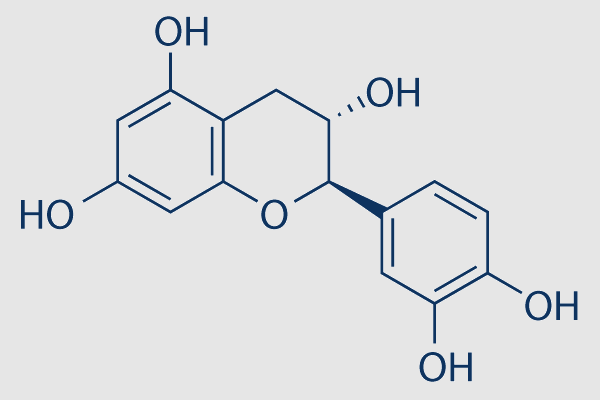
[CAS NO. 154-23-4] (+)-Catechin
Please click "REQUEST A QUOTE" button if you need other sizes or custom synthesis
request a quote
If there is no stock, or you need other sizes or custom synthesis, please:
PRODUCTS SPECIFICATIONS [154-23-4]
Store

Catalog
SLK-S4722
Brand
Selleck
CAS
154-23-4
DESCRIPTION [154-23-4]
Overview
| MDL | MFCD00075649 |
|---|---|
| Molecular Weight | 290.27 |
| Molecular Formula | C15H14O6 |
| SMILES | O[C@@H]1[C@H](OC=2C(C1)=C(O)C=C(O)C2)C3=CC(O)=C(O)C=C3 |
For research use only.
Storage
3 years,-20°C,powder
1 years,-80°C,in solvent
1 years,-80°C,in solvent
Shipping
Room temperature shipping(Stability testing shows this product can be shipped without any cooling measures.)
Preparing Stock Solutions
| 1 mg | 5 mg | 10 mg | |
| 1 mM | 3.4451 mL | 17.2253 mL | 34.4507 mL |
| 5 mM | 0.6890 mL | 3.4451 mL | 6.8901 mL |
| 10 mM | 0.3445 mL | 1.7225 mL | 3.4451 mL |
| 50 mM | 0.0689 mL | 0.3445 mL | 0.6890 mL |
Description
(+)-Catechin (Cianidanol, Catechinic acid, Catechuic acid) is an antioxidant flavonoid, occurring especially in woody plants as both (+)-catechin and (-)-epicatechin (cis) forms.,
In vitro
The catechin flavonoid reduces proliferation and induces apoptosis of murine lymphoma cells LB02 through modulation of antiapoptotic proteins. Treatment of human prostate cancer cells with catechin induces apoptosis and results in effects on a variety of survival signals suggesting the potential of these compounds as chemopreventive agents for prostate cancer. Catechin is well known to inhibit cyclooxygenase activity with reported IC50 values ranging from 4O μM to 943 μM. It has also been reported to act as an inhibitor of COX-1 and COX-2 with IC50 of about 80 µM and 130 μM.
In vivo
Dietary catechin significantly delayed tumor onset. Continued intake of catechin, a potential antioxidant, prevents memory regression and DNA oxidative damage in senescence-accelerated (SAMP10) mice. It does not prolong the lifetime of SAMP10 mice, but it does delay brain senescence. (+)-Catechin inhibits intestinal tumor formation and suppresses Focal adhesion kinase activation in the Min/+ Mouse.
References
[1] Daniela Laura Papademetrio, et al. Rev bras farmacogn. 2013, 23(3):455-463.
[2] Tayyaba Afsar, et al. Scientific Reports 6. 2016, 23077.
[3] Noreen Y, et al. Planta Med. 1998, 64(6):520-4.
[4] Yin P, et al. Cancer Lett. 1994, 79(1):33-8.
[5] Ebeler SE, et al. Am J Clin Nutr. 2002, 76(4):865-72.
[6] Unno K, et al. Biogerontology. 2007, 8(2):89-95.
[7] Michael J, et al. Cancer research. 2001, 61:119-125.
[2] Tayyaba Afsar, et al. Scientific Reports 6. 2016, 23077.
[3] Noreen Y, et al. Planta Med. 1998, 64(6):520-4.
[4] Yin P, et al. Cancer Lett. 1994, 79(1):33-8.
[5] Ebeler SE, et al. Am J Clin Nutr. 2002, 76(4):865-72.
[6] Unno K, et al. Biogerontology. 2007, 8(2):89-95.
[7] Michael J, et al. Cancer research. 2001, 61:119-125.
Synonyms
2H-1-Benzopyran-3,5,7-triol, 2-(3,4-dihydroxyphenyl)-3,4-dihydro-, (2R,3S)-
Catechol
2H-1-Benzopyran-3,5,7-triol, 2-(3,4-dihydroxyphenyl)-3,4-dihydro-, (2R-trans)-
(2R,3S)-2-(3,4-Dihydroxyphenyl)-3,4-dihydro-2H-1-benzopyran-3,5,7-triol
d-Catechin
(+)-Catechol
(+)-Catechin
(+)-(2R:3S)-5,7,3′,4′-Tetrahydroxyflavan-3-ol
Catechin
Catechinic acid
Catechuic acid
Catechol (flavan)
D-Catechol
D-(+)-Catechin
Catechin (flavan)
trans-(+)-3,3′,4′,5,7-Flavanpentol
(+)-3′,4′,5,7-Tetrahydroxy-2,3-trans-flavan-3-ol
3-Cyanidanol, (+)-
Catergen
(+)-Cyanidan-3-ol
(+)-Cyanidanol-3
Cianidanol
Cyanidanol
D-Catechin
(+)-Cianidanol
(+)-Cyanidanol
Biocatechin
Sunkatol No. 1
(2R,3S)-(+)-Catechin
Dexcyanidanol
Cyanidol
NSC 2819
Teafuran 30A
Teafuran 30E
HB-MC-TS 35
P 70A
(+)-(2R,3S)-2-(3,4-Dihydroxyphenyl)-3,4-dihydro-1(2H)-benzopyran-3,5,7-triol
Sunphenon 90
PP-S4-1

Powered by Arctom Copyright © 2026 Arctom. All rights
reserved.