
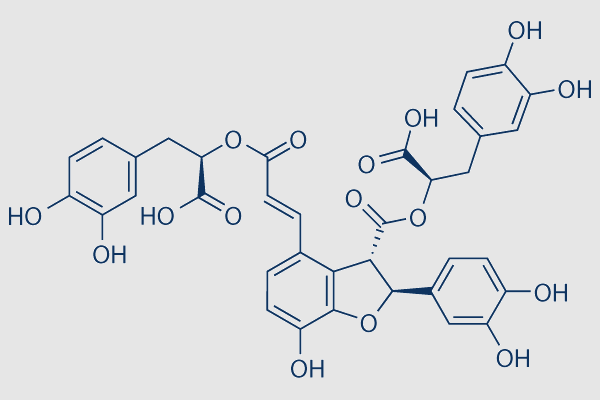
[CAS NO. 121521-90-2] Salvianolic acid B
Please click "REQUEST A QUOTE" button if you need other sizes or custom synthesis
request a quote
If there is no stock, or you need other sizes or custom synthesis, please:
PRODUCTS SPECIFICATIONS [121521-90-2]
Store

Catalog
SLK-S4735
Brand
Selleck
CAS
121521-90-2
DESCRIPTION [121521-90-2]
Overview
| MDL | MFCD07779133 |
|---|---|
| Molecular Weight | 718.61 |
| Molecular Formula | C36H30O16 |
| SMILES | C(O[C@H](CC1=CC(O)=C(O)C=C1)C(O)=O)(=O)[C@H]2C=3C(O[C@@]2(C4=CC(O)=C(O)C=C4)[H])=C(O)C=CC3/C=C/C(O[C@H](CC5=CC(O)=C(O)C=C5)C(O)=O)=O |
For research use only.
Storage
3 years,-20°C,powder
1 years,-80°C,in solvent
1 years,-80°C,in solvent
Shipping
Room temperature shipping(Stability testing shows this product can be shipped without any cooling measures.)
Preparing Stock Solutions
| 1 mg | 5 mg | 10 mg | |
| 1 mM | 1.3916 mL | 6.9579 mL | 13.9158 mL |
| 5 mM | 0.2783 mL | 1.3916 mL | 2.7832 mL |
| 10 mM | 0.1392 mL | 0.6958 mL | 1.3916 mL |
| 50 mM | 0.0278 mL | 0.1392 mL | 0.2783 mL |
Description
Salvianolic acid B (Sal B, Lithospermate B, Lithospermic acid B), an antioxidant and free radical scavenging compound, is the most abundant bioactive compound extracted from the root of Salvia miltiorrhiza Bunge.
Targets
| SIRT [2] |
In vitro
Salvianolic acid B, also known as satanic acid B or lithospermic acid B, is a new generation of the natural antioxidants. It can influence Ca2+ aggregation and endothelial cell NO release of hypoxia/ reoxygenation-induced cell. When acid B concentration is 2.5, 5, and 10 mg/l, cell viability and superoxide dismutase (SOD) activity are enhanced, and the formation of malondialdehyde (MDA) in human umbilical vein endothelial cells (ECV304) is inhibited. SalB inhibits HG-induced oxidative stress and reduces the generation of ROS and 8-hydroxy-2-deoxyguanosine (8-OHDG) and mitochondrial depolarization and apoptosis in a dose-dependent manner. It can downregulate the expression of Bax and AIF nuclear translocation and cytochrome c release mediated by HG, but upregulate the expression of Bcl-2 induced by HG. Besides, SalB attenuates HG-induced caspase of the enzyme 3, 9 and minimize PARP cleavage of Schwann cells (SCs). SalB inhibits angiotensin II or H2O2 and TNF-α-induced gelatinolytic activity in human aortic smooth muscle cells (HASMCs) in a concentration-dependent manner. Salvianolic acid B can inhibit platelet aggregation and adhesion. Salvianolic acid B can promote cardiac angiogenesis effect. SalB can enhance cell activity and reduce the number of sub-G1 and apoptotic nuclei of ischemic cell model in order to show its antiapoptotic effects. Salvianolic acid B inhibits ischemia and hypoxia of myocardial injury. Salvianolic acid B inhibits the synthesis of type I collagen of non-TGF-1 stimulated human hepatic stellate cell line (LX-2). SalB activates mammalian sirtuins 1 (SIRT1), an NAD-dependent class III histone deacetylase (HDAC) that plays important roles in several physiological processes, including gene transcription, senescence, energy metabolism, oxidative stress and inflammation. (HG:High glucose)
In vivo
Salvianolic acid B can significantly reduce the myocardial infarct size and blood lactate dehydrogenase level of model rat with acute myocardial infarction, improve cardiac function and myocardial tissue structure, thus inhibiting ischemia and hypoxia of myocardial injury. salvianolic acid B can improve blood hemorheology, reduce oxidative damage, improve the vascular endothelial cell function, and prevent the development of coronary artery disease. Salvianolic acid B could selectively inhibit the activity of MMP-9 in a rat model of myocardial infarction. Salvianolic acid B can also effectively increase the thickness of the left ventricular wall in the myocardial infarction rats to improve the contraction of the heart, and reduce cardiac fibrosis. SalB treatment ameliorates ethanol-induced hepatic inflammation by decreasing the levels of hepatotoxic cytokines such as tumor necrosis factor-α (TNF-α) and interleukin-6 (IL-6). SalB has beneficial effects against hepatic fibrosis in animal models and has been shown to possess cardioprotective and neuroprotective activity via anti-oxidative and anti-inflammatory actions.
References
Synonyms
3-Benzofurancarboxylic acid, 4-[(1E)-3-[(1R)-1-carboxy-2-(3,4-dihydroxyphenyl)ethoxy]-3-oxo-1-propen-1-yl]-2-(3,4-dihydroxyphenyl)-2,3-dihydro-7-hydroxy-, 3-[(1R)-1-carboxy-2-(3,4-dihydroxyphenyl)ethyl] ester, (2S,3S)-
3-Benzofurancarboxylic acid, 4-[3-[1-carboxy-2-(3,4-dihydroxyphenyl)ethoxy]-3-oxo-1-propenyl]-2-(3,4-dihydroxyphenyl)-2,3-dihydro-7-hydroxy-, 3-[1-carboxy-2-(3,4-dihydroxyphenyl)ethyl] ester, [2S-[2α,3β(S*),4[E(S*)]]]-
3-Benzofurancarboxylic acid, 4-[(1E)-3-[(1R)-1-carboxy-2-(3,4-dihydroxyphenyl)ethoxy]-3-oxo-1-propenyl]-2-(3,4-dihydroxyphenyl)-2,3-dihydro-7-hydroxy-, 3-[(1R)-1-carboxy-2-(3,4-dihydroxyphenyl)ethyl] ester, (2S,3S)-
Lithospermic acid B
Dan Shen Suan B
Danfensuan B
Salvianolic acid B
ZINC 49538628
Lithospermate B
Salvianolate

Powered by Arctom Copyright © 2026 Arctom. All rights
reserved.