
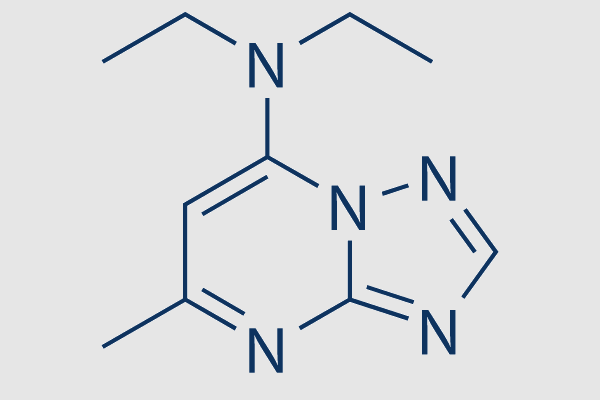
[CAS NO. 15421-84-8] Trapidil
Please click "REQUEST A QUOTE" button if you need other sizes or custom synthesis
request a quote
If there is no stock, or you need other sizes or custom synthesis, please:
PRODUCTS SPECIFICATIONS [15421-84-8]
Store

Catalog
SLK-S4736
Brand
Selleck
CAS
15421-84-8
DESCRIPTION [15421-84-8]
Overview
| MDL | MFCD00193104 |
|---|---|
| Molecular Weight | 205.26 |
| Molecular Formula | C10H15N5 |
| SMILES | N(CC)(CC)C=1N2C(N=C(C)C1)=NC=N2 |
For research use only.
Storage
3 years,-20°C,powder
1 years,-80°C,in solvent
1 years,-80°C,in solvent
Shipping
Room temperature shipping(Stability testing shows this product can be shipped without any cooling measures.)
Preparing Stock Solutions
| 1 mg | 5 mg | 10 mg | |
| 1 mM | 4.8719 mL | 24.3593 mL | 48.7187 mL |
| 5 mM | 0.9744 mL | 4.8719 mL | 9.7437 mL |
| 10 mM | 0.4872 mL | 2.4359 mL | 4.8719 mL |
| 50 mM | 0.0974 mL | 0.4872 mL | 0.9744 mL |
Description
Trapidil (Rocornal, Trapymin, Avantrin, Trapymine) is a antagonist that can inhibit the proliferation of the PDGF-producing glioma cells.
Targets
| PDGF [1] |
In vitro
Trapidil interrupts the autocrine loop at the PDGF and PDGF-receptor level.Trapidil has proved to possess a significant antiproliferative activity. The addition of 100 to 400 μg/ml trapidil significantly reduced cell proliferation induced by different growth factors (FCS, PDGF-BB, bFGF, EGF), the highest inhibitory effect being on PDGF-BB stimulated Mesangial cell(MC) growth. The effect of the drug was dose-dependent and seemingly specific. Trapidil is an anti-platelet drug active against various aggregating agents, such as collagen, ADP, arachidonic acid, PAF and calcium ionophore. It exerts its action by blocking the biosynthesis of thromboxane A2 and antagonizing its effect at the receptor level, and by stimulating the synthesis and release of prostacyclin. Trapidil strongly inhibited osteoclast formation in co-cultures of bone marrow cells and osteoblasts without affecting receptor activator of NF-κB ligand (RANKL) or osteoprotegerin expression in osteoblasts. In addition, trapidil suppressed RANKL-induced osteoclast formation from osteoclast precursors. Trapidil reduced RANKL-induced expression of nuclear factor of activated T cells, cytoplasmic 1 (NFATc1), a master transcription factor for osteoclastogenesis, without affecting the expression of c-Fos that functions as a key upstream activator of NFATc1 during osteoclastogenesis. Trapidil has also been reported to inhibit phosphodiesterase, thromboxane A2, and CD40 signaling and activate protein kinase A.
In vivo
Trapidil is an antiplatelet drug with specific platelet-derived growth factor antagonism and antiproliferative effects in the rat and rabbit models after balloon angioplasty. Trapidil had a potent inhibitory effect on osteoclast formation and bone resorption induced by interleukin-1 in an animal model. No abnormal symptoms, such as changes in body weight, diarrhea, high fever, and convulsion, were observed after intraperitoneal injections of trapidil.
References
Synonyms
[1,2,4]Triazolo[1,5-a]pyrimidin-7-amine, N,N-diethyl-5-methyl-
s-Triazolo[1,5-a]pyrimidine, 7-(diethylamino)-5-methyl-
N,N-Diethyl-5-methyl[1,2,4]triazolo[1,5-a]pyrimidin-7-amine
5-Methyl-7-(diethylamino)-s-triazolo[1,5-a]pyrimidine
5-Methyl-7-(diethylamino)-1,2,4-triazolo[1,5-a]pyrimidine
Rocornal
Trapymin
Trapymine
4-(Diethylamino)-6-methyl-1,3,3a,7-tetraazaindene
Trapidil
Avantrin
AR 12008

Powered by Arctom Copyright © 2026 Arctom. All rights
reserved.