
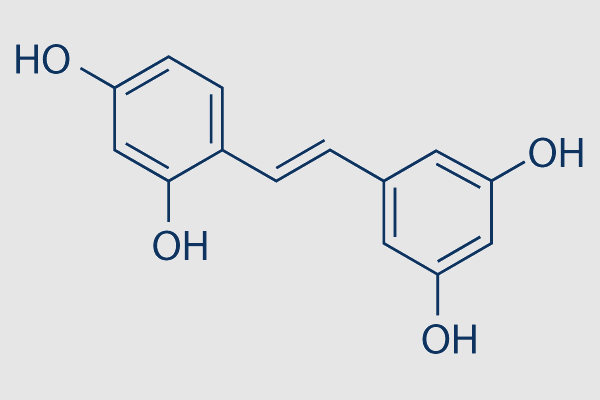
[CAS NO. 29700-22-9] Oxyresveratrol
Please click "REQUEST A QUOTE" button if you need other sizes or custom synthesis
request a quote
If there is no stock, or you need other sizes or custom synthesis, please:
PRODUCTS SPECIFICATIONS [29700-22-9]
Store

Catalog
SLK-S4739
Brand
Selleck
CAS
29700-22-9
DESCRIPTION [29700-22-9]
Overview
| MDL | MFCD11974969 |
|---|---|
| Molecular Weight | 244.24 |
| Molecular Formula | C14H12O4 |
| SMILES | C(=C/C1=C(O)C=C(O)C=C1)\C2=CC(O)=CC(O)=C2 |
For research use only.
Storage
3 years,-20°C,powder
1 years,-80°C,in solvent
1 years,-80°C,in solvent
Shipping
Room temperature shipping(Stability testing shows this product can be shipped without any cooling measures.)
Preparing Stock Solutions
| 1 mg | 5 mg | 10 mg | |
| 1 mM | 4.0943 mL | 20.4717 mL | 40.9433 mL |
| 5 mM | 0.8189 mL | 4.0943 mL | 8.1887 mL |
| 10 mM | 0.4094 mL | 2.0472 mL | 4.0943 mL |
| 50 mM | 0.0819 mL | 0.4094 mL | 0.8189 mL |
Description
Oxyresveratrol (Tetrahydroxystilbene, 2,3',4,5'-tetrahydroxystilbene), a naturally occurring compound particularly found in Morus alba L., exhibits a potent inhibitory effect on dopa oxidase activity of tyrosinase which catalyzes rate-limiting steps of melanin biosynthesis.
In vitro
Oxyresveratrol has been reported to inhibit β-amyloid-induced neurotoxicity in cultured cortical neurons and in vitro activity of β-secretase, an enzyme vital for the production of the Aβ protein. And it can also prevent neurotoxicity and DNA damage through its antioxidant properties in cultured neuronal cells. It shows modest inhibitory activity against H5N1 neuraminidase (an enzyme found in avian influenza virus), but strong inhibition against α-glucosidase, an enzyme responsible for the breaking down of starch and polysaccharides into glucose in the intestine. Oxyresveratrol is an effective radical scavenger. Oxyresveratrol protects hepatocytes against oxidative stress, mitochondrial damage, and resultant cell death. It induces activation of an antioxidant transcription factor, Nrf2, mediated through ERK phosphorylation.
In vivo
Oxyresveratrol has been reported to undergo extensive hepatic metabolism and rapid urinary elimination, resulting in a short half-life time, and thereby restricting its clinical use. Moreover, its postulated function as a preventive agent for neurodegenerative disorders, such as AD or PD, appears to be hindered by its low ability to cross the blood-brain barrier (BBB). Despite its moderate in vitro inhibitory activity against herpes simplex virus type I (HSV-1), oxyresveratrol, in the form of topical cream, exhibits high therapeutic efficacy in mice cutaneously infected with HSV-1, with a potency comparable to that of the antiviral drug acyclovir. Oxyresveratrol ameliorates acute liver injury caused by CCl4 in mice.
References
Synonyms
1,3-Benzenediol, 4-[(1E)-2-(3,5-dihydroxyphenyl)ethenyl]-
2,3′,4,5′-Stilbenetetrol, (E)-
1,3-Benzenediol, 4-[2-(3,5-dihydroxyphenyl)ethenyl]-, (E)-
4-[(1E)-2-(3,5-Dihydroxyphenyl)ethenyl]-1,3-benzenediol
Oxyresveratrol
trans-Stilbene-2,4,3′,5′-tetrol
trans-Oxyresveratrol

Powered by Arctom Copyright © 2026 Arctom. All rights
reserved.