
[CAS NO. 249921-19-5] Anamorelin
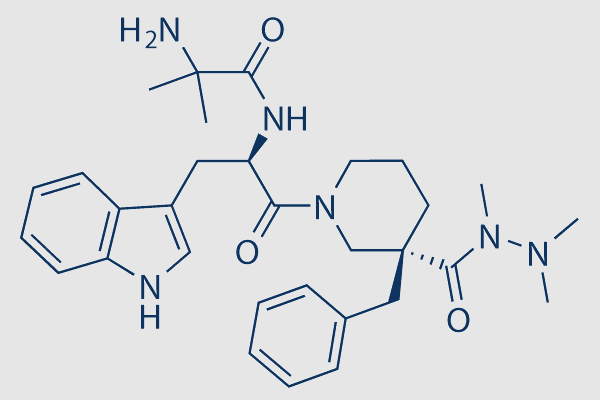
Please click "REQUEST A QUOTE" button if you need other sizes or custom synthesis
request a quote
If there is no stock, or you need other sizes or custom synthesis, please:
PRODUCTS SPECIFICATIONS [249921-19-5]
Store

Catalog
SLK-S4980
Brand
Selleck
CAS
249921-19-5
DESCRIPTION [249921-19-5]
Overview
| MDL | - |
|---|---|
| Molecular Weight | 546.70 |
| Molecular Formula | C31H42N6O3 |
| SMILES | C([C@@]1(C(N(N(C)C)C)=O)CN(C([C@@H](CC=2C=3C(NC2)=CC=CC3)NC(C(C)(C)N)=O)=O)CCC1)C4=CC=CC=C4 |
For research use only.
Storage
3 years,-20°C,powder
1 years,-80°C,in solvent
1 years,-80°C,in solvent
Shipping
Room temperature shipping(Stability testing shows this product can be shipped without any cooling measures.)
Preparing Stock Solutions
| 1 mg | 5 mg | 10 mg | |
| 1 mM | 1.8292 mL | 9.1458 mL | 18.2916 mL |
| 5 mM | 0.3658 mL | 1.8292 mL | 3.6583 mL |
| 10 mM | 0.1829 mL | 0.9146 mL | 1.8292 mL |
| 50 mM | 0.0366 mL | 0.1829 mL | 0.3658 mL |
Description
Anamorelin (ONO-7643, RC-1291, ST-1291) is an orally active, high-affinity, selective agonist of the with an EC50 value of 0.74 nM in the HEK293/GRLN FLIPR assay.
Targets
| ghrelin receptor [2] (HEK293/GRLN FLIPR assay) |
| 0.74 nM(EC50) |
In vitro
Anamorelin shows significant agonist and binding activity on the ghrelin receptor, and stimulates growth hormone (GH) release in vitro. Through its ghrelin and GH-releasing activity, anamorelin has both orexigenic and anabolic properties. In the screening for anamorelin activity, 10 μM Anamorelin shows weak binding to the calcium channel L-type receptors, the serotonin transporter, and the sodium channel. Therefore, it exhibits a high selectivity versus ghrelin receptors. By inhibiting nuclear factor κB, anamorelin reduces production of pro-inflammatory cytokines and stops muscle breakdown (inhibits proteolysis).
In vivo
In rats, Anamorelin significantly and dose-dependently increases food intake and body weight at all dose levels compared with control, and significantly increased growth hormone (GH) levels at 10 or 30 mg/kg doses. Growth hormone and IGF-1 levels increase following anamorelin administration in pigs. Anamorelin is orally active and has a longer half-life (approximately 7 h) than ghrelin. It stimulates neuroendocrine responses and can induce rapid positive effects on appetite and metabolism. Plasma clearance of radiolabelled anamorelin shows that most of the drug is excreted in the feces (92%). Food decreases the area under the curve (AUC) of anamorelin by 4-fold. Metabolism occurs by CYP3A4. In mouse tumor models, such as Lewis lung and human bronchioalveolar carcinoma, anamorelin does not promote tumor growth.
References
Synonyms
3-Piperidinecarboxylic acid, 1-[(2R)-2-[(2-amino-2-methyl-1-oxopropyl)amino]-3-(1H-indol-3-yl)-1-oxopropyl]-3-(phenylmethyl)-, 1,2,2-trimethylhydrazide, (3R)-
3-Piperidinecarboxylic acid, 1-(2-methylalanyl-D-tryptophyl)-3-(phenylmethyl)-, trimethylhydrazide, (3R)-
RC 1291
Anamorelin

Powered by Arctom Copyright © 2026 Arctom. All rights
reserved.