
[CAS NO. 1948-33-0] TBHQ
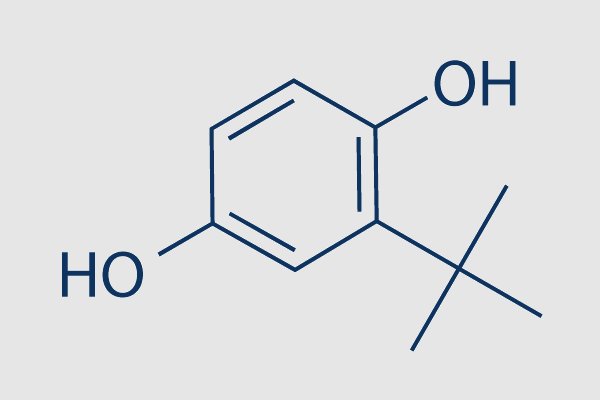
Please click "REQUEST A QUOTE" button if you need other sizes or custom synthesis
request a quote
If there is no stock, or you need other sizes or custom synthesis, please:
PRODUCTS SPECIFICATIONS [1948-33-0]
Store

Catalog
SLK-S4990
Brand
Selleck
CAS
1948-33-0
DESCRIPTION [1948-33-0]
Overview
| MDL | MFCD00002344 |
|---|---|
| Molecular Weight | 166.22 |
| Molecular Formula | C10H14O2 |
| SMILES | C(C)(C)(C)C1=C(O)C=CC(O)=C1 |
For research use only.
Storage
3 years,-20°C,powder
1 years,-80°C,in solvent
1 years,-80°C,in solvent
Shipping
Room temperature shipping(Stability testing shows this product can be shipped without any cooling measures.)
Preparing Stock Solutions
| 1 mg | 5 mg | 10 mg | |
| 1 mM | 6.0161 mL | 30.0806 mL | 60.1612 mL |
| 5 mM | 1.2032 mL | 6.0161 mL | 12.0322 mL |
| 10 mM | 0.6016 mL | 3.0081 mL | 6.0161 mL |
| 50 mM | 0.1203 mL | 0.6016 mL | 1.2032 mL |
Description
Tert-butylhydroquinone (TBHQ) is an compound which is used to prevent lipid peroxidation and shows multiple cytoprotective actions. It is an activator of .
Targets
| Nrf2 [1] |
In vitro
Tert-butylhydroquinone (tBHQ) is a metabolite of the chemical compound butylated hydroxyanisole and induces Nrf2 activation and conveys protection against hydrogen peroxide, 6-hydroxydopamine, the pesticidal deltamethrin, and other toxicants. tBHQ preferentially alters the redox status in the mitochondrial compartment in HeLa cells. HeLa cells treated with tBHQ show a preferential oxidation of mitochondrial thioredoxin-2 (Trx2), while cellular glutathione and cytosolic thioredoxin-1 are not affected. In cultured H9c2 cells and primary cardiac myocytes, TBHQ stimulates Akt phosphorylation and suppresses oxidant-induced apoptosis.
In vivo
TBHQ treatment elicits significant cytoprotective actions in different organs under pathological conditions. Systemic or local intra-cerebroventricular treatment with TBHQ in an ischemic stroke model in rats significantly reduces the infarct size and neurological deficits. Administration of TBHQ in rats suppresses renal damage and oxidative stress after ischemia and reperfusion injury. In mice with type 1 diabetes, chronic treatment with TBHQ significantly reduces the degree of glomerular fibrosis and ameliorates proteinuria. TBHQ treatment prevents left ventricular dilatation and cardiac dysfunction induced by transverse aortic constriction (TAC), and decreases the prevalence of myocardial apoptosis. The beneficial effects of TBHQ are associated with an increase in Akt activation, but not related to activations of Nrf2 or AMP-activated protein kinase. TBHQ-induced Akt activation is accompanied by increased phosphorylation of Bad, glycogen synthase kinase-3β (GSK-3β) and mammalian target of rapamycin (mTOR).
References
Synonyms
1,4-Benzenediol, 2-(1,1-dimethylethyl)-
Hydroquinone, tert-butyl-
2-(1,1-Dimethylethyl)-1,4-benzenediol
tert-Butylhydroquinone
2-tert-Butylhydroquinone
Mono-tert-butylhydroquinone
tert-Butyl-1,4-benzenediol
TBHQ
MTBHQ
Mono-tertiarybutylhydroquinone
t-Butylhydroquinone
2-tert-Butyl-1,4-benzenediol
2-(1,1-Dimethylethyl)hydroquinone
2-(tert-Butyl)-p-hydroquinone
Banox 20BA
Tenox TBHQ
2-tert-Butyl-1,4-hydroquinone
2-tert-Butyl-1,4-dihydroxybenzene
t-Butylhydroquinone
Tenox 20
NSC 4972
Keniox 20
tert-Butyldihydroxybenzene
2-t-Butylhydroquinone
MC-TB 20
Grindox 450
Grindox 204
tert-Butyl-1,4-dihydroxybenzene
2-tert-Butyl-4-hydroxyphenol
Stearer TBH
PI 172

Powered by Arctom Copyright © 2026 Arctom. All rights
reserved.