
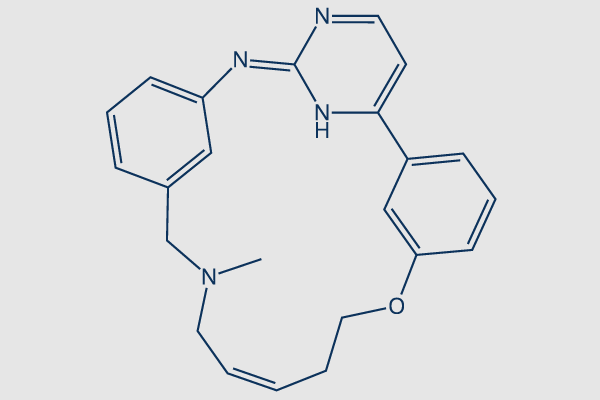
[CAS NO. 937270-47-8] Zotiraciclib
Please click "REQUEST A QUOTE" button if you need other sizes or custom synthesis
request a quote
If there is no stock, or you need other sizes or custom synthesis, please:
PRODUCTS SPECIFICATIONS [937270-47-8]
Store

Catalog
SLK-S7002
Brand
Selleck
CAS
937270-47-8
DESCRIPTION [937270-47-8]
Overview
| MDL | - |
|---|---|
| Molecular Weight | 372.46 |
| Molecular Formula | C23H24N4O |
| SMILES | - |
For research use only.
Storage
2 years -80 in solvent
Room temperature shipping(Stability testing shows this product can be shipped without any cooling measures.)
Room temperature shipping(Stability testing shows this product can be shipped without any cooling measures.)
Shipping
Room temperature shipping(Stability testing shows this product can be shipped without any cooling measures.)
Preparing Stock Solutions
| 1 mg | 5 mg | 10 mg | |
| 1 mM | 2.6849 mL | 13.4243 mL | 26.8485 mL |
| 5 mM | 0.5370 mL | 2.6849 mL | 5.3697 mL |
| 10 mM | 0.2685 mL | 1.3424 mL | 2.6849 mL |
| 50 mM | 0.0537 mL | 0.2685 mL | 0.5370 mL |
Description
Zotiraciclib (SB1317; TG02) is a novel small molecule potent inhibitor, emerged with potent CDK (IC50 against CDKs 1, 2 and 9 = 9, 5 and 3 nM, respectively), FLT3 (IC50 = 19 nM) and JAK2 (IC50 = 19 nM) potency.
Features
TG02 adopts a slightly different preferred conformation in order to achieve the key interaction with Asp698 when docks into FLT3.
In vitro
SB1317/TG02 inhibits the proliferating of all the cell lines tested including solid tumor cell lines such as colon (HCT-116, COLO205) and prostate (DU145) with IC50 of 33 nM, 72 nM and 140 nM, respectively. SB1317/TG02 potently inhibits the CDK2 biomarker pRb (phospho-Rb, retinoblastoma tumor suppressor protein) in HCT-116, and effects can be detected at the 40 nM with the protein phosphorylation being completely inhibited at 200 nM. SB1317/TG02 is potent against pRb in MV4-11 cells with IC50 of 0.13 μM and also inhibits pFLT3 and pSTAT5 in the same cell line. SB1317/TG02 results in the permeability (Papp) of 26h in the apical to basolateral (Papp,A→B) direction and in the basolateral to apical (Papp,B→A) direction of 28.0 × 10 cm/s and 27.4 ×10 cm/s, respectively, in the Caco-2 bidirectional permeability assays. SB1317/TG02 is found to be stable with a half-life of 45 min in human liver microsomes (HLM), is moderately stable in DLM (t = 33 min), and is quite rapidly cleared in MLM (t2 = 12 min) and in RLM (t = 11 min). TG02 most potently inhibits CDK isoforms, inhibits CDK1, CDK2, CDK3, CDK5 and CDK9 with IC50 of 9 nM, 5 nM, 8 nM, 4 nM and 3 nM, respectively. TG02 also inhibits Lck, TYK2, Fyn, JAK2 and FLT3 with IC50 of 11 nM, 14 nM, 15 nM, 19 nM and 19 nM, respectively. TG02 has more potent anti-proliferative effects than SNS-032 in tumor cell lines. TG02 shows a stronger inhibition of the liquid tumor panel with IC50 of 0.13 μM compared with the solid tumor panel with IC50 of 0.30 μM. TG02 (100 nM) induces cell cycle arrest and apoptosis in MV4-11 cells. TG02 inhibits pRb, pFLT3 and pSTAT5 with IC50 of 125 nM, 4.7 μM and 560 nM, respectively, in MV4-11 cells. TG02 inhibits pJAK2 (Y1007/8) and pSTAT3 with IC50 of 63 nM and 53 nM, respectively, in Karpas 1106P. TG02 (300 nM) exposure leads to CDK9 inhibition, followed by G1 phase arrest and apoptotic induction, in HL-60 cells.
References

Powered by Arctom Copyright © 2026 Arctom. All rights
reserved.