
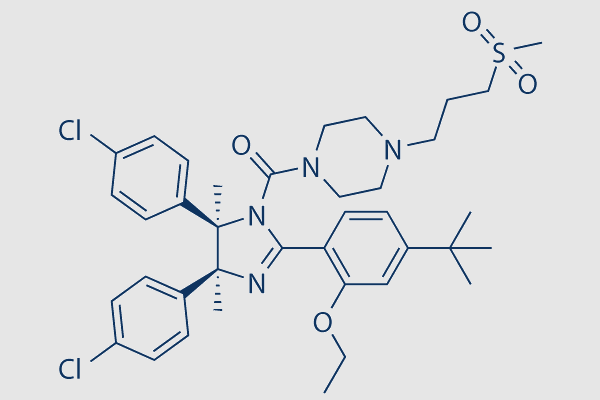
[CAS NO. 939981-39-2] RG-7112
Please click "REQUEST A QUOTE" button if you need other sizes or custom synthesis
request a quote
If there is no stock, or you need other sizes or custom synthesis, please:
PRODUCTS SPECIFICATIONS [939981-39-2]
Store

Catalog
SLK-S7030
Brand
Selleck
CAS
939981-39-2
DESCRIPTION [939981-39-2]
Overview
| MDL | MFCD18206914 |
|---|---|
| Molecular Weight | 726.28 |
| Molecular Formula | C38H48Cl2N4O4S |
| SMILES | C[C@@]1([C@](C)(N(C(C2=CC=C(C=C2OCC)C(C)(C)C)=N1)C(N3CCN(CC3)CCCS(=O)(C)=O)=O)C4=CC=C(C=C4)Cl)C5=CC=C(C=C5)Cl |
For research use only.
Storage
3 years,-20°C,powder
1 years,-80°C,in solvent
1 years,-80°C,in solvent
Shipping
Room temperature shipping(Stability testing shows this product can be shipped without any cooling measures.)
Description
RG7112 (RO5045337) is an orally bioavailable and selective inhibitor with HTRF IC50 of 18 nM.
In vitro
RG7112 is a potent and selective member of the nutlin family of MDM2 antagonists currently in phase I clinical studies. RG7112 binds MDM2 with high affinity (K of 10.7 nM), blocking its interactions with p53 in vitro. A crystal structure of the RG7112–MDM2 complex reveals that the small molecule binds in the p53 pocket of MDM2, mimicking the interactions of critical p53 amino acid residues. Treatment of cancer cells expressing wild-type p53 with RG7112 activates the p53 pathway, leading to cell-cycle arrest and apoptosis. RG7112 shows potent antitumor activity against a panel of solid tumor cell lines. However, its apoptotic activity varies widely with the best response observed in osteosarcoma cells with MDM2 gene amplification.
In vivo
RG7112 activates p53 pathway and induces apoptosis in tumor cells in vivo. Oral administration of RG7112 to human xenograft-bearing mice at nontoxic concentrations caused dose-dependent changes in proliferation/apoptosis biomarkers as well as tumor inhibition and regression. Notably, RG7112 is highly synergistic with androgen deprivation in LNCaP xenograft tumors.

Powered by Arctom Copyright © 2026 Arctom. All rights
reserved.