
[CAS NO. 882257-11-6] P5091 (P005091)
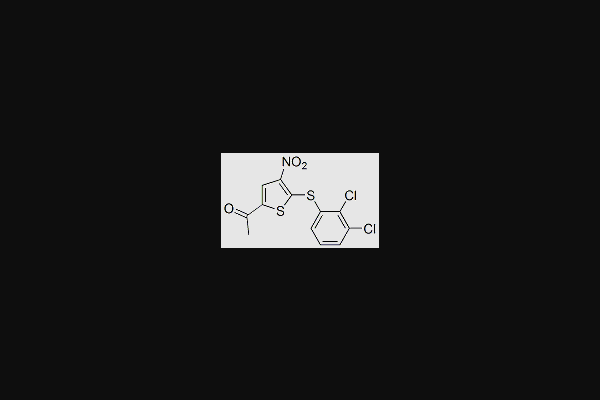
Please click "REQUEST A QUOTE" button if you need other sizes or custom synthesis
request a quote
If there is no stock, or you need other sizes or custom synthesis, please:
PRODUCTS SPECIFICATIONS [882257-11-6]
Store

Catalog
SLK-S7132
Brand
Selleck
CAS
882257-11-6
DESCRIPTION [882257-11-6]
Overview
| MDL | MFCD00123202 |
|---|---|
| Molecular Weight | 348.22 |
| Molecular Formula | C12H7Cl2NO3S2 |
| SMILES | CC(C1=CC([N+]([O-])=O)=C(SC2=CC=CC(Cl)=C2Cl)S1)=O |
For research use only.
Storage
3 years,-20°C,powder
1 years,-80°C,in solvent
1 years,-80°C,in solvent
Shipping
Room temperature shipping(Stability testing shows this product can be shipped without any cooling measures.)
Preparing Stock Solutions
| 1 mg | 5 mg | 10 mg | |
| 1 mM | 2.8717 mL | 14.3587 mL | 28.7175 mL |
| 5 mM | 0.5743 mL | 2.8717 mL | 5.7435 mL |
| 10 mM | 0.2872 mL | 1.4359 mL | 2.8717 mL |
| 50 mM | 0.0574 mL | 0.2872 mL | 0.5743 mL |
Description
P5091(P005091) is a selective and potent inhibitor of with of 4.2 μM and the closely related USP47.
In vitro
P5091 is a trisubstituted thiophene with dichlorophenylthio, nitro, and acetyl substituents mediating anti-USP7 activity. P5091 exhibits potent, specific, and selective deubiquitylating activity against USP7. In contrast, P5091 does not inhibit other DUBs or other families of cysteine proteases tested (EC50 > 100 mM). P5091 inhibits the labeling of USP7 with HA-UbVME in a concentration-dependent manner. USP7-mediated cleavage of high molecular weight polyubiquitin chains is inhibited in a dose-dependent manner by P5091. Moreover, P5091 inhibits USP7- but not USP2- or USP8-mediated cleavage of poly K48-linked ubiquitin chains. USP7 inhibition by P5091 induces HDM2 polyubiquitylation and accelerates degradation of HDM2. P5091 inhibits USP7 deubiquitylating activity, without blocking proteasome activity in MM Cells. P5091 inhibits growth in MM cells and overcomes bortezomib-resistance. P5091 induces a dose-dependent decrease in viability of various MM cell lines, including those that are resistant to conventional therapies dexamethasone (Dex) (MM.1R), doxorubicin (Dox-40), or melphalan (LR5) (IC50 range 6–14 μM). P5091 overcomes bone marrow stromal cell-induced growth of MM Cells. P5091 decreased HDM2 and HDMX, as well as upregulated p53 and p21 levels. Overall, P5091-induced cytotoxicity is mediated in part via HDM2-p21 signaling axis and although p53 is upregulated in response to P5091 treatment, the cytotoxic activity of P5091 is not dependent on p53.
References

Powered by Arctom Copyright © 2026 Arctom. All rights
reserved.