
[CAS NO. 312636-16-1] SKI II
Please click "REQUEST A QUOTE" button if you need other sizes or custom synthesis
request a quote
If there is no stock, or you need other sizes or custom synthesis, please:
PRODUCTS SPECIFICATIONS [312636-16-1]
Store

Catalog
SLK-S7176
Brand
Selleck
CAS
312636-16-1
DESCRIPTION [312636-16-1]
Overview
| MDL | MFCD00733553 |
|---|---|
| Molecular Weight | 302.78 |
| Molecular Formula | C15H11ClN2OS |
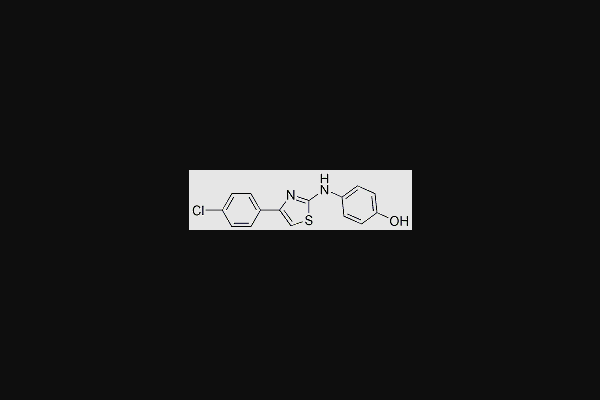
| SMILES | N(C1=NC(=CS1)C2=CC=C(Cl)C=C2)C3=CC=C(O)C=C3 |
For research use only.
Storage
3 years,-20°C,powder
1 years,-80°C,in solvent
1 years,-80°C,in solvent
Shipping
Room temperature shipping(Stability testing shows this product can be shipped without any cooling measures.)
Preparing Stock Solutions
| 1 mg | 5 mg | 10 mg | |
| 1 mM | 3.3027 mL | 16.5136 mL | 33.0273 mL |
| 5 mM | 0.6605 mL | 3.3027 mL | 6.6055 mL |
| 10 mM | 0.3303 mL | 1.6514 mL | 3.3027 mL |
| 50 mM | 0.0661 mL | 0.3303 mL | 0.6605 mL |
Description
SKI II (SphK-I2) is a highly selective and non ATP-competitive inhibitor with IC50 of 0.5 μM, while exhibiting no inhibitory action on other kinases including PI3K, PKCα and ERK2.
Targets
| Sphingosine Kinase [1] |
| 0.5 μM |
In vitro
SKI II potently inhibits endogenous SK activities in the breast cancer cell line MDA-MB-231. SKI II demonstrates significantly antiproliferative effects in human cancer cell lines including T-24, MCF-7, MCF-7/VP, NCI/ADR with IC50 of 4.6 μM , 1.2 μM, 0.9 μM and 1.3 μM, respectively. SKI II also induces apoptosis of T24 cells consistent with the hypothesized consequence of reducing S1P levels. As demonstrated previously in MDA-MB-231 cells, SKI II decreases S1P formation in JC cells in a concentration-dependent manner, with IC50 of 12 μM. In addition, SKI-II can reverse drug resistance of SGC7901/DDP to cisplatin by down-regulating expression of P-gp and up-regulating apoptosis through down-regulation of SphK1.
In vivo
SKI II (50 mg/kg) after intraperitoneal or oral administration significantly decreases tumor growth a syngeneic Balb/c mouse solid tumor model that uses JC mammary adenocarcinoma cells relative to control groups with no overt toxicity or weight loss. SKI-II (50 mg/kg ip) ameliorates antigen-induced bronchial smooth muscle hyperresponsiveness in mice by endogenously inhibiting generation of S1P.
References
Synonyms
Phenol, 4-[[4-(4-chlorophenyl)-2-thiazolyl]amino]-
4-[[4-(4-Chlorophenyl)-2-thiazolyl]amino]phenol
SKI 2

Powered by Arctom Copyright © 2026 Arctom. All rights
reserved.