
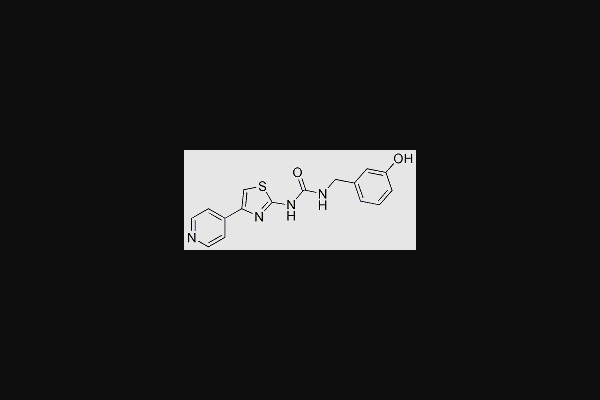
[CAS NO. 1342278-01-6] RKI-1447
Please click "REQUEST A QUOTE" button if you need other sizes or custom synthesis
request a quote
If there is no stock, or you need other sizes or custom synthesis, please:
PRODUCTS SPECIFICATIONS [1342278-01-6]
Store

Catalog
SLK-S7195
Brand
Selleck
CAS
1342278-01-6
DESCRIPTION [1342278-01-6]
Overview
| MDL | MFCD26142658 |
|---|---|
| Molecular Weight | 326.37 |
| Molecular Formula | C16H14N4O2S |
| SMILES | O=C(NC1=NC(C2=CC=NC=C2)=CS1)NCC3=CC=CC(O)=C3 |
For research use only.
Storage
3 years,-20°C,powder
1 years,-80°C,in solvent
1 years,-80°C,in solvent
Shipping
Room temperature shipping(Stability testing shows this product can be shipped without any cooling measures.)
Preparing Stock Solutions
| 1 mg | 5 mg | 10 mg | |
| 1 mM | 3.0640 mL | 15.3200 mL | 30.6401 mL |
| 5 mM | 0.6128 mL | 3.0640 mL | 6.1280 mL |
| 10 mM | 0.3064 mL | 1.5320 mL | 3.0640 mL |
| 50 mM | 0.0613 mL | 0.3064 mL | 0.6128 mL |
Description
RKI-1447 is a potent inhibitor of and , with of 14.5 nM and 6.2 nM, respectively, has anti-invasive and antitumor activities.
In vitro
RKI-1447 is a cell-permeable pyridylthiazolyl-urea that acts as a potent, ATP site-targeting Rho Kinase inhibitor, displaying much reduced potency against PKA, PKN1/PRK1, p70S6K/RPS6kB1, AKT1, MRCKa/CDC42BPA (85.5%, 80.5%, 61.9%, 56.0%, and 50.4% inhibition, respectively, by 1 µM RKI-1447) or 15 other kinases. Crystal structures of the RKI-1447/ROCK1 complex reveals that RKI-1447 is a Type I kinase inhibitor that binds the ATP binding site through interactions with the hinge region and the DFG motif. RKI-1447 suppresses phosphorylation of the ROCK substrates MLC-2 and MYPT-1 in human cancer cells, but had no effect on the phosphorylation levels of the AKT, MEK, and S6 kinase at concentrations as high as 10 μM. RKI-1447 is also highly selective at inhibiting ROCK-mediated cytoskeleton re-organization (actin stress fiber formation) following LPA stimulation, but does not affect PAK-meditated lamellipodia and filopodia formation following PDGF and Bradykinin stimulation. RKI-1447 inhibits migration, invasion and anchorage-independent tumor growth of breast cancer cells.
In vivo
RKI-1447 is highly effective at inhibiting the outgrowth of mammary tumors in a transgenic mouse model. Tumors from mice treated with the RKI-1447 increases in size with an average percent change in tumor volume of only 8.8%. Thus, RKI-1447 inhibited mammary tumor growth by 87%, and on average the mammary tumors from Compared with those tumors from mice treated with the vehicle control, RKI-1447 treated mice are 7.7-fold smaller. RKI-1447 treatments does not result in mouse weight loss.
References

Powered by Arctom Copyright © 2026 Arctom. All rights
reserved.