
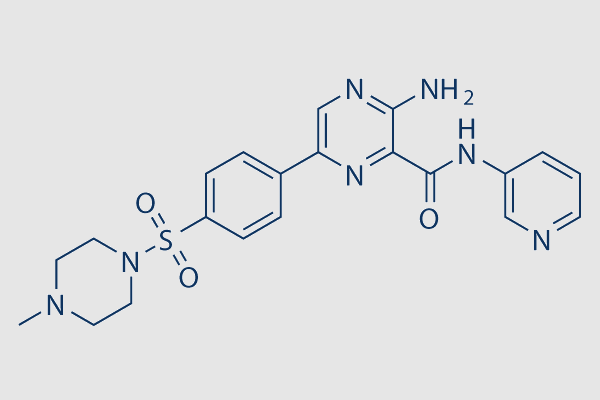
[CAS NO. 486424-20-8] AZD2858
Please click "REQUEST A QUOTE" button if you need other sizes or custom synthesis
request a quote
If there is no stock, or you need other sizes or custom synthesis, please:
PRODUCTS SPECIFICATIONS [486424-20-8]
Store

Catalog
SLK-S7253
Brand
Selleck
CAS
486424-20-8
DESCRIPTION [486424-20-8]
Overview
| MDL | MFCD26397072 |
|---|---|
| Molecular Weight | 453.52 |
| Molecular Formula | C21H23N7O3S |
| SMILES | O=C(C1=NC(C2=CC=C(S(=O)(N3CCN(C)CC3)=O)C=C2)=CN=C1N)NC4=CC=CN=C4 |
For research use only.
Storage
3 years,-20°C,powder
1 years,-80°C,in solvent
1 years,-80°C,in solvent
Shipping
Room temperature shipping(Stability testing shows this product can be shipped without any cooling measures.)
Preparing Stock Solutions
| 1 mg | 5 mg | 10 mg | |
| 1 mM | 2.2050 mL | 11.0249 mL | 22.0497 mL |
| 5 mM | 0.4410 mL | 2.2050 mL | 4.4099 mL |
| 10 mM | 0.2205 mL | 1.1025 mL | 2.2050 mL |
| 50 mM | - | - | - |
Description
AZD2858 is a selective inhibitor with an of 68 nM, activating Wnt signaling, increases bone mass in rats.
Targets
| GSK-3 [1] |
| 68 nM |
In vitro
AZD2858 is a selective GSK-3 inhibitor with an IC50 of 68 nM, inhibits tau phosphorylation at the S396 site, activates Wnt signaling pathway. AZD2858 treatment (1 μM, 12 h) on primary isolated human osteoblast-like cells results in a 3-fold increase of β-catenin levels. AZD2858 causes β-catenin stabilisation in human and rat mesenchymal stem cells, stimulates hADSC commitment towards osteoblasts and osteogenic mineralisation in vitro.
In vivo
In rats, oral AZD2858 treatment causes a dose-dependent increase in trabecular bone mass compared to control after a two-week treatment with a maximum effect at a dose of 20 mg/kg once daily (total BMC: 172% of control). A small but significant effect is also seen at cortical sites (total BMC: 111% of control). AZD285 treatment (30 μmol/kg) on rats daily for up to 3 weeks shows an increase in both mineral density (of 28% at 2 weeks and 38% at 3 weeks) and mineral content (of 81% at 2 weeks and 93% at 3 weeks) in the calluses. AZD285 treatment makes the fractures heals more rapidly, with a bony callus without an obvious endochondral component. AZD2858 produces time-dependent changes in serum bone turnover biomarkers and increases bone mass over 28 days exposure in rats. After 7 days, AZD2858 increases the bone formation biomarker P1NP, and reduces the resorption biomarker TRAcP-5b, indicating increased bone anabolism and reduced resorption in rats.
References

Powered by Arctom Copyright © 2026 Arctom. All rights
reserved.