
[CAS NO. 1038915-73-9] Niraparib (MK-4827) tosylate
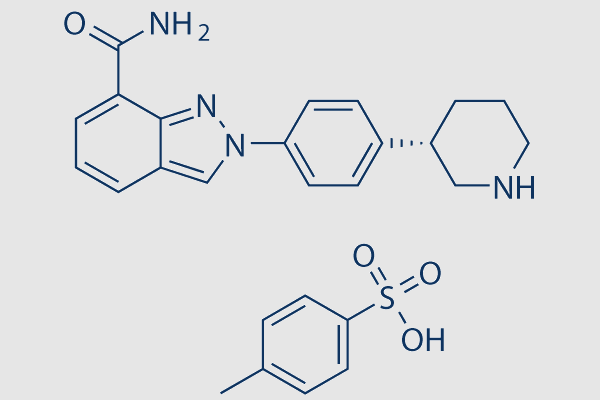
Please click "REQUEST A QUOTE" button if you need other sizes or custom synthesis
request a quote
If there is no stock, or you need other sizes or custom synthesis, please:
PRODUCTS SPECIFICATIONS [1038915-73-9]
Store

Catalog
SLK-S7625
Brand
Selleck
CAS
1038915-73-9
DESCRIPTION [1038915-73-9]
Overview
| MDL | MFCD28167748 |
|---|---|
| Molecular Weight | 492.59 |
| Molecular Formula | C19H20N4O.C7H8O3S |
| SMILES | O=C(C1=CC=CC2=CN(C3=CC=C([C@H]4CNCCC4)C=C3)N=C12)N.O=S(C5=CC=C(C)C=C5)(O)=O |
For research use only.
Storage
3 years,-20°C,powder
1 years,-80°C,in solvent
1 years,-80°C,in solvent
Shipping
Room temperature shipping(Stability testing shows this product can be shipped without any cooling measures.)
Preparing Stock Solutions
| 1 mg | 5 mg | 10 mg | |
| 1 mM | 2.0301 mL | 10.1504 mL | 20.3009 mL |
| 5 mM | 0.4060 mL | 2.0301 mL | 4.0602 mL |
| 10 mM | 0.2030 mL | 1.0150 mL | 2.0301 mL |
| 50 mM | 0.0406 mL | 0.2030 mL | 0.4060 mL |
Description
Niraparib tosylate (MK-4827, ZEJULA) is a selective inhibitor of with of 3.8 nM/2.1 nM. Niraparib increases formation of PARP-DNA complexes resulting in DNA damage, , and cell death.
In vitro
Micromolar concentrations of niraparib radiosensitizes tumor cell lines derived from lung, breast, and prostate cancers independently of their p53 status but not cell lines derived from normal tissues. Niraparib also sensitizes tumor cells to H2O2 and converts H2O2-induced single strand breaks (SSBs) into DSBs during DNA replication.
In vivo
MK-4827 strongly enhances the effect of radiation on a variety of human tumor xenografts, both p53 wild type and p53 mutant. MK-4827 reduces PAR levels in tumors by 1 h after administration which persisted for up to 24 h. In vivo treatment with MK-4827 and radiation prolonged survival (p<0.01) compared to single modalities. In vivo superiority of MK-4827 plus radiation is further documented by significant elevations of cleaved caspase-3 and γ-H2AX in tumors from the combination group compared to single modality cohorts.
References

Powered by Arctom Copyright © 2026 Arctom. All rights
reserved.