
[CAS NO. 1392136-43-4] Verdinexor (KPT-335)
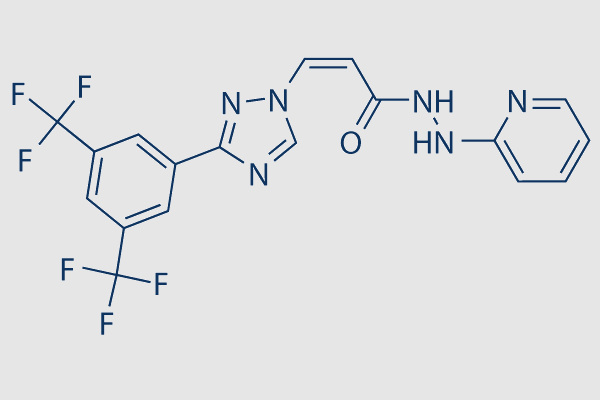
Please click "REQUEST A QUOTE" button if you need other sizes or custom synthesis
request a quote
If there is no stock, or you need other sizes or custom synthesis, please:
PRODUCTS SPECIFICATIONS [1392136-43-4]
Store

Catalog
SLK-S7707
Brand
Selleck
CAS
1392136-43-4
DESCRIPTION [1392136-43-4]
Overview
| MDL | - |
|---|---|
| Molecular Weight | 442.32 |
| Molecular Formula | C18H12F6N6O |
| SMILES | O=C(NNC1=NC=CC=C1)/C=C\N2N=C(C3=CC(C(F)(F)F)=CC(C(F)(F)F)=C3)N=C2 |
For research use only.
Storage
3 years,-20°C,powder
1 years,-80°C,in solvent
1 years,-80°C,in solvent
Shipping
Room temperature shipping(Stability testing shows this product can be shipped without any cooling measures.)
Preparing Stock Solutions
| 1 mg | 5 mg | 10 mg | |
| 1 mM | 2.2608 mL | 11.3040 mL | 22.6081 mL |
| 5 mM | 0.4522 mL | 2.2608 mL | 4.5216 mL |
| 10 mM | 0.2261 mL | 1.1304 mL | 2.2608 mL |
| 50 mM | 0.0452 mL | 0.2261 mL | 0.4522 mL |
Description
Verdinexor (KPT-335, ATG-527) is an orally bioavailable, selective inhibitor.
Targets
| CRM1 [1] |
In vitro
Verdinexor inhibits the viability of Jurkat, OCI-Ly3, OCI-Ly10, and CLBL1 cells with IC50 of 0.3 nM, 2.1 nM, 41.8 nM, and 8.5 nM, respectively. KPT-335 also induces apoptosis in CLBL1 cells and primary canine DLBCL cells that express XPO1 and SINE. Verdinexor potently and selectively inhibits vRNP export and effectively inhibits the replication of various influenza virus A and B strains, including pandemic H1N1 virus, highly pathogenic H5N1 avian influenza virus, and the recently emerged H7N9 strain.
In vivo
Verdinexor (25 mg/kg twice daily, p.o.) reduces proinflammatory cytokine expression in the lung, produces in vivo antiviral activity by reducing lung virus titers, and thus reduces pulmonary disease pathogenesis and death associated with lethal influenza A virus challenge. In autosomal-dominant polycystic kidney disease model, Verdinexor (5 mg/kg, i.p.) attenuates cyst growth via inhibition of XPO1.
References

Powered by Arctom Copyright © 2026 Arctom. All rights
reserved.